Who eats whom
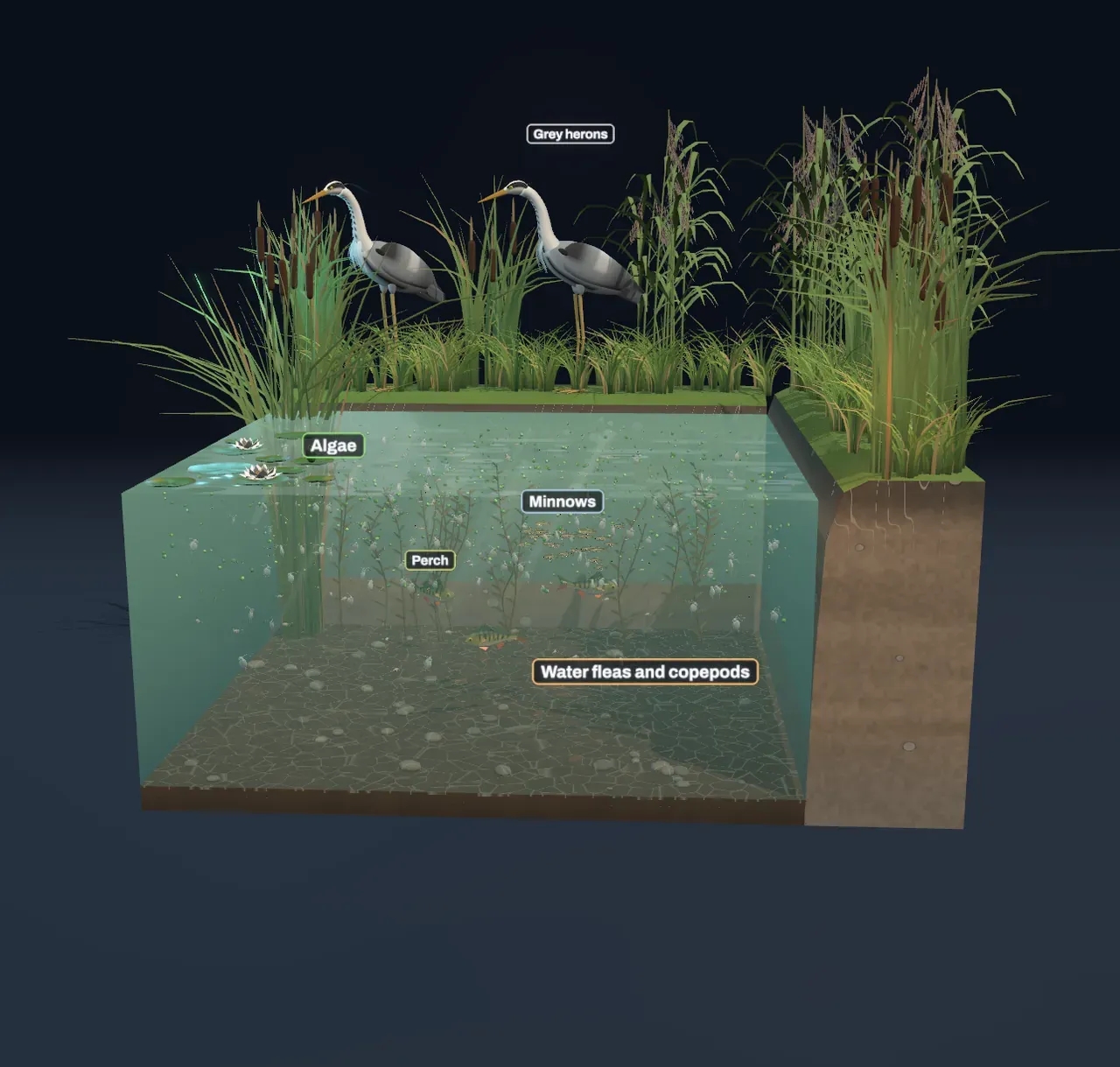
A grey heron stands at the edge of a lake for an hour and then stabs a perch. The perch spent its summer eating minnows. The minnows ate water fleas and copepods, animals a few millimetres long, and those grazed on algae, single cells floating near the surface, too small to see one by one, that turn the water green. That line of eating is a food chain, and each step along it is a trophic level, from the Greek for food.
Every chain starts with producers, living things that make their own food. In the lake these are the algae, which build sugar from carbon dioxide and water using the energy of sunlight, by photosynthesis. Everything else is a consumer: the zooplankton that graze the algae are primary consumers, the minnows secondary, the perch tertiary, and the heron, at the top, eats perch and is eaten by nothing.
Try it: zoom in on the water. The green specks near the surface are algal cells and golden diatoms, the jerky dots below are water fleas and copepods, and the minnows school through the middle of the pond.
Energy flows one way
The cycles of matter go round: the carbon a heron breathes out can be built into algae again next spring. Energy does not go round. It arrives as sunlight and leaves as heat, and every living thing along the way only borrows it for a while.
Very little of the sunlight gets in at all. Most of it is reflected, warms the water, or falls on algae at the wrong moment. In the Scene the algae turn about 0.35% of the sunlight on the lake into new algae over a year, which is typical of a productive lake. At 125 W/m², the year-round average for a temperate climate, that new algae holds 20,000 dots of energy, each one a year of food for a heron.
Only a tenth passes on
Of all the energy the algae capture, only about a tenth ends up in the bodies of the zooplankton that eat them. Most of the rest does not leave the algae as food at all: they burn it to stay alive, by cellular respiration, and it becomes heat. Some algae die and sink uneaten, and the energy in them feeds bacteria and fungi on the mud, the decomposers, which burn it too. Of what the zooplankton do eat, some passes out undigested.
The same happens at every link. A minnow swims, breathes, digests and repairs itself, and all of that work turns food into heat. A perch has scales and bones a heron cannot digest. Ecologists sum this up as the ten per cent rule: each level passes on about a tenth of the energy it gets. Real links range from about 2% to 20% or more. Cold-blooded animals such as fish and insects tend to pass on more; birds and mammals, which burn much of their food just to stay warm, pass on less.
Try it: under Build the energy pyramid, choose Energy pyramid. Each level’s yearly energy flies out of the water where its creatures live and lands as a tier of dots on the pond floor. The tier above lands on the centre of the one below, covering exactly the dots that were passed up, and the rim it leaves bare turns orange: the energy that level lost as heat.
Each tier holds a tenth as many dots as the one below, so it has a tenth of the area and about a third of the width. This stack is an energy pyramid, and its shape does not depend on the lake or the animals: energy can only be lost along the chain, never gained, so every tier is smaller than the one it stands on.
Why food chains are short
Take a tenth of a tenth of a tenth of a tenth and you are left with a ten-thousandth. The algae’s 20,000 dots become 2,000 for the zooplankton, 200 for the minnows, 20 for the perch and 2 for the herons. So this lake, about a square kilometre of water, feeds two herons. A sixth level, something that ate only herons, would get a fifth of a dot: not enough to keep even one animal alive for a year.
That is why food chains seldom have more than four or five links, and why animals at the top are few and far between. A lake full of minnows has a handful of herons; a forest full of mice has a few owls; the Serengeti’s millions of grazing animals feed a few thousand lions. Top predators need huge areas to find enough food, which is part of why they are often the first animals to disappear when habitat is cut up. Ecosystems and population dynamics follows what happens to predator and prey numbers over the years.
Try it: slide Energy passed on down to 5%. The herons get an eighth of a dot, and they leave; the chain now ends at the perch, though the algae have not changed at all. Slide it up to 20%: the same lake could feed 32 herons. Then try Shade under Sunlight: less sunlight means less algae at the bottom, and the herons go again.
Pyramids of numbers and biomass
An energy pyramid counts what flows through each level in a year. Counting other things gives other shapes. A pyramid of numbers counts individuals, and it can be upside down: one oak tree feeds thousands of caterpillars. A pyramid of biomass weighs what is alive at one moment, and in a lake it can be upside down too. Algae are eaten almost as fast as they grow, so at any moment there can be less of them by weight than of the zooplankton grazing them, even though they produce far more over a year. Only the energy pyramid always stands the right way up.
Webs, not chains
Real lakes have food webs, not single chains. Herons also eat frogs, eels and water voles; young perch eat zooplankton before they are big enough to eat minnows; ducks eat weed and snails; and the decomposers eat what everything leaves behind. A chain is one path through the web, but the ten per cent rule holds along every path, so the shorter the path from the sunlight, the more energy is left at its end.
That is true for people too. A field of wheat eaten as bread feeds roughly ten times as many people as the same field fed to cattle and eaten as beef, because the cattle burn most of what they eat. And because each level depends on the one below, removing one link shakes the rest: take the perch out of a lake by overfishing, and the minnows multiply, eat down the water fleas, and the algae they no longer graze turn the water green.
What this model leaves out
The Scene follows one chain and gives every link the same share of the energy below it, so it shows the rule, not a real lake, where each link passes on its own share and many animals eat at more than one level. The algae’s yearly growth here is simply in proportion to the sunlight. In most real lakes nitrogen and phosphorus in the water run short first, and a shaded lake can still be rich if it is fed from the land around it.
A dot is a year of a heron’s food, about 400 g of fish a day, or 150 kg and 700 MJ a year. The lake is about a square kilometre, and in real lakes herons often eat more than this one chain offers. The model does not ask how a population would get to its size, only how much energy a level could have: a lake that can feed two herons is a lake where two could live, not one where they must. The pond in the Scene is a small corner of that lake, its plankton drawn far larger than life and its populations a sample that grows and shrinks with the energy their level gets.