Producers, consumers and trophic levels in a lake’s food chain, the arrows that show where the energy flows, and why energy flows one way and leaves as heat while matter goes round in a cycle.
Step 1 of 5 · Who eats whom
Step 1 of 5
Who eats whom
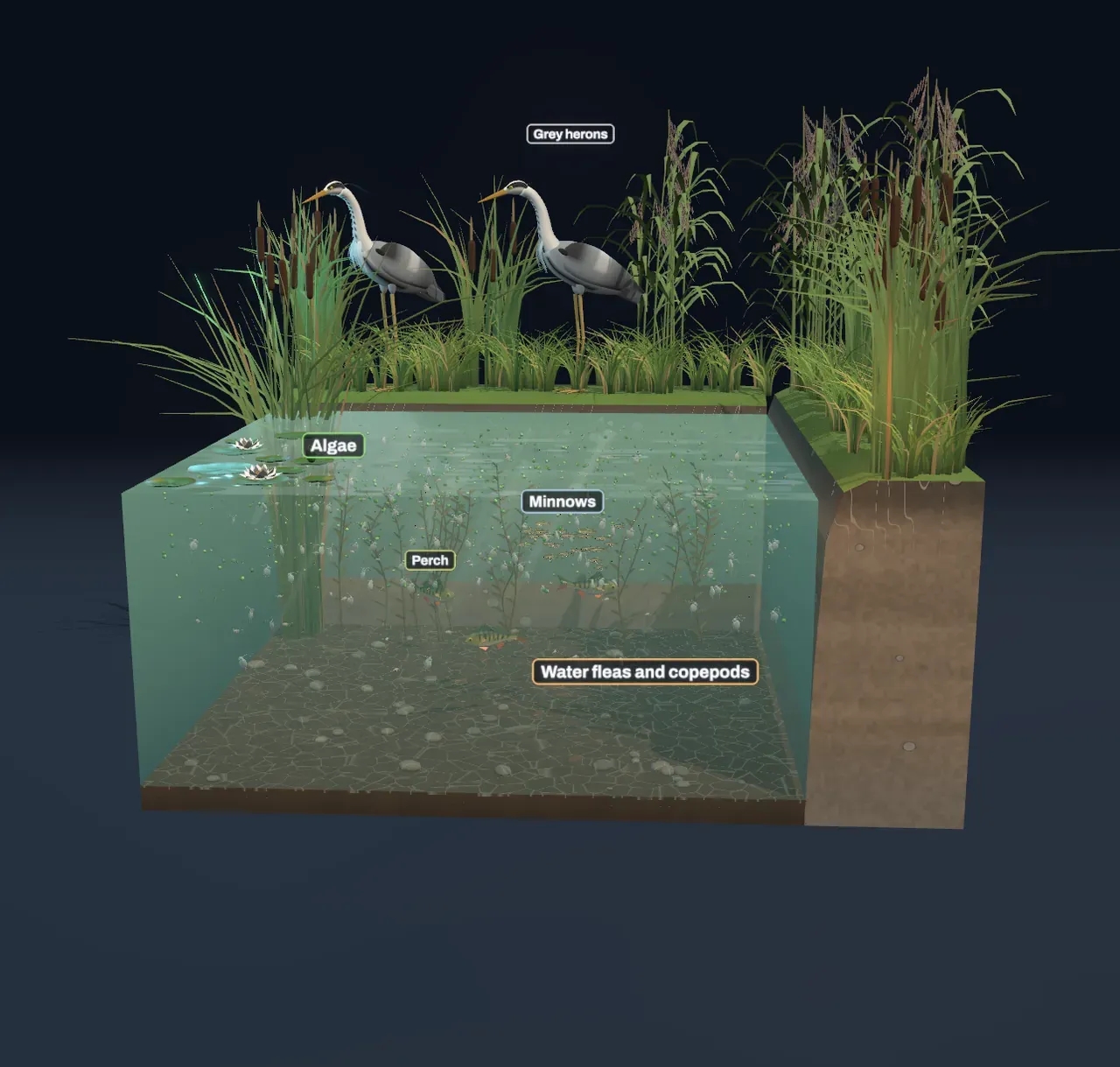
A grey heron stands at the edge of the lake and stabs its bill into a perch. The perch ate small fish, the small fish ate zooplankton, water fleas and copepods a few millimetres long, and those grazed algae, tiny cells floating near the surface. That line of eating is a food chain, and each step in it is a trophic level.
Every chain starts with producers, living things that make their own food from sunlight, by photosynthesis. Everything else is a consumer, and consumers are counted in the order they eat: primary, secondary, tertiary. Move close to the water in the Scene and look for every link.
Step 2 of 5
One way
Matter in the lake goes round in a cycle: the carbon in a dead fish’s body returns to the air and the water, and algae build sugar from it again. About energy you have to ask a different question. Answer, then press Energy pyramid under Build the energy pyramid and look at the orange rims of each tier.
Step 3 of 5
A tenth
The Scene counts energy in dots: each dot is a year of food for one heron, about 700 MJ. In the sunlight of a temperate climate, the lake’s algae, over about a square kilometre, capture dots a year. Most of the energy a level gets is not passed on: living things burn it to stay alive, in cellular respiration. Ecologists sum this up as the ten per cent rule. Here Energy passed on is fixed at 10%.
Step 4 of 5
Arrows
Biology books draw food chains and food webs with arrows from level to level. The arrow is part of the language, and it is worth knowing what it says before you read a whole web.
Step 5 of 5
Less sun
All the lake’s energy starts as the sunlight the algae capture, and they grow in proportion to the light. Energy passed on is fixed, and Sunlight is about to drop to the light of a shaded lake. The herons do not eat algae. Predict what happens to them.
Loading the interactive version…
Loading the interactive version…
Each step sets up the Scene for you, and a control marked “fixed” stays put for that step.
Practice · Choose
The lake’s food chain: algae, zooplankton (water fleas and copepods), small fish, perch and herons. Which are the secondary consumers?
Practice · Choose
The lake’s food chain: algae, zooplankton (water fleas and copepods), small fish, perch and herons. Which are the secondary consumers?
Practice · Choose
The heron breathes out carbon dioxide, and the algae can build sugar from it next spring. What happens to the energy a level gets and does not pass on?
Practice · Choose
The heron breathes out carbon dioxide, and the algae can build sugar from it next spring. What happens to the energy a level gets and does not pass on?
Practice · Calculate
Each year the lake’s algae capture dots of energy, and each dot is a year of food for one heron. Each level passes on 10% of the energy it gets. How many dots reach the zooplankton?
Practice · Calculate
Each year the lake’s algae capture dots of energy, and each dot is a year of food for one heron. Each level passes on 10% of the energy it gets. How many dots reach the zooplankton?
Practice · Choose
You draw the lake’s food chain with arrows. Which way does the arrow between the algae and the zooplankton point?
Practice · Choose
You draw the lake’s food chain with arrows. Which way does the arrow between the algae and the zooplankton point?
Practice · Predict, then look
The lake feeds two herons. Now Sunlight drops from 125 W/m² to 50 W/m², as in a shaded lake. The herons eat perch, not algae. How many herons can the lake feed?
Practice · Predict, then look
The lake feeds two herons. Now Sunlight drops from 125 W/m² to 50 W/m², as in a shaded lake. The herons eat perch, not algae. How many herons can the lake feed?
Lesson complete. Every practice question here is done.