Foxes and rabbits on one meadow rise and fall in a cycle: four quarters of a loop round a balance point, the foxes lagging behind the rabbits, and the surprise in the averages: good years for rabbits raise foxes, and better hunters stay few.
Step 1 of 6 · Four quarters
Step 1 of 6
Four quarters
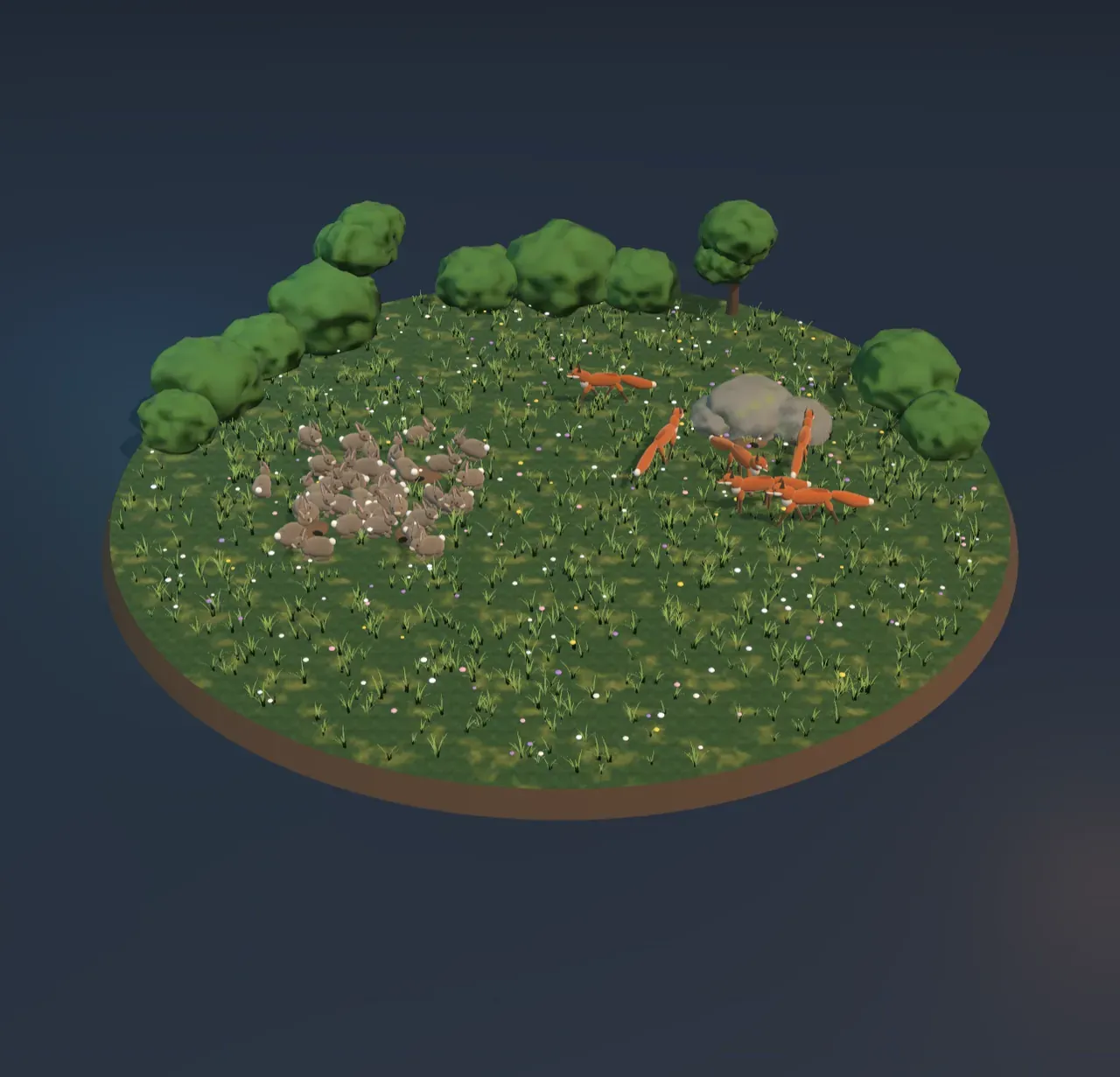
A population is all the individuals of one species in one place. The Scene boils an ecosystem down to two populations: wild rabbits, which eat grass that never runs out, and foxes, which eat rabbits. The fox is the predator and the rabbit the prey. In year the meadow has rabbits and foxes, and each figure is one animal.
How each population grows depends on the size of the other. The rabbits multiply while there are fewer than foxes, and the foxes multiply while there are more than rabbits. Those two lines split the loop into four quarters. Years is locked at year for now; read the note in the Scene and predict the next quarter.
Step 2 of 6
The foxes lag
Drag Years slowly back and forth round years to , and watch the first chart: two waves, the foxes’ a little behind the rabbits’. The second chart shows the same run another way, rabbits across and foxes up, and the point goes round it anticlockwise.
Step 3 of 6
The balance point
The cross inside the loop is the balance point: if the meadow ever had exactly rabbits and foxes, births and deaths would balance for both and nothing would change. It is also each population’s average over a whole turn. The model is the Lotka–Volterra equations,
and when both rates are zero, and . Here is Rabbit birth rate, is the foxes’ death rate, is the share of a cub each rabbit caught raises, and is set by Hunting success.
Step 4 of 6
Breaking even
The foxes stop growing exactly when the cubs born replace the foxes that die. You can ask this of a single fox: how many rabbits must it catch?
Step 5 of 6
Bumper years
The two balance-point formulas say something unexpected: the rabbits’ birth rate appears only in the foxes’ average, and the foxes’ death rate only in the rabbits’. Before changing anything, predict what happens to the averages.
Step 6 of 6
Better hunters
Rabbit birth rate is fixed, and Hunting success is free. What happens to the foxes when they learn to hunt better? Use the formula for to know which way to go.
Loading the interactive version…
Loading the interactive version…
Each step sets up the Scene for you, and a control marked “fixed” stays put for that step.
Practice · Predict, then look
Year : the meadow has nearly rabbits, more than the balance point of , and only foxes, fewer than . The note in the Scene says the foxes are raising more cubs. What happens next?
Practice · Predict, then look
Year : the meadow has nearly rabbits, more than the balance point of , and only foxes, fewer than . The note in the Scene says the foxes are raising more cubs. What happens next?
Practice · Choose
The chart shows the foxes peaking about a year after the rabbits: the rabbits are already falling, and the foxes are still rising. Why?
Practice · Choose
The chart shows the foxes peaking about a year after the rabbits: the rabbits are already falling, and the foxes are still rising. Why?
Practice · Predict, then look
The rabbits’ average over a whole turn is the balance point, , with and , and is Hunting success as a fraction, times . Now , and . Predict: how many rabbits will there be on average when Hunting success rises to 30%?
Practice · Predict, then look
The rabbits’ average over a whole turn is the balance point, , with and , and is Hunting success as a fraction, times . Now , and . Predict: how many rabbits will there be on average when Hunting success rises to 30%?
Practice · Calculate
In the model each fox dies at a rate of a year, and each rabbit it catches raises of a cub. How many rabbits must a fox catch a year for the foxes to raise exactly enough cubs to replace those that die?
Practice · Calculate
In the model each fox dies at a rate of a year, and each rabbit it catches raises of a cub. How many rabbits must a fox catch a year for the foxes to raise exactly enough cubs to replace those that die?
Practice · Predict, then look
Under Rabbit birth rate, bumper years: the rate rises from to a year. What goes up on average over a whole turn?
Practice · Predict, then look
Under Rabbit birth rate, bumper years: the rate rises from to a year. What goes up on average over a whole turn?
Practice · Reach the target
Rabbit birth rate is fixed at , and on average the meadow has foxes. Change Hunting success until the foxes’ average falls to , half, then press Check.
Practice · Reach the target
Rabbit birth rate is fixed at , and on average the meadow has foxes. Change Hunting success until the foxes’ average falls to , half, then press Check.
Lesson complete. Every practice question here is done.