One animal, two bodies: a caterpillar that grows in jumps inside a skin that will not stretch, a chrysalis in which most of the body is broken down and rebuilt, a tadpole whose tail is absorbed into the froglet, and the hormones that decide when.
Step 1 of 6 · One animal, two bodies
Step 1 of 6
One animal, two bodies
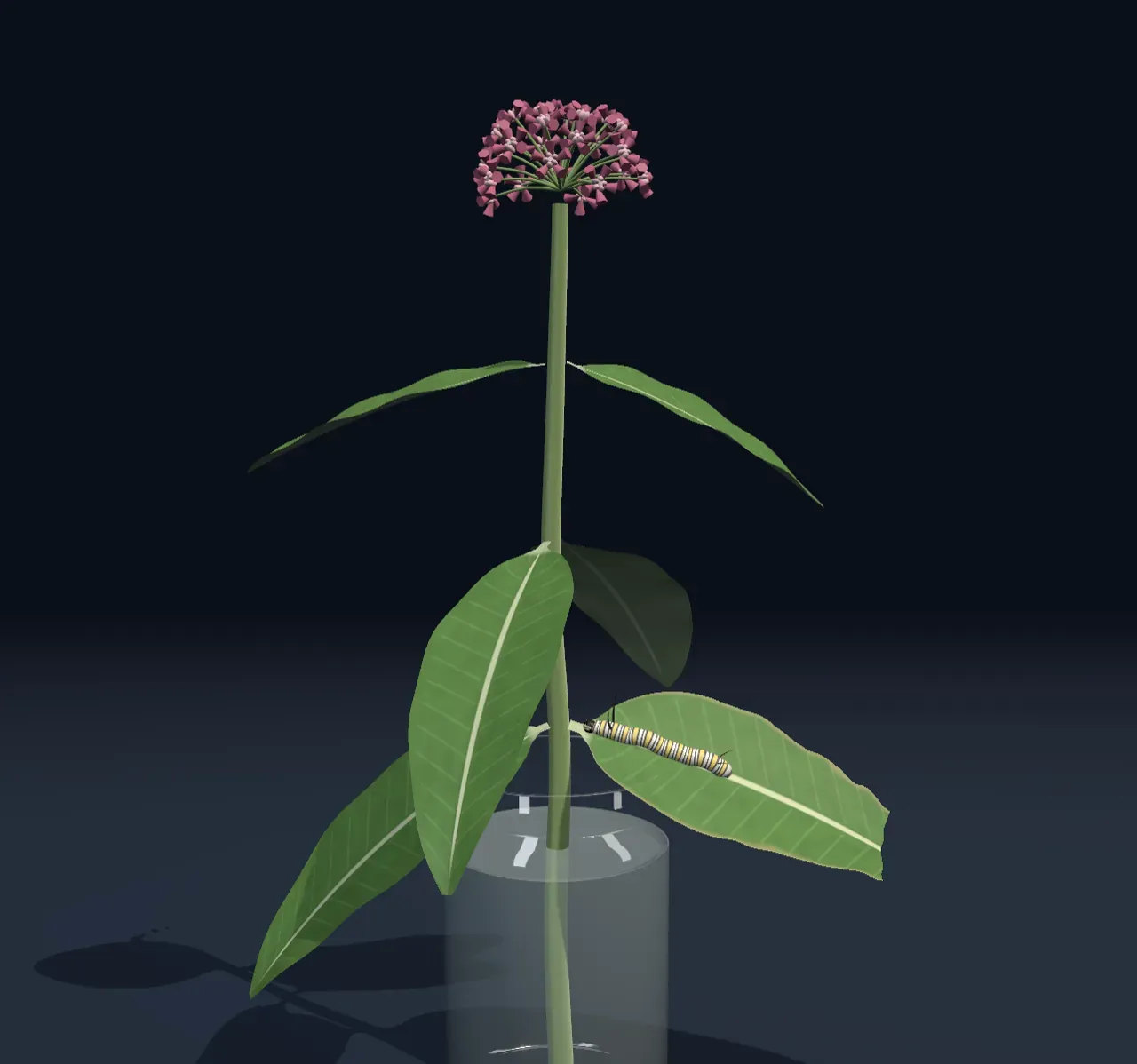
In metamorphosis an animal swaps one body for another. The larva is built to eat and grow; the adult is built to travel and breed. Animal is a Monarch butterfly on a sprig of milkweed, and Time is locked at almost five days: a 2 mm caterpillar has hatched and starts eating the leaf. The chart lays the stages out on a calendar and plots the body’s length.
Step 2 of 6
Growing inside a skin
An insect’s skin, the cuticle, is a stiff case of chitin and protein. The soft body inside can stretch it a little, but the hard head cannot grow at all. Each stage between two moults is an instar; a monarch has five.
Step 3 of 6
Inside the chrysalis
The caterpillar hangs in a J, its skin splits, and underneath is the chrysalis, a jade case with gold dots. From outside, for nine days nothing happens. Since it was an embryo, the caterpillar has carried small pockets of cells, imaginal discs.
Step 4 of 6
Who decides when
Hormones set the timing. Ecdysone starts each moult. Juvenile hormone decides what the moult makes: while there is plenty of it, a moult makes a bigger caterpillar; when it falls, a chrysalis; when none is left, the chrysalis becomes an adult. Hormones at Kept young means juvenile hormone stays high.
Step 5 of 6
The tadpole’s way
Animal is a Common frog. A tadpole is a gut that swims: it grazes algae with a long, coiled gut and breathes through gills. After about seven weeks it grows hind legs, and in the eleventh week the front legs break out. Now the climax of metamorphosis begins, about two weeks in which the tadpole stops eating. Watch its length on the chart.
Step 6 of 6
A giant tadpole
In frogs the signal is thyroid hormone, which the gland in the throat releases when the brain tells it to. At Kept young the hormone is blocked; at Hurried it is added to the water.
Loading the interactive version…
Loading the interactive version…
Each step sets up the Scene for you, and a control marked “fixed” stays put for that step.
Practice · Predict, then look
The caterpillar hatched 2 mm long. Predict how many millimetres long it is about two weeks later, when it stops eating and hangs in a J.
Practice · Predict, then look
The caterpillar hatched 2 mm long. Predict how many millimetres long it is about two weeks later, when it stops eating and hangs in a J.
Practice · Choose
The caterpillar stops eating and sheds its skin, five times in two weeks. Why does it need to?
Practice · Choose
The caterpillar stops eating and sheds its skin, five times in two weeks. Why does it need to?
Practice · Predict, then look
From outside, nothing happens in the chrysalis for nine days. Predict what you will see when you switch on Cut open in the middle of the chrysalis stage.
Practice · Predict, then look
From outside, nothing happens in the chrysalis for nine days. Predict what you will see when you switch on Cut open in the middle of the chrysalis stage.
Practice · Predict, then look
Normally there is a butterfly after days. Predict what there is on day when Hormones switches to Kept young, with juvenile hormone kept high.
Practice · Predict, then look
Normally there is a butterfly after days. Predict what there is on day when Hormones switches to Kept young, with juvenile hormone kept high.
Practice · Predict, then look
The tadpole has legs, and is about 42 mm long with its tail. Predict what happens to its length as Time moves on until it is a froglet.
Practice · Predict, then look
The tadpole has legs, and is about 42 mm long with its tail. Predict what happens to its length as Time moves on until it is a froglet.
Practice · Reach the target
Time is locked at about weeks, and a 1.6 cm froglet sits in the tank. An ordinary tadpole never reaches 5 cm. Change Hormones so that on the same day a tadpole at least 5 cm long swims in the tank, and press Check.
Practice · Reach the target
Time is locked at about weeks, and a 1.6 cm froglet sits in the tank. An ordinary tadpole never reaches 5 cm. Change Hormones so that on the same day a tadpole at least 5 cm long swims in the tank, and press Check.
Lesson complete. Every practice question here is done.