Five heads and five foods: a cow grinding grass from side to side, a cat shearing meat with scissor-like teeth, a whale sieving krill through baleen, a hummingbird lapping nectar with a forked tongue, and guts that lengthen when food is hard to digest.
Step 1 of 6 · Built for food
Step 1 of 6
Built for food
Every animal has to get food into its body and break it down, and its mouth, jaws and gut are shaped by what it eats. Biologists sort the ways into a few kinds: bulk feeders eat large pieces; filter feeders sieve small food out of water; fluid feeders drink a liquid, such as nectar, sap or blood; and substrate feeders live in or on their food. Food is at Krill: the head of a humpback whale.
Step 2 of 6
Grinding grass
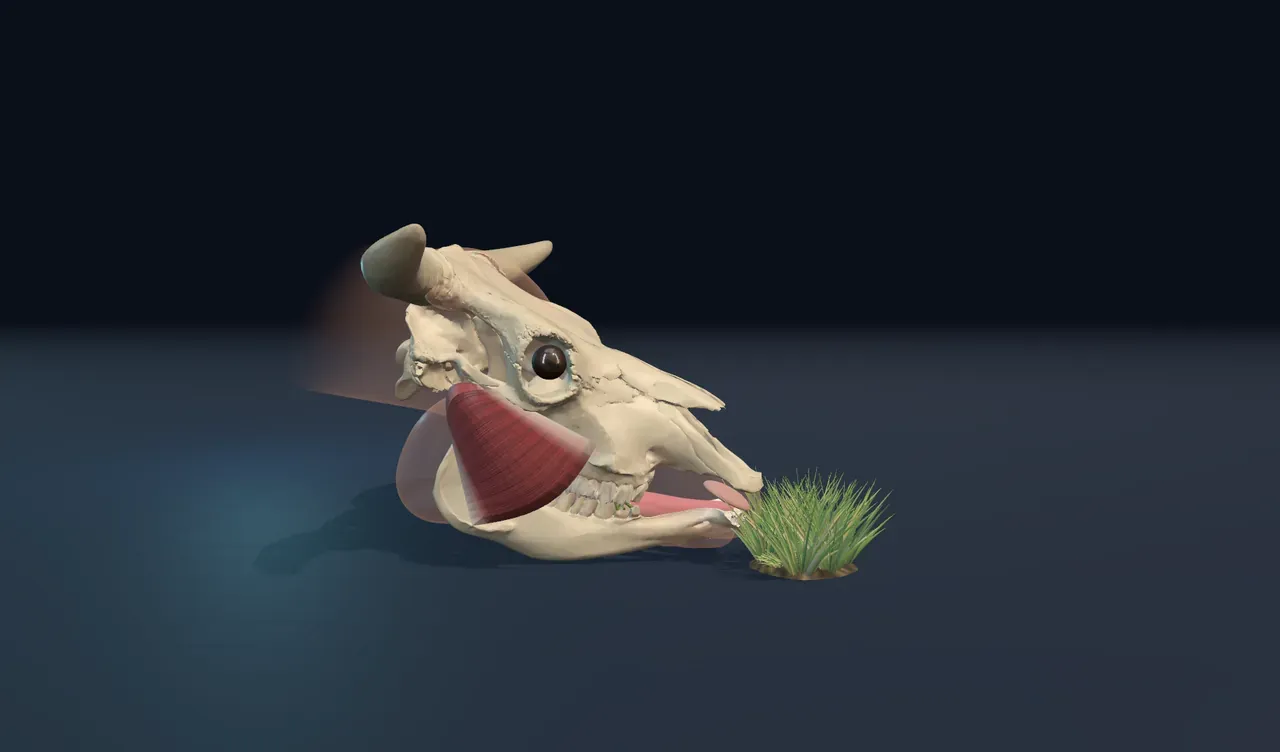
Grass is poor, tough food, mostly cellulose, and full of tiny grains of silica that wear teeth down. A cow has no upper front teeth: the tongue wraps a bunch of grass, and the lower teeth press it against a dental pad. Further back, the cheek teeth are flat, ridged millstones, and the masseter muscle pulls the jaw.
Step 3 of 6
Cutting meat
Meat is the opposite: soft, rich and easy to digest, but it has to be caught and cut. Skin and muscle is off, so the skull shows. The cat’s jaw joint is a tight hinge level with the teeth, and the temporalis muscle closes the jaw hard and fast. The canines at the front grip, and further back one tooth in each jaw has a sharp blade: the carnassial. Drag Time until the jaw closes.
Step 4 of 6
Sieving the sea
A humpback whale eats krill, shrimp-like animals two or three centimetres long, by the tonne. It has no teeth: from its upper jaw hang about three hundred plates of baleen on each side, made of keratin, the stuff of fingernails. Time is locked at the moment the mouth is open nearly at a right angle. Every head in the Scene is drawn the same size, but beside each lies a brass scale bar showing its real scale.
Step 5 of 6
Lapping nectar
Nectar is sugar dissolved in water, hidden at the bottom of a flower. The hummingbird’s long, thin bill reaches it. Drag Time slowly, and watch the pink rods round the back of the skull, the hyoid horns.
Step 6 of 6
Long guts, short guts
The design does not stop at the mouth. The cow swallows the shredded grass into the rumen, the first and biggest chamber of its four-chambered stomach, and later brings it back up as cud to chew again. A cow’s intestines are about twenty times as long as its body; a cat’s, about four times.
Loading the interactive version…
Loading the interactive version…
Each step sets up the Scene for you, and a control marked “fixed” stays put for that step.
Practice · Choose
What kind of feeder is the humpback whale?
Practice · Choose
What kind of feeder is the humpback whale?
Practice · Predict, then look
The cow starts grinding the grass with its cheek teeth. Predict how its lower jaw moves as Time moves on.
Practice · Predict, then look
The cow starts grinding the grass with its cheek teeth. Predict how its lower jaw moves as Time moves on.
Practice · Choose
What do the cat’s carnassials do as the jaw closes?
Practice · Choose
What do the cat’s carnassials do as the jaw closes?
Practice · Calculate
The scale bar beside the whale’s head marks one metre. Measure with it: how long is the head really?
Practice · Calculate
The scale bar beside the whale’s head marks one metre. Measure with it: how long is the head really?
Practice · Choose
How does the hummingbird get nectar out of the bottom of the flower?
Practice · Choose
How does the hummingbird get nectar out of the bottom of the flower?
Practice · Choose
Why are a cow’s intestines twenty times its body length, and a cat’s only four?
Practice · Choose
Why are a cow’s intestines twenty times its body length, and a cat’s only four?
Lesson complete. Every practice question here is done.