Built for the food
Watch a cow in a field and a cat with its dinner and you see two different machines at work. The cow’s jaw swings from side to side, minute after minute. The cat bites a few times, straight up and down, and swallows. Neither could eat the other’s food well: a cat’s teeth cannot grind grass, and a cow’s cannot slice meat.
Every animal has to get food into its body and break it down, and its mouth, jaws and gut are shaped for the food it eats and the way it gets it. Biologists group the ways into a few kinds. Bulk feeders, such as the cow, the cat and the finch, eat large pieces. Filter feeders, such as the humpback whale, strain small food out of water. Fluid feeders, such as the hummingbird, drink a liquid: nectar, sap or blood. A fourth kind, substrate feeders, live in or on their food, as a caterpillar lives on its leaf. Food chains asks where the energy in food goes; this Article asks how an animal gets hold of it in the first place.
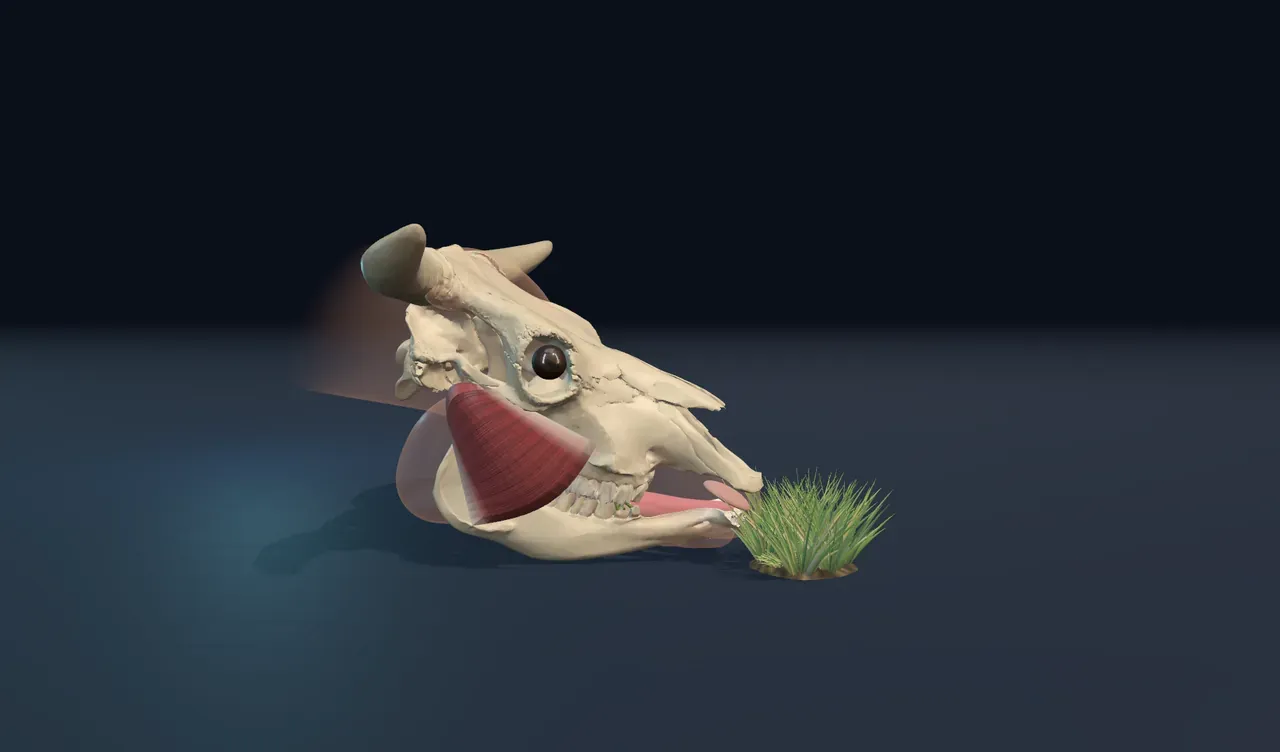
Try it: leave Food on Grass and watch one mouthful from the first bite until it is swallowed. Watch the lower jaw: it opens only a little, but it swings to one side and back three times.
Grinding grass
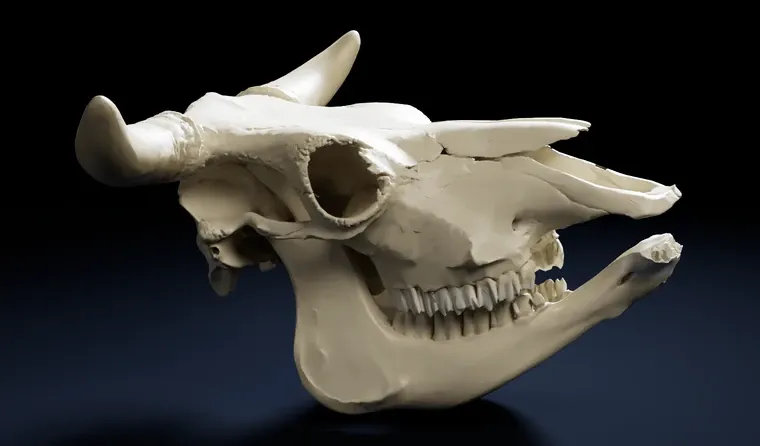
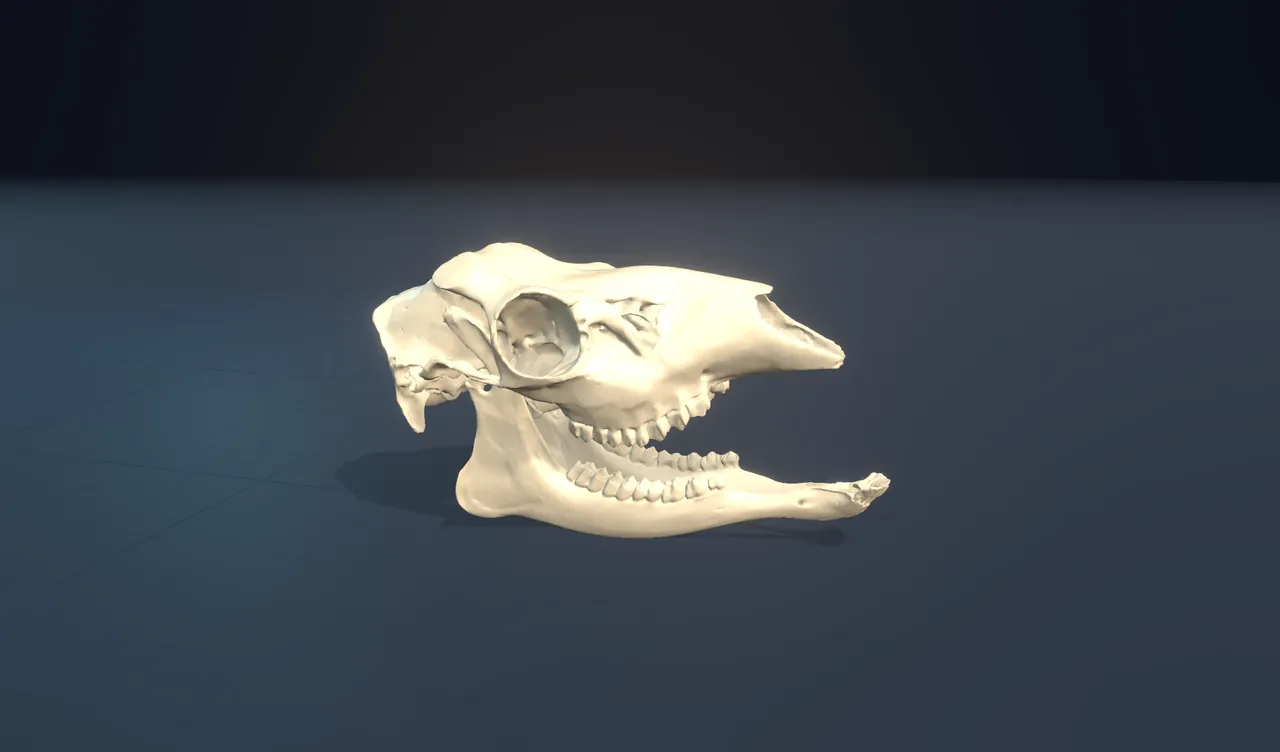
Grass is a poor, tough food. Most of it is cellulose, the fibre of plant cell walls, which no mammal can digest on its own, and it is gritty with tiny grains of silica that wear teeth down. A cow eats it with a set of tools that matches each problem.
It has no upper front teeth. Its long tongue wraps round a bunch of grass and pulls it in, and its eight lower front teeth pinch it against a hard, toothless dental pad in the upper jaw; a tug of the head tears it off. Behind a long gap, the cheek teeth form two rows of flat, ridged millstones. The jaw joint sits high above them, and the big masseter muscle on the side of the face pulls the lower jaw sideways across the upper teeth, so the ridges shred the grass between them. The teeth are tall, and keep wearing down slowly through the animal’s life.
Chewing is only the start. The cow swallows the shredded grass into its rumen, the first and largest chamber of its four-part stomach, where billions of bacteria and other microbes ferment the cellulose it cannot digest itself. Later it brings the mass back up as cud and chews it again, for hours each day. The microbiome and symbiosis follows microbes like these in our own gut.
Slicing meat
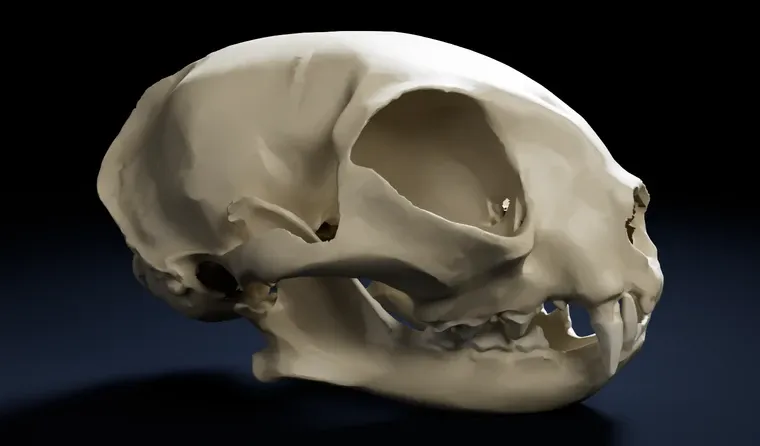
Meat is the opposite: soft, rich and easy to digest, but it has to be caught, torn off and cut. A cat’s skull is short, with large eyes facing forward and wide cheekbones that leave room for a big temporalis muscle, which runs from the top of the skull down to the jaw and closes it hard and fast.
Its jaw joint is a tight hinge level with the teeth, so the jaw can only swing up and down, and wide. The long canines at the front grip. Further back, one tooth in each jaw, the carnassials, has a sharp blade, and the upper blade passes just outside the lower one as the jaw shuts. They work like the two blades of scissors, which is why a cat chews on the side of its mouth and tips its head to do it. It cuts meat into pieces and swallows them almost unchewed.
Try it: choose Meat and watch the cat take a mouse it has caught: the canines grip, and a pull of the head tears a piece off. Press Pause motion as the jaw shuts on the piece, turn off Skin and muscle to see the carnassials slide past each other, and notice that the lower jaw never moves sideways.
Straining the sea
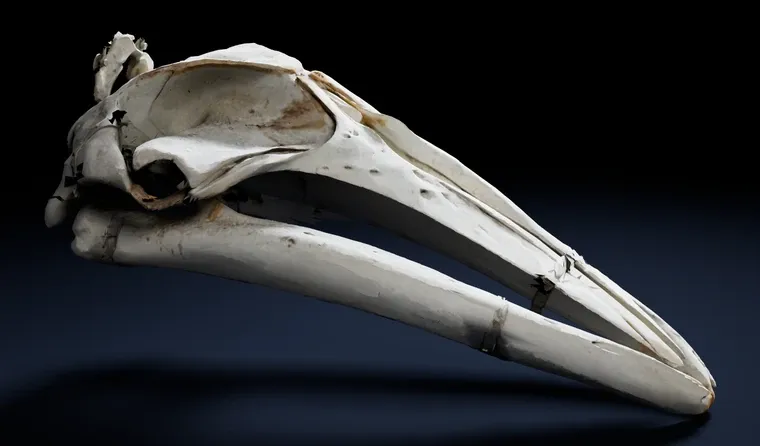
A humpback whale eats animals two or three centimetres long, mostly krill, and it eats them by the tonne. It has no teeth. From its upper jaw hang about three hundred plates of baleen on each side, made of keratin, the same stuff as your fingernails, frayed into a mat of bristles on their inner edge.
The whale lunges into a swarm with its mouth open almost to a right angle. The pleated skin of its throat unfolds like an accordion, and its throat balloons with many tonnes of water and krill. The mouth shuts, the throat squeezes, and the tongue presses up: the water streams out between the baleen plates, and the krill stay caught on the bristles, to be swallowed. One mouthful can hold thousands of krill.
Sipping nectar
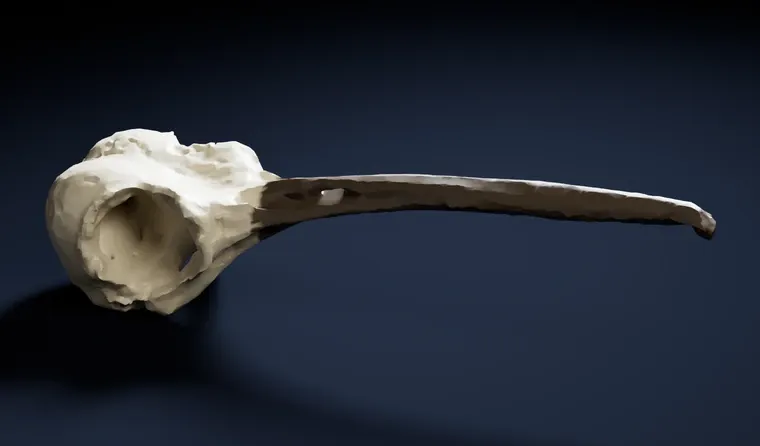
Nectar is sugar dissolved in water, hidden at the bottom of a flower. A hummingbird’s long, thin bill reaches it, and the bill hardly opens at all. The work is done by the tongue, which slides out past the tip of the bill into the nectar. Its tip is split in two, and each half is a groove with a fringed edge; in the nectar the halves open, then close round the liquid as the tongue is pulled back.
The tongue can reach so far because its roots, two thin rods called the hyoid horns, wrap round the back of the skull up to the forehead and slide forward when it goes out. A hummingbird licks about fifteen times a second and drinks a large share of its own weight in nectar every day, because it burns energy faster than almost any other animal.
Try it: choose Nectar and watch a few licks. Watch the pink rods round the back of the skull: they slide down as the tongue goes out into the flower.
Cracking seeds
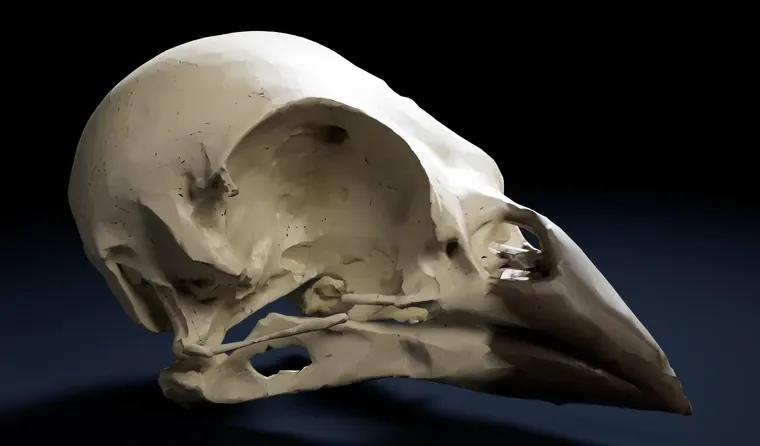
A seed is food packed in a hard shell. Birds have no teeth, so a seed-eating finch cracks the shell with its beak. The medium ground finch of the Galápagos Islands has a short, deep beak and large jaw muscles bulging behind it. It moves a seed to the base of its beak, close to the hinge, where the bite is strongest, as you crack a nut near the joint of a nutcracker, and squeezes until the shell splits. It drops the husk and swallows the kernel. A muscular part of its stomach, the gizzard, does the grinding that teeth would do, helped by small stones the bird swallows.
Finches show how fast such shapes can change. In a drought on the island of Daphne Major in 1977, the small, soft seeds ran out and only large, hard ones were left. Finches with deeper beaks could crack them and survived better, and their young had beaks about 4% deeper than before the drought. Natural selection explains how differences like that add up over generations.
Long guts for plants, short guts for meat
The shaping does not stop at the mouth. Plant food takes a long time to digest, so plant-eaters have long guts and large chambers where microbes can work on it: the intestines of a cow are about twenty times the length of its body. Meat digests quickly, so meat-eaters have short, simple guts: a cat’s are about four times its body length. A digestive tract like yours, eating a mixed diet, sits in between. Even a tadpole, which grazes on algae, has a long coiled gut that shortens when it turns into an insect-eating frog.
These are trade-offs. A long gut and a big rumen are heavy and slow; long, high-crowned grinding teeth are no use for catching prey. Each body is good at one way of eating, which is part of why so many kinds of animals can share one place without competing for the same food, as Ecosystems and population dynamics shows. Not every living thing even has a mouth: fungi pour digestive enzymes out onto their food and absorb what dissolves.
What this model leaves out
The Scene shows one stroke of each kind of feeding, slowed down and simplified into a few clear stages. A real cow chews in a steady rhythm of about one stroke a second, a cat may cut many times along one strip, and a whale’s lunge, gulp and filter take about a minute. The hummingbird’s four licks here stand for the fifteen or so it makes each second.
The heads are drawn about the same size so they can be compared; the caption gives each one’s real length. The skulls are simplified: the number and shape of the teeth, the bones of the whale’s jaw and the birds’ skulls are reduced to their main parts, and only the main jaw muscle on each side is shown. The krill are drawn larger than life and in a smaller swarm than a real one. The gut lengths in the text are typical figures; they vary with the animal’s age, breed and diet.