One animal, two bodies
A caterpillar chews leaves, has no wings and crawls on sixteen short legs. The butterfly it becomes sips nectar through a coiled tongue, flies on four wings and stands on long, thin legs. A tadpole breathes water through gills, scrapes algae off stones and swims with its tail. The frog it becomes breathes air, has no tail and catches insects with a sticky tongue. In each pair, one animal has lived in two bodies.
The change from one body to the other after hatching is called metamorphosis, from the Greek for “change of shape”. The young form is the larva (a caterpillar and a tadpole are both larvae), and the final form is the adult. Most insect species go through it, including every beetle, fly, bee, ant, butterfly and moth, and so do frogs, toads and most salamanders.
Two bodies let one life do two jobs. The larva is built to eat and grow; the adult is built to spread out and breed. Because they eat different food in different places, the young do not compete with their own parents.
Growing inside a skin
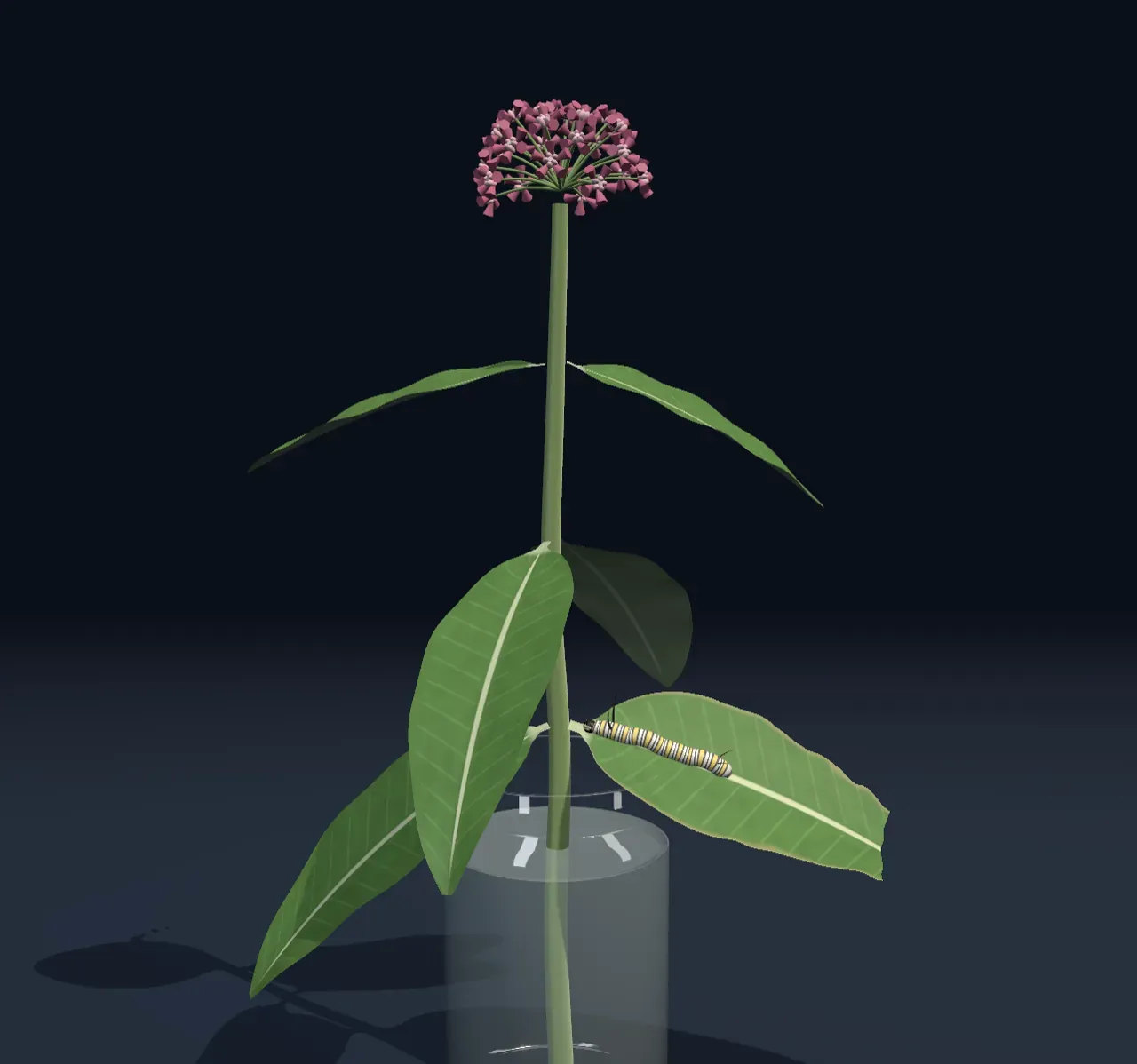
The monarch’s mother lays each egg alone on a milkweed leaf, usually underneath it (here it is on top, so you can see it). The egg is about 1.2 mm tall, a cream-coloured cone with fine ribs. After about four days a caterpillar 2 mm long chews its way out, eats its eggshell and starts on the leaf.
An insect’s skin, the cuticle, is a coat of tough, waterproof chitin and protein. The soft body inside can stretch it a little, but the hard head cannot grow at all. So every few days the caterpillar moults: it stops eating, grows a new, looser skin underneath, and splits the old one, walking out of it with a bigger head. Each stage between moults is an instar. A monarch has five, and its head is about half as wide again after each moult. In two weeks it goes from 2 mm to about 45 mm long and becomes about two thousand times heavier.
Try it: drag Time slowly from Egg. The inset magnifies the egg and the first small caterpillar; watch its leaf being eaten as it grows, and the marks on the caterpillar’s bar in the chart, one for each moult.
Milkweed is poisonous to most animals. Its sap carries heart poisons called cardenolides, and the monarch caterpillar stores them in its body. A bird that eats a monarch vomits, and learns to leave the yellow, black and white bands alone. The adult keeps the poison, and its orange and black wings carry the same warning.
Rebuilt inside the chrysalis
When the fifth instar is fully grown, the caterpillar wanders off, spins a pad of silk under a leaf and hooks its rear end into it. It lets go and hangs head down, curled into a J, for most of a day. Then the skin splits behind its head and is wriggled up to the top, and underneath is the chrysalis: a jade case with a crown of gold dots. The stage inside is called the pupa.
From outside, nothing happens for nine days. Inside, digestive enzymes break down most of the caterpillar’s body: its crawling muscles, much of its gut, its silk glands. The adult is built from small pockets of cells called imaginal discs, which the caterpillar has carried since it was an embryo. They grow slowly while it feeds and fast in the last instar, and in the pupa they unfold into wings, eyes, antennae and the rest of the adult, by ordinary cell division. The broken-down tissue is their food.
It is not a complete soup. The nervous system, the heart and the breathing tubes are rebuilt rather than destroyed, and in experiments with tobacco hornworm moths, caterpillars trained to avoid a smell still avoided it after they became moths.
Try it: turn Cut open on and drag Time through the chrysalis. First the blue discs in the caterpillar; then the case filled with broken-down tissue; then the adult taking shape. On the last day the case turns clear and the wings show through from outside.
The butterfly splits the case, climbs out and hangs from it. Its wings are small, soft and crumpled. It pumps blood from its swollen body into the veins of the wings until they spread to full size, and hangs for a few hours while they harden. From then on it never grows again: every insect’s growing is done as a larva.
The tadpole’s way
Switch Animal to Common frog. A frog lays its eggs in a clump of jelly, frogspawn, which floats near the edge of a pond. Each egg is a black ball about 2 mm across, dark on top and pale underneath. It divides into thousands of cells and lengthens into an embryo with a tail, and after one to three weeks a tadpole wriggles out. At first it breathes through feathery gills outside its head; within days a flap of skin grows over them and water flows over gills inside.
A tadpole is a swimming gut. It grazes algae, and plant food takes a long time to digest, so its gut is very long, coiled like a watch spring in its belly. Turn Cut open on to see it. After about seven weeks hind legs bud at the base of the tail and grow joints and webbed toes. The front legs grow hidden under the skin, and at about eleven weeks they push out.
Then comes the climax of metamorphosis, about two weeks in which the tadpole stops eating. Its cells in the tail kill themselves on cue, by a process called apoptosis, and the tail’s material is recycled. Its gut shortens to suit a hunter’s diet of insects, its lungs grow, its gills go, its mouth widens and its eyes bulge. It climbs out as a froglet only about 1.5 cm long, much shorter than the tadpole with its tail. It will take two or three more years to grow into an adult.
Unlike a butterfly, a frog never stops to rebuild inside a case. Its metamorphosis happens to an animal that is still swimming, and every stage, with legs and a tail at once, is a working body.
What says when
The timing is set by hormones, chemical messages carried in the blood. In insects two of them work together. Ecdysone, from a gland in the thorax, starts each moult. Juvenile hormone, from tiny glands behind the brain, decides what the moult makes. While there is plenty of it, a caterpillar moults into a bigger caterpillar; when the level drops in the last instar, the next moult makes a pupa; with none left, the pupa moults into the adult.
In the 1930s Vincent Wigglesworth showed this in a blood-sucking bug. Giving a nearly grown young bug the glands of a younger one made it moult into an extra, giant young stage instead of an adult; taking the glands away from a young one made it turn into a tiny adult early. Silkworms whose glands were removed spun miniature cocoons and became miniature moths.
In frogs the signal is thyroid hormone, from the thyroid gland in the throat, released as the brain tells it to. In 1912 Friedrich Gudernatsch fed tadpoles on thyroid tissue, and they changed early into frogs no bigger than flies. Tadpoles without a thyroid never change at all; they keep growing into giant tadpoles. The axolotl, a Mexican salamander, does this in the wild: it keeps its gills and breeds in the water as a larva all its life, though thyroid hormone can still make one change into a land salamander. How glands and hormones run the whole body is the subject of hormones and the endocrine system.
Try it: set Hormones to Kept young and drag Time to Weeks later. The caterpillar moults again and again into a giant; the tadpole never grows legs. Then try Hurried: a small caterpillar turns into a chrysalis two moults early and becomes a miniature butterfly, and a young tadpole becomes a tiny froglet weeks before its time. The chart keeps the ordinary course as a faded bar and a dashed line.
Complete, incomplete and none
Butterflies, beetles, flies, bees and ants go through complete metamorphosis: egg, larva, pupa, adult. Grasshoppers, dragonflies, cockroaches and true bugs go through incomplete metamorphosis: the young, called nymphs, already look like small wingless adults, their wings grow in pads outside the body, and the last moult turns them straight into adults with no pupa. A few insects, such as silverfish, hardly change at all.
Complete metamorphosis is the most successful of the three, if counting species is the measure: most of the insects alive today use it. Letting the larva and the adult become specialists, each with its own food and its own way of life, gives natural selection two bodies to shape. Both are built from the same genes; what differs is which genes are switched on, and when. How one fertilised egg builds a body in the first place is the story of embryonic development.
What this model leaves out
The animals are raised at a fixed temperature, about 25 °C for the monarch and 15 °C for the frog, and their days and sizes are typical round figures. Warmth speeds both up and cold slows them down: a monarch takes about a month from egg to butterfly in summer, more in spring, and a cold year can hold tadpoles over the winter.
The Scene follows one animal. A real monarch lays hundreds of eggs, and a clump of frogspawn holds a thousand or more, most of which are eaten. The other eggs of the clump hatch with ours and are not followed. A froglet would climb out onto a stone or a plant; here it uses a raft of cork bark.
The hormone settings are simplified versions of real experiments. Keeping juvenile hormone high does make extra caterpillar moults, but such caterpillars usually pupate in the end, and the Scene stops before that could happen. Real hurried animals are often smaller and less healthy than the Scene shows.
Cutting the animals open is a way of seeing, not something the animal survives. The imaginal discs are coloured blue so you can find them; they are really pale. The broken-down tissue in the chrysalis is drawn as loose round cells, far fewer and larger than there are, and the adult forming inside it as a simple outline. The inset shows anything small at the magnification printed under it; everything outside it is life size.