A dog, a trout and a pigeon move in place in a lab: each pushes the ground, the water or the air backwards and gets an equal push back. A walk that turns into a run, feet that push harder than the weight, and what a metre costs on land, in water and in air.
Step 1 of 6 · Push and push back
Step 1 of 6
Push and push back
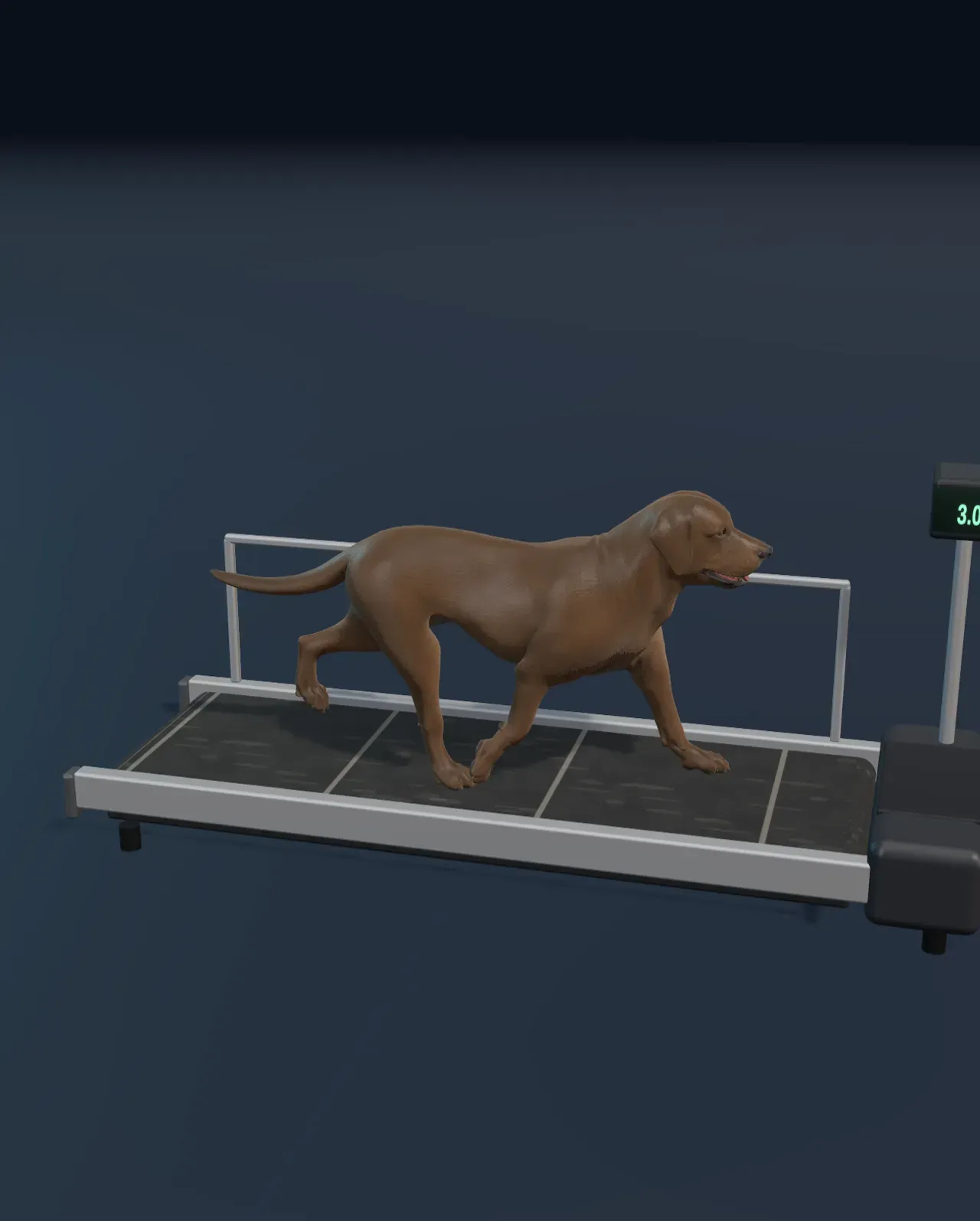
No animal can push itself. To move it must push on something else, and by Newton’s third law, whatever it pushes pushes it back. In the Scene the animal moves in place, because the ground, water or air streams back past it: a Dog on a treadmill, a Trout in a swim tunnel and a Pigeon in a wind tunnel. Show the pushes is at Pushes: the amber arrow is the animal’s push, and the sky-blue arrow is the push on it.
Step 2 of 6
Walk to trot
A walking dog vaults over each straight leg, like an upside-down pendulum: the body rises over the foot and falls forward onto the next. That works only up to a certain speed. Mammals of every size switch from walking to running at about the same Froude number, , where is the leg’s length: at . This dog’s leg is 0.5 m long.
Step 3 of 6
Legs like springs
In a run the legs work like springs: the tendons stretch on landing and spring back. In a gallop, at Cycling pace, the back flexes and stretches, and for moments no foot touches the ground. The dog’s weight is 245 N.
Step 4 of 6
What a metre costs
Biologists compare ways of moving by the cost of transport: the food energy it takes to carry one kilogram of animal one metre, in J/(kg·m). It is measured as in the Scene: the animal on a treadmill, and the oxygen it breathes shows how much food it burns. The dog, 25 kg, runs at Jogging pace, 3 m/s, burning about 347 W. The chart beside the Scene plots the cost against speed.
Step 5 of 6
Fins in water
Water is about times as dense as air. Its buoyancy balances a fish’s weight, but it is hard to push through, and the fish needs a steady push to match the drag. The tail sweeps from side to side and throws water back.
Step 6 of 6
Wings in air
Air is too thin to hold a bird up. A pigeon must carry all its weight by throwing air downwards with every wingbeat. Show the pushes is at Wake: each downstroke throws a ring of air down and back. The pigeon is flying at 10 m/s.
Loading the interactive version…
Loading the interactive version…
Each step sets up the Scene for you, and a control marked “fixed” stays put for that step.
Practice · Choose
One of the dog’s feet pushes the belt backwards. What is true of the belt’s push on the dog?
Practice · Choose
One of the dog’s feet pushes the belt backwards. What is true of the belt’s push on the dog?
Practice · Reach the target
Find the highest Speed at which the dog still walks rather than trotting, and press Check.
Practice · Reach the target
Find the highest Speed at which the dog still walks rather than trotting, and press Check.
Practice · Calculate
The dog gallops at 7 m/s. What is the largest push of a leg on the belt in each stride? Compare it with its weight, 245 N.
Practice · Calculate
The dog gallops at 7 m/s. What is the largest push of a leg on the belt in each stride? Compare it with its weight, 245 N.
Practice · Calculate
The dog, 25 kg, runs at 3 m/s burning about 347 W. What is its cost of transport, in J per kilogram per metre?
Practice · Calculate
The dog, 25 kg, runs at 3 m/s burning about 347 W. What is its cost of transport, in J per kilogram per metre?
Practice · Predict, then look
Running costs the dog about 4.6 J per kilogram per metre. Predict what it costs the trout, at its cheapest speed, about half a metre a second.
Practice · Predict, then look
Running costs the dog about 4.6 J per kilogram per metre. Predict what it costs the trout, at its cheapest speed, about half a metre a second.
Practice · Predict, then look
At 10 m/s the pigeon burns about 17 W. Predict what happens to the power when Speed drops to 3 m/s.
Practice · Predict, then look
At 10 m/s the pigeon burns about 17 W. Predict what happens to the power when Speed drops to 3 m/s.
Lesson complete. Every practice question here is done.