Push back to go forward
No animal can push itself. To speed up, slow down or keep going against drag, it has to push on something else, and by Newton’s third law whatever it pushes pushes back on it just as hard, in the opposite direction. That push back is the only force that moves it forward.
So every way of moving comes down to the same trick: throw something backwards. A dog’s feet push back on the ground, a fish’s tail pushes back on the water, a bird’s wings push back and down on the air. What differs is what there is to push against, and that decides almost everything else: how the body is built, how fast the animal goes and how much each metre costs it.
The pushing itself is done by muscles, which can only pull, working the bones as levers (see movement and muscles).
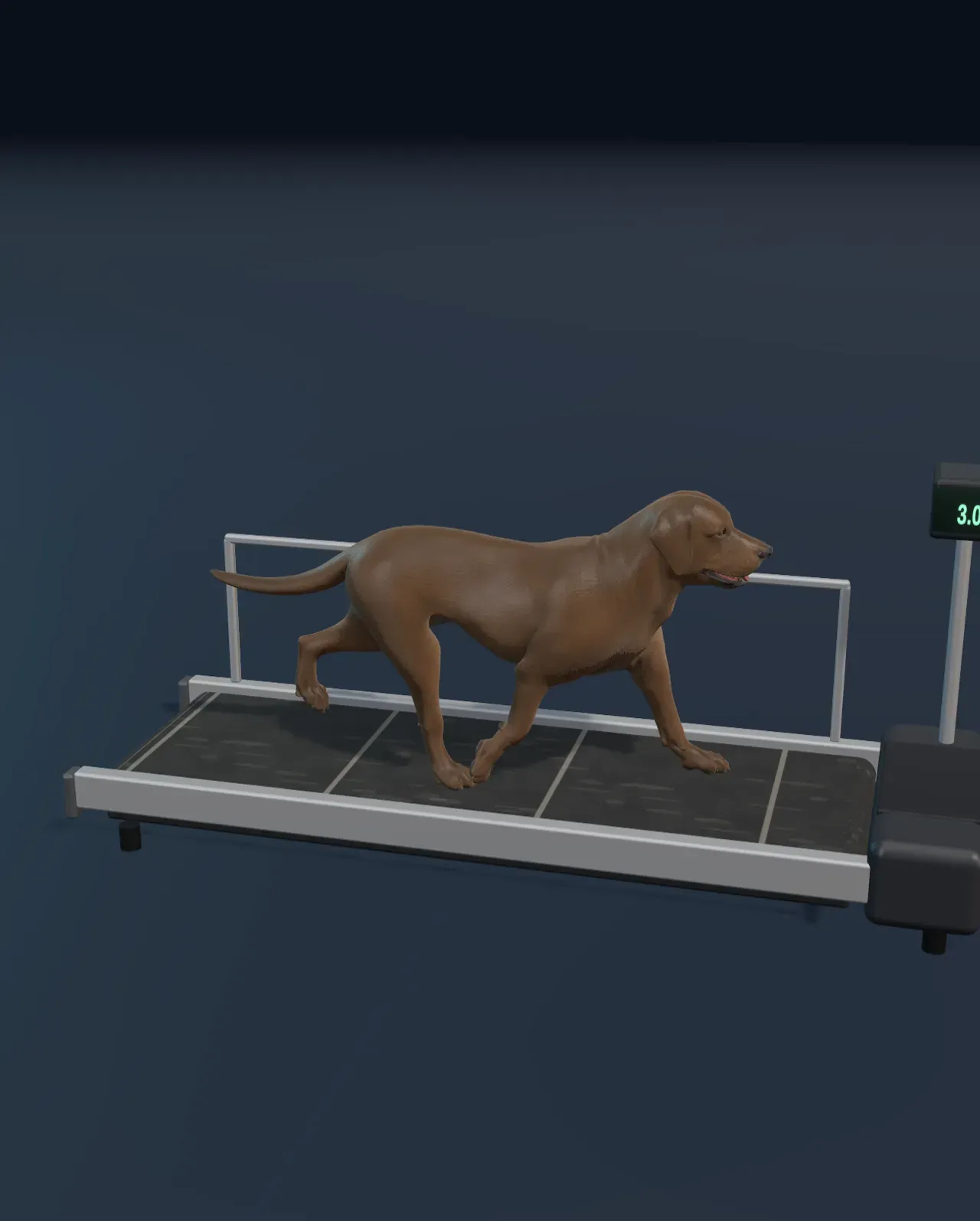
Try it: step Show the pushes to Pushes. The amber arrow is the animal’s push on the ground, water or air; the sky-blue arrow is the push back on the animal. They are always the same length and point opposite ways.
Legs on solid ground
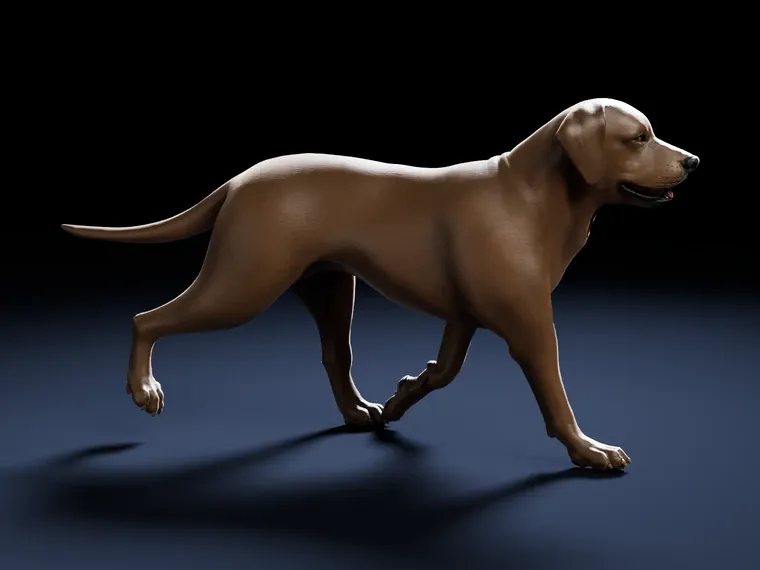
The ground is the easiest thing to push against: it is joined to the whole Earth, so it pushes back without giving way. Most of a foot’s push goes straight down, holding the dog up. Watch the sky-blue arrow at Walking pace: it stands nearly upright and only tips a little, first backwards as each foot lands and brakes, then forwards as the foot pushes off. Over a stride the braking and the pushing cancel, and the upward pushes add up to exactly the dog’s weight.
A walking dog vaults over each fairly straight leg like an upside-down pendulum. Its body rises as it passes over the foot, swapping some movement energy for height, and gets it back as it falls forward to the next foot (as on a roller coaster). That only works up to a point. Mammals of every size switch from walking to running at about the same Froude number, the speed squared divided by gravity times leg length: about 0.5, which for this dog’s legs is about 1.6 m/s.
Running works differently. The legs bend and act as springs, the tendons stretch as the body lands and spring back as it leaves the ground, and the body is lowest, not highest, when the push is greatest. A trot moves diagonal pairs of legs together. Above about 3.5 m/s the dog breaks into a gallop: the feet land one after another, the back flexes and stretches to lengthen each stride, and for moments in every stride no foot touches the ground at all. Each foot then has less time on the ground to do its share, so it has to push harder: at a full gallop a single stride’s peak push is nearly three times the dog’s weight.
Try it: with Dog on a treadmill, drag Speed slowly from Walking pace to Cycling pace. The legs switch from four separate beats to pairs, then to the gallop’s rolling sequence, and the arrows grow taller and briefer.
Step on to Wake and each foot leaves a print on the belt, brighter where it pushed harder. That is all the ground keeps. It does not move away, so none of the dog’s work is carried off by the ground. The cost of running is spent inside the dog: in muscles holding up its weight at every step, and in swinging its legs to and fro.
Fins in water
Water is about 800 times denser than air, which changes both halves of the problem. It holds the trout up for free: a fish’s body is about as dense as water, so the water’s buoyancy balances its weight (see floating and buoyancy), and none of its muscle goes into staying up. But dense water is also hard to push through, so the fish needs a steady forward push to match the drag on it.
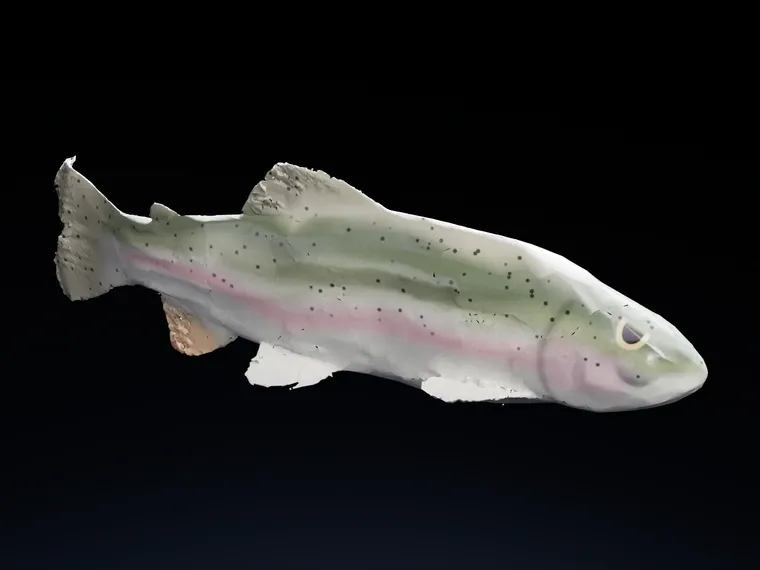
A trout gets that push by bending its body in a wave that runs back towards the tail, growing as it goes. The tail sweeps side to side, and because it meets the water at an angle, each sweep pushes water back as well as sideways. The sideways slaps cancel from one sweep to the next; the backward part is the push that drives the fish. At 1 m/s it is only about 0.2 N, a fiftieth of the trout’s weight, which is why the Scene draws it four times longer.
Try it: choose Trout in a swim tunnel and step Show the pushes to Wake. Each sweep of the tail sheds a ring of swirling water, alternately to one side and the other, and the specks that pass through the rings are flung backwards.
Pushing water back means setting it moving, and the energy in that moving water is lost to the fish. A fish swims most efficiently by pushing a lot of water back gently, rather than a little water hard. Drag also grows with the square of speed, so the power to swim grows with the cube of speed. In this model the trout’s cheapest speed is only about half a metre a second, just over one body length a second. Faster than about 1.2 m/s it runs on muscle fibres that tire within minutes, and about 3 m/s is the most it can manage even in a burst.
Wings in air
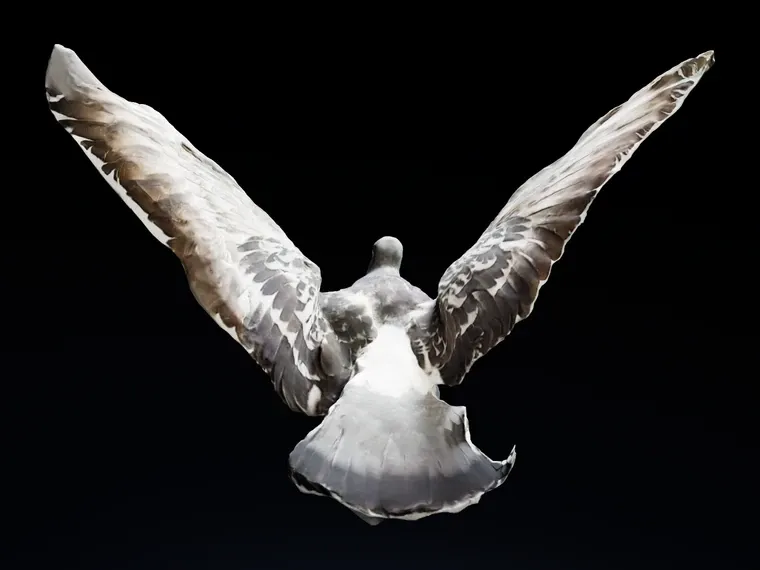
Air is too thin to hold a bird up. A pigeon must support its whole weight by throwing air downwards, all the time, and that is where most of its effort goes. On each downstroke the wings push air down and back, and the air pushes the bird up and forward. On the upstroke the wings fold and twist so they slice back up through the air with little push either way. Over a whole wingbeat the upward pushes add up to the pigeon’s weight.
How hard the wings must work depends on how much air they can reach. Flying slowly, little air passes each second, so it has to be thrown down fast, at about 1.4 m/s for this pigeon at 3 m/s. That takes a lot of power, which is why slow flight takes deep, fast wingbeats and why a pigeon can hover for only a few seconds. Fly faster and more air streams past the wings each second, so a gentler downward push holds the bird up. The wing itself is a lifting surface like an aircraft’s (see flight), but here it also provides the forward push. At high speed, though, the drag of the body grows steeply. Add the two and the power needed falls, then rises again: a U-shaped power curve.
Try it: choose Pigeon in a wind tunnel, step Show the pushes to Wake, and compare Walking pace with Town traffic. At the slow speed the rings of air plunge steeply downwards; at speed they are stretched out behind and sink only gently.
What a metre costs
Biologists compare ways of moving by the cost of transport: the food energy it takes to carry one kilogram of animal one metre. It is measured just as the Scene shows, with the animal on a treadmill, in a swim tunnel or in a wind tunnel, while the oxygen it breathes tells how much food it is burning. The chart beside the Scene plots this cost against speed for all three animals.
- Running costs the dog about the same per metre at any running speed, a little over 4 joules per kilogram, because faster running burns energy in proportion. At a jog it burns about 350 W.
- Swimming is by far the cheapest: under 1 joule per kilogram per metre at the trout’s best speed, because the water holds it up. But push a trout to 2 m/s and it pays nearly as much per metre as the dog.
- Flying is dear when slow and cheap when fast. At its best, near 19 m/s, the pigeon pays about 2.5 joules per kilogram per metre, and it covers ground far faster than the other two.
So the answer to the opening question lies in what the surroundings do for you. Water holds a fish up, so it pays only for drag. Air holds nothing up, so a bird pays to throw air down, and makes it worthwhile by flying fast. The ground holds a runner up but every stride still costs muscle work to bear the weight.
Size matters too
The three animals in the Scene are not the same size, and size changes the cost. Per kilogram, a large animal moves more cheaply than a small one: a 0.4 kg rat running would pay about 14 joules per kilogram per metre, more than three times the dog’s cost, and much more than a pigeon of the same weight flying. Compared at the same body mass, flying costs several times less than running, and swimming several times less again. Part of the reason is the square–cube law: a big animal’s longer legs take fewer, longer strides to cover the same ground, and each stride costs about the same per kilogram.
What this model leaves out
The animals here are stand-ins built from round numbers for animals of their size: a lean 25 kg dog with legs about half a metre long, a 1 kg trout 40 cm long and a 0.4 kg pigeon. The dog’s cost of running is a straight-line fit of the kind measured across many mammals, the trout’s comes from its drag and a muscle-and-tail efficiency of 20%, and the pigeon’s from the momentum of the air its wings throw down plus the drag of its body, with its flight muscles 23% efficient. Real animals differ, and real costs also depend on temperature, fitness and terrain.
The dog’s forces are smooth half-sine pushes shared 60:40 between front and hind legs, and real animals choose speeds within each gait that keep their cost low, which a straight line hides. The trout’s push is idealised as a steady forward drive with sideways slaps that cancel, and the pigeon’s as a strong downstroke and a light upstroke. The vortex rings and the tracer specks show where the water and air go, not exactly how they swirl, and the rigs ignore the walls’ own effect on the flow.
The Scene shows the animals in place, as in the lab. Out of doors, the ground and the still water or air stay put and the animal moves through them, which changes none of the forces.