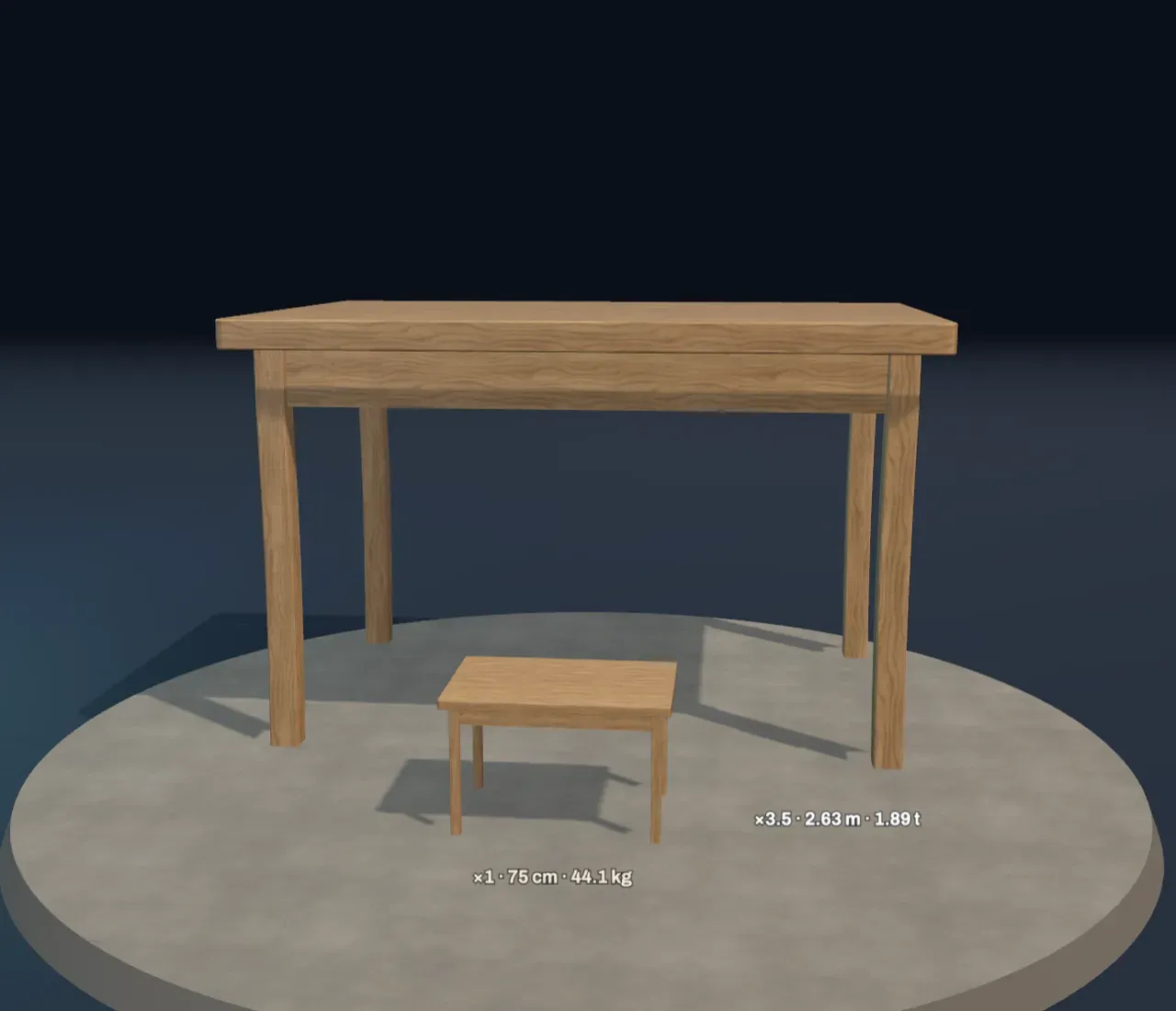
Bigger is not just bigger
A toy model of a horse can look exactly like a horse, but it is not a horse made smaller. It is far stronger for its weight. Drop it off a table and nothing happens. Drop a real horse the same distance, scaled up, and it is badly hurt. The difference has nothing to do with what either is made of. It comes from what happens to lengths, areas and volumes when something changes size while keeping its shape.
Galileo worked this out in 1638, in his last book, Two New Sciences. It opens in the shipyard of Venice, where the builders knew that a big ship needs far stronger props on the slipway than a small boat, or it may break under its own weight. Galileo explained why, and carried the argument from wooden frames to living ones. A giant built exactly like a man, only many times taller, would break its bones under its own weight, and nature could only make very big animals by giving them thicker bones or lighter bodies. He drew two bones side by side to show it: the bone of a big animal is not just longer, it is fatter for its length. The idea is now called the square–cube law. The Scene puts it on a kitchen table, which is built the way a four-legged animal is: a heavy body carried on four legs.
Lengths, areas and volumes
Take a cube 1 centimetre on a side. Its six faces have an area of 6 square centimetres and it holds 1 cubic centimetre. Now make a cube twice as big, 2 centimetres on a side. Each face is 2 × 2 = 4 times bigger, so the area is 24 square centimetres. But you can fit 2 × 2 × 2 = 8 of the small cubes inside it, so its volume is 8 cubic centimetres.
That is the whole law. When every length of a shape grows by a scale factor , its areas grow by and its volumes by . It does not matter whether the shape is a cube, a ball, a table or an animal. The table in the Scene has square legs and a slab top, which makes it easy to count.
Try it: set Size to 2 and choose Slices and cubes under Slice and count. The slice through the copy’s leg holds 4 squares of the original’s leg, and the cube from its top holds 8 of the original’s cubes.
Why the legs give way
Two things matter for a leg. The weight it carries comes from the mass of the whole table, most of it in the top, and the mass is set by the volume, so it grows as . The strength of the leg, the largest force it can bear before the wood crushes or the leg buckles, is set by the area of its cross-section, the slice you would see if you sawed it straight through. A leg twice as wide has four times the area to share the load, so strength grows as . The same holds for an animal’s leg bones.
What decides whether a leg breaks is the load on each square centimetre of it, the weight divided by the area. That is the stress, and for a copy of the same shape it grows as
Double the table and each square of its legs carries twice the load. Make it ten times bigger and each square carries ten times the load, with exactly the same oak. In the Scene the original’s legs are given a margin like an animal’s: they can hold six times its weight. That margin is not wasted. A table must carry whatever is put on it, and an animal’s legs take two or three times its weight every time it runs or lands from a jump. At a Size of 3.5, room-high, the copy still stands, but a load as heavy as itself would break its legs. At 7, house-high, its legs bow, snap, and the top comes down. Nothing about the copy has changed except its size.
How real giants cope
The way out is the one Galileo saw: change the shape. To keep the stress the same, the area of the legs must grow as fast as the weight, as , so their width must grow as , faster than the table’s length. Give the house-high copy, at Size 7, legs two and a half times as thick and it stands again, with strength to spare. That is why a banquet table or a carpenter’s bench has stout legs while a doll’s-house table has spindly ones. Among animals, it is why an elephant’s legs are pillars while a gazelle’s are sticks, and why a mouse’s bones are slender.
Thicker legs bring their own problem: they are heavier, and the extra weight needs still more wood or bone. In the Scene even the thickest legs leave the copy at its largest size unable to take a load. Real animals have other tricks as well. Large mammals stand on straighter legs, held under the body like columns, so the force goes down the bone instead of bending it. They move more carefully: an elephant never has all four feet off the ground at once. The largest land animals that ever lived, long-necked dinosaurs that may have weighed several tens of tonnes, had hollow, air-filled bones that saved weight. The largest animal of all, the blue whale, at well over 100 tonnes, lives in water, which carries its weight for it (see Floating and buoyancy).
Small things live in a different world
Run the law the other way and small things turn out to be over-built. At a Size of 0.2, toy-sized, each square of the copy’s legs carries a fifth of the original’s load. A mouse can fall a long way and walk off, and an ant can carry many times its own weight, because their strength, which goes with area, is huge compared with their weight, which goes with volume.
Other things change with size too. Heat escapes through the skin, so it goes with area, while heat is made by the body’s volume. A small animal has a lot of skin for its volume and loses heat fast: a shrew must eat nearly its own weight in food every day to stay warm. Small animals also live faster. A mouse’s heart beats about 600 times a minute and an elephant’s about 30. For an insect, the forces that act on surfaces, such as the pull of a water surface, are strong enough to trap it in a drop (see Surface tension and capillarity). And every living cell has to take in food and get rid of waste through its surface, which is one reason cells stay small (see Cells).
Engineering at every scale
Engineers meet the same law. A bridge twice as long, built in the same proportions, weighs eight times as much but its beams are only four times as strong, so big bridges and tall buildings need relatively deeper beams and stronger materials (see Structures and bridges). It is why a model in a wind tunnel or a test tank does not behave exactly like the full-sized aircraft or ship, and why the giant ants and apes of old films could never stand up, let alone walk.
What this model leaves out
The table is solid oak, taken at 700 kilograms per cubic metre, and its strength is taken to be proportional to the cross-section of its legs. That is right for crushing a leg straight down. A slender leg that buckles sideways fails at a load that also grows as the area for a copy of the same shape, but real tables more often fail at their joints. The biggest simplification is the margin. The original’s legs are given a margin of six times its weight, as an animal’s legs have, so that the copy fails within the range of the slider. A real oak table’s legs could hold several hundred times its weight, so it would have to be hundreds of times bigger before it fell under its own weight. That is the law’s other lesson: furniture and buildings are made with large margins and rarely meet it, while animals, which must be light enough to move, live much closer to the limit. Thickening the legs here does not lengthen them or move them, and when they fail they simply snap at mid-height. Finally, the two tables are redrawn at every size so that both fit in the view: the labels and the counts, not the size on the screen, show how big each one is. To see how wide the range of real sizes is, from atoms to galaxies, try the Scale of the universe.