The square–cube law: when area grows as the square and volume as the cube, the surface area to volume ratio shrinks, which is why cells are small and big animals need lungs.
Step 1 of 6 · Skin
Step 1 of 6
Skin
Everything a cell or an animal needs, oxygen, food and water, comes in through its surface: the cell membrane, the skin, the lungs, the gut wall. And whatever it uses, it uses throughout its volume. That is why the ratio between the two matters so much: surface area to volume.
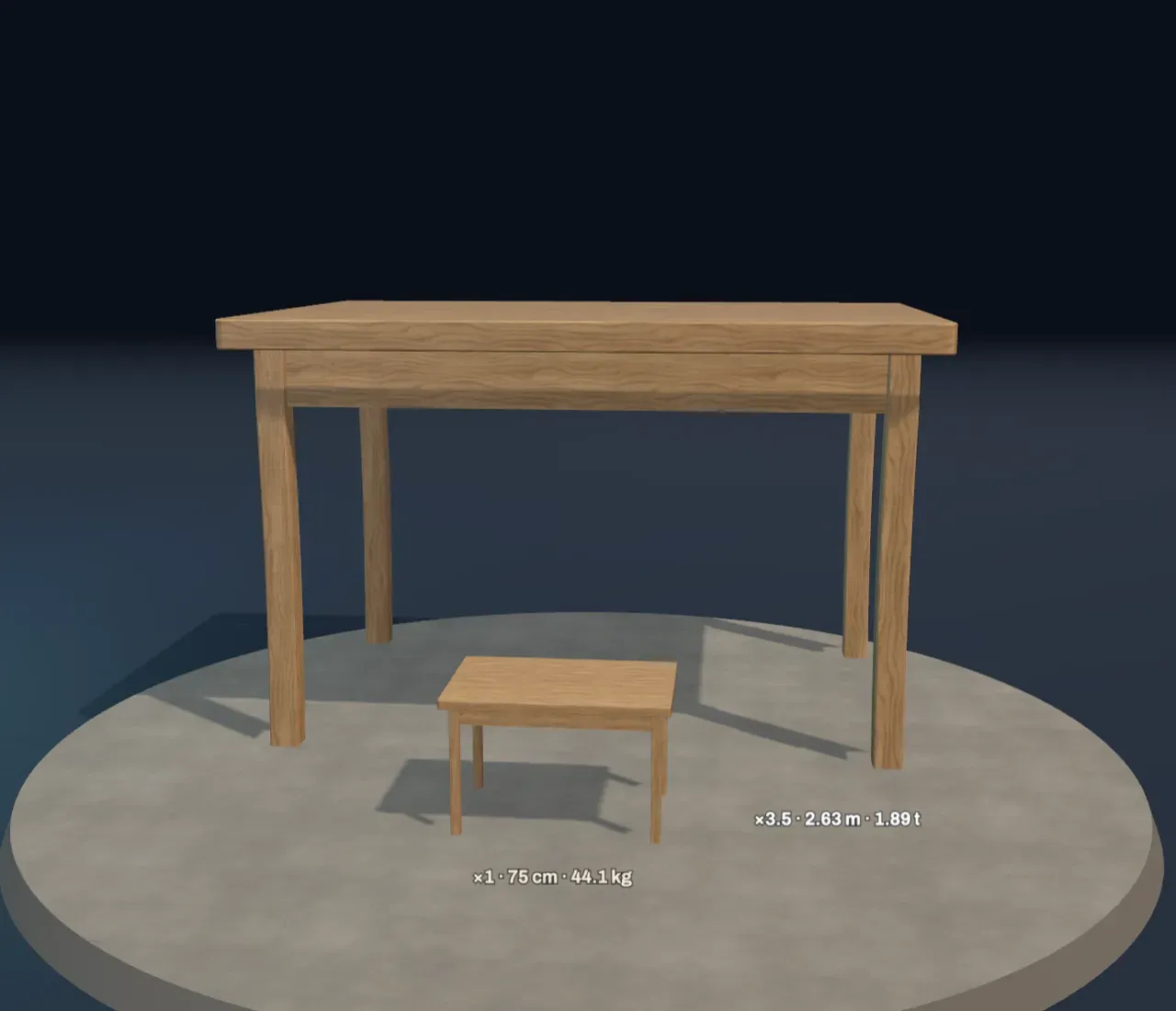
The Scene shows a solid-oak kitchen table beside a copy of it 3 times bigger in every length: height, length and width. Slice and count is on Slices and cubes: every leg is sawn through, and a cube is lifted out of each top. The copy’s leg slice is gridded in squares the size of the original’s slice.
Step 2 of 6
Body
Now look at the cubes lifted out of the tops: the copy’s cube is gridded in cubes the size of the original’s.
Step 3 of 6
The ratio
Area grows as and volume as , so volume always wins. The bigger the animal, the fewer square centimetres of skin, lung and gut it has for each cubic centimetre.
Step 4 of 6
A quarter
Size is free now, starting at the original’s size.
Step 5 of 6
Cubes
The same sum works for any shape, but it is easiest to see in a cube. A cube has six faces, each a square.
Step 6 of 6
Why cells are small
Shrink the table to toy size and the ratio grows: a lot of surface for its volume. An animal is the same: a rat has far more skin for each cubic centimetre than an elephant. And a cell is thousands of times smaller than a rat. A 10 µm cell gets enough oxygen for all its volume through its membrane by diffusion alone, and the way from its membrane to its middle is short.
Loading the interactive version…
Loading the interactive version…
Each step sets up the Scene for you, and a control marked “fixed” stays put for that step.
Practice · Calculate
The copy is 3 times the original in every length, with the same shape. How many times bigger is its surface area?
Practice · Calculate
The copy is 3 times the original in every length, with the same shape. How many times bigger is its surface area?
Practice · Calculate
And how many times bigger are the volume and weight of the copy, 3 times the size?
Practice · Calculate
And how many times bigger are the volume and weight of the copy, 3 times the size?
Practice · Calculate
Now the copy is 2 times the size. By what factor has its surface area to volume ratio changed, compared with the original?
Practice · Calculate
Now the copy is 2 times the size. By what factor has its surface area to volume ratio changed, compared with the original?
Practice · Reach the target
Change the copy’s Size until its surface area to volume ratio is a quarter of the original’s, then press Check.
Practice · Reach the target
Change the copy’s Size until its surface area to volume ratio is a quarter of the original’s, then press Check.
Practice · Calculate
A cube with 1 cm edges has a surface area of 6 cm² and a volume of 1 cm³: a ratio of . What is the surface area to volume ratio of a cube with 3 cm edges, in cm⁻¹?
Practice · Calculate
A cube with 1 cm edges has a surface area of 6 cm² and a volume of 1 cm³: a ratio of . What is the surface area to volume ratio of a cube with 3 cm edges, in cm⁻¹?
Practice · Choose
Why are most cells small, a few tens of micrometres at most?
Practice · Choose
Why are most cells small, a few tens of micrometres at most?
Lesson complete. Every practice question here is done.