Four mothers and two bets: a million cheap eggs left to chance, or a few young looked after. External and internal fertilisation, one budget shared out, and why about one or two from each brood grow up.
Step 1 of 6 · Inside or out
Step 1 of 6
Inside or out
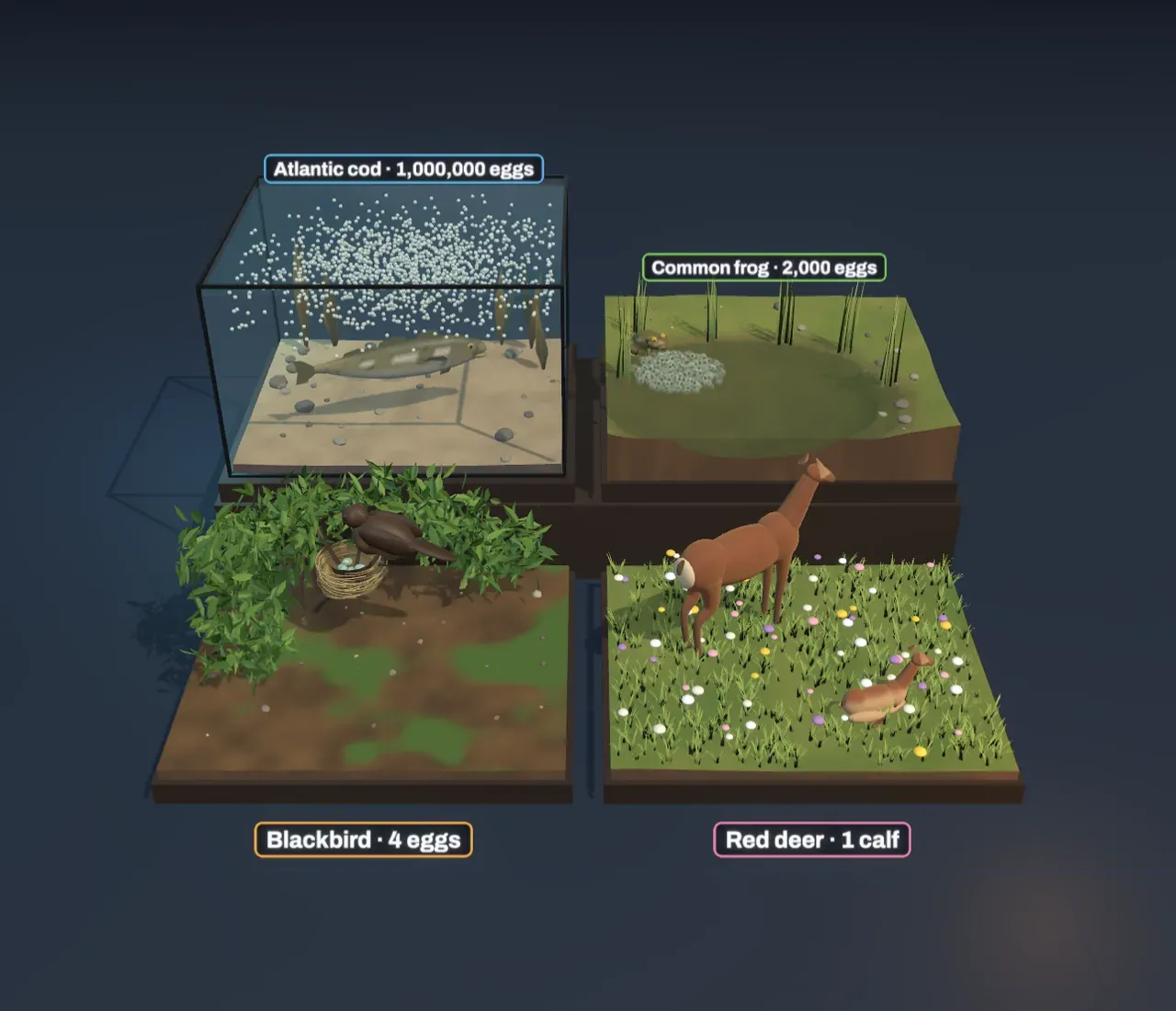
Almost all animals reproduce sexually: a male’s sperm joins a female’s egg, and the egg is fertilised. The Scene holds four mothers, each in a display case of her own: a cod, a frog, a blackbird and a red deer hind. Time is at Laid or born: a million cod eggs drift in the water, two thousand frog eggs sit in a clump of jelly, four blackbird eggs lie in a nest, and one calf lies in the grass.
In external fertilisation the female releases eggs into the water and the male releases sperm beside them. In internal fertilisation the male passes sperm into the female’s body, and the eggs are fertilised there.
Step 2 of 6
Almost all die
Larvae and tadpoles are eaten by fish, jellyfish and dragonfly larvae, starve, or drift somewhere too cold. Nests are robbed, and calves are taken. The chart beside the Scene shows each brood’s survivors on a logarithmic scale, where each line is ten times the one below, so a million and one fit in the same column.
Step 3 of 6
The first weeks
Losses are sharpest at the start, when the young are smallest, and for the cod and the frog nobody guards them. Time is locked at about days after laying. Above each case is how many young are alive.
Step 4 of 6
One budget
A mother can put only so much food into breeding each year. She can split it into many tiny portions or a few large ones. Brood size scales every brood against what the animal has in nature, but the mother’s budget stays the same, so each young gets less.
Step 5 of 6
Care makes few possible
A blackbird that laid four eggs and flew off would raise no family: the eggs would chill, and the chicks could not feed themselves. A few young succeed only when the parents put the effort saved into them: warming, guarding, feeding and nursing.
Step 6 of 6
Two strategies
r-strategists make huge numbers of small young and leave them to chance: cod, frogs, most insects. K-strategists make a few large young and look after them: elephants, whales, deer. Most animals sit somewhere between. In any population that lasts, each pair of parents leaves on average about two young that grow up and breed, to replace themselves.
Loading the interactive version…
Loading the interactive version…
Each step sets up the Scene for you, and a control marked “fixed” stays put for that step.
Practice · Choose
Which of the Scene’s four mothers have their eggs fertilised outside the body? Choose all of them.
Practice · Choose
Which of the Scene’s four mothers have their eggs fertilised outside the body? Choose all of them.
Practice · Predict, then look
The cod lays a million eggs, and the hind has one calf. Predict how many young cod from this brood are alive when Time reaches Three years on.
Practice · Predict, then look
The cod lays a million eggs, and the hind has one calf. Predict how many young cod from this brood are alive when Time reaches Three years on.
Practice · Calculate
About days after laying. Read how many young cod are still alive out of the million eggs. What percentage of the eggs is that?
Practice · Calculate
About days after laying. Read how many young cod are still alive out of the million eggs. What percentage of the eggs is that?
Practice · Predict, then look
The blackbird raises one grown young from four eggs. Predict how many grow up when Brood size rises to 2×, eight eggs from the same budget.
Practice · Predict, then look
The blackbird raises one grown young from four eggs. Predict how many grow up when Brood size rises to 2×, eight eggs from the same budget.
Practice · Predict, then look
Predict what happens to the four broods when Parental care switches to None.
Practice · Predict, then look
Predict what happens to the four broods when Parental care switches to None.
Practice · Choose
Why do whales and elephants need decades to recover from hunting, while a cod population can bounce back in a few good years?
Practice · Choose
Why do whales and elephants need decades to recover from hunting, while a cod population can bounce back in a few good years?
Lesson complete. Every practice question here is done.