Two parents, one new animal
Almost every animal makes its young by sexual reproduction. Each parent makes special cells by meiosis, a cell division that halves the DNA: the mother makes eggs, large cells packed with food, and the father makes sperm, tiny cells that can swim. When a sperm joins an egg, the egg is fertilised. The new cell, the zygote, holds one set of DNA from each parent, so every young animal is a new mix, a little different from its brothers and sisters. How that one cell becomes a body is the subject of embryonic development; this Article is about what happens around it, from the parents’ side.
A few animals can also reproduce without a partner. Aphids, some lizards and water fleas can grow young from unfertilised eggs, and sponges, corals and freshwater hydra can bud off copies of themselves. Those offspring are clones of the parent. Plants do the same with runners and cuttings, alongside their own sexual reproduction with flowers and seeds.
Outside or inside the mother
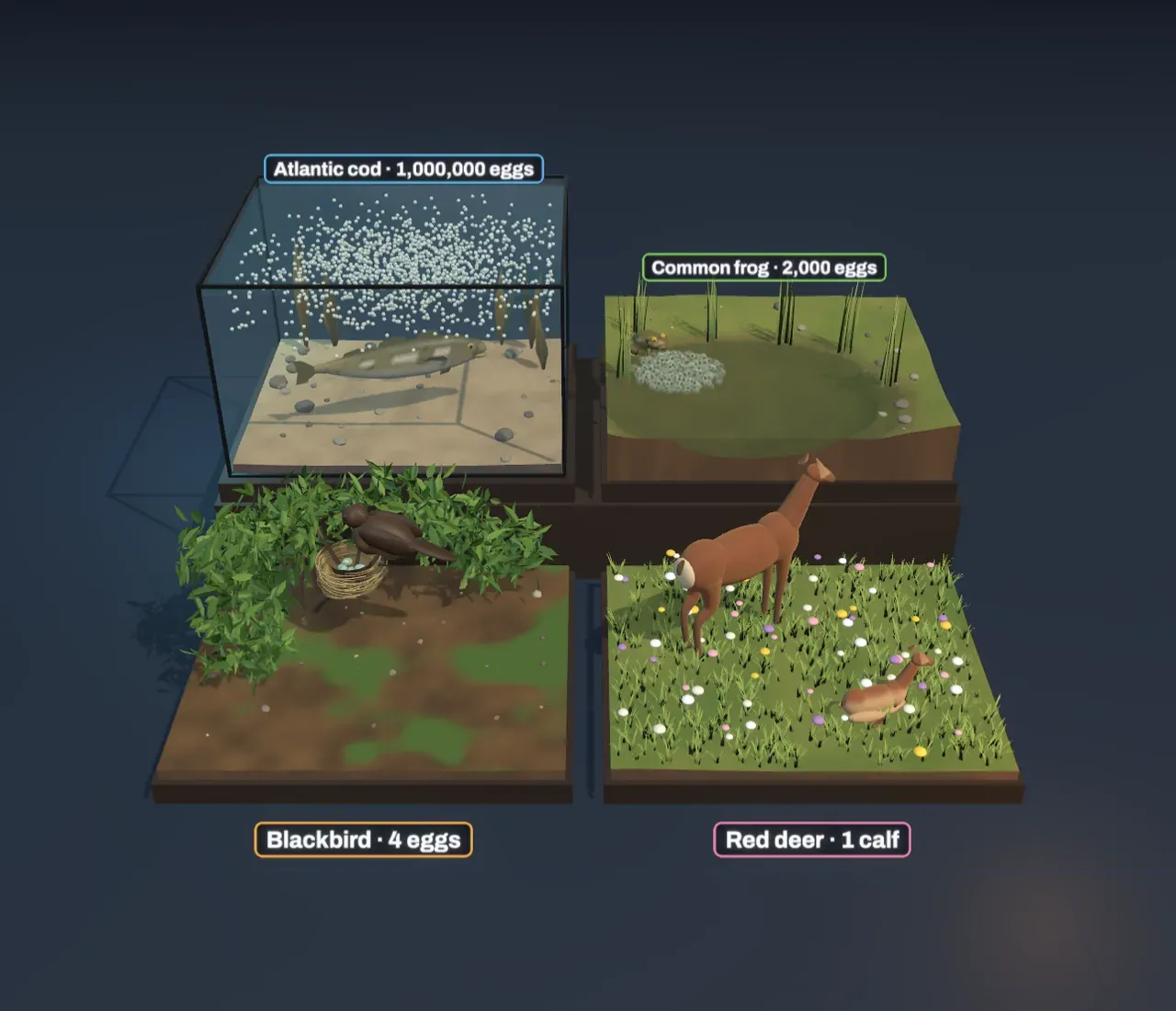
The four animals in the Scene bring sperm and egg together in two different ways.
The cod and the frog use external fertilisation. They breed in water, and the female releases her eggs while the male releases sperm right beside them. The sperm swim the short distance through the water to the eggs. Fertilisation like this needs water, so the eggs are not wasted drying out, and it needs many eggs, since plenty are lost before or after a sperm finds them. Most fish, frogs and toads, and many sea animals such as sea urchins and corals, breed this way.
Birds and mammals use internal fertilisation: the male places sperm inside the female’s body, and the eggs are fertilised there. It works on land, and almost every egg can be fertilised, so the mother can afford to make fewer, bigger eggs. Insects, spiders, reptiles, sharks and some other fish do it too.
What comes next differs again. The blackbird lays eggs that develop outside her body, each one with a large yolk to feed the chick and a hard shell that keeps it from drying out while she sits on it to keep it warm. The red deer, like almost all mammals, gives live birth: the calf grows inside its mother for about eight months, fed through the placenta, and is born able to stand within an hour. Some animals mix the two: many sharks, snakes and lizards keep their eggs inside the body until they hatch and give birth to live young.
Try it: at Laid or born, look at what each mother leaves. The cod’s million eggs drift in open water, the frog’s two thousand sit in a clump of jelly, the blackbird’s four lie in a nest, and the deer’s one calf lies in the grass beside her.
One budget, shared out
A mother can only put so much food into reproduction each year. She can split it into many tiny portions or a few large ones, and that choice shapes everything else.
A cod egg is about 1.5 mm across, with just enough yolk to make a larva a few millimetres long that must start catching plankton within days. A frog’s egg is a little bigger, inside a ball of jelly that swells in the water, and the tadpole feeds itself from the moment it leaves. A blackbird’s egg weighs about 7 g, close to a tenth of the mother, and after it hatches both parents bring food to the nest from dawn to dusk for weeks. The red deer calf weighs about 7 kg at birth and then drinks its mother’s milk for most of a year. One mother makes a million cheap young; another makes one expensive one.
The Scene follows that rule. Brood size scales every brood from what the animal really has; the mother’s budget stays the same, so each young gets less. The cod’s eggs get smaller and the larvae weaker, more blackbird chicks share the same number of caterpillars, and twin calves share one mother’s milk.
Try it: slide Brood size up to 2× and slide Time to Three years on. The cod and the frog start with twice as many eggs and end with about as many grown young as before. The blackbird’s eight chicks are each fed half as much, and none grows up. Now try 0.5×.
Almost all of them die
Slide Time and watch the counts fall. Nearly a million of the cod’s eggs and larvae are eaten by fish, jellyfish and comb jellies, starve when there is too little plankton at the right moment, or drift somewhere too cold. Tadpoles are eaten by dragonfly larvae, newts, fish and birds, and the froglets that leave the pond are eaten on land. Blackbird nests are raided by magpies, crows, squirrels and cats, and young deer are taken by foxes, eagles and, where they live, wolves and lynx, or die in a hard winter.
The losses are steepest at the start, while the young are smallest. For the cod and the frog, that is also when nobody guards them, so their counts plunge in the first few weeks. Young that are cared for lose far fewer early on, then face the same dangers once they are on their own. The chart beside the Scene shows these as curves on a log scale, where every line up is ten times the one below, so that a million and one fit on the same page.
At the end, each brood has left about one or two grown young. That is not a coincidence. A mother and a father, over their whole lives, need to leave on average two young that grow up and breed to replace them. If they leave more, the population grows; if fewer, it shrinks. A population that has lasted for a long time is one in which, on average, almost exactly that many of the young survive, whether they started as a million eggs or a single calf.
Try it: slide Time slowly from Laid or born and watch the chart. By two months, the cod has lost all but a few hundred of its million eggs; the blackbird still has two of its four, and the calf is still alive.
Care makes few young possible
A blackbird could not raise a family by laying four eggs and flying off. The eggs would chill and never hatch, and chicks that did hatch could not feed themselves. Few young can work only when parents put the saved effort into looking after them: keeping eggs warm, guarding the nest, carrying food, nursing. In mammals, care starts before birth, when the young grows safely inside the mother.
Try it: under Parental care, press None, then slide Time. The blackbird’s eggs go cold and the calf has no milk, so none of them survive. The cod and the frog are not affected at all: they never cared for their eggs.
The extra care is costly, and it limits how many young a parent can raise. A blackbird pair can feed about four chicks at a time; with eight, each gets too little and more starve, so laying more eggs would not leave more young. This is why many birds lay about the number of eggs they can raise, and lay fewer in years with little food.
Two strategies, many shades between
Ecologists once sorted animals into two kinds. r-strategists, named after the rate at which a population can grow, make huge numbers of small young and leave them to chance: cod, frogs, oysters, most insects. K-strategists, named after the carrying capacity of their surroundings, make a few large young and care for them: elephants, whales, great apes, albatrosses, deer. Most animals sit somewhere in between, and biologists now treat it as a range of trade-offs rather than two boxes.
Each end fits a different kind of life. Many cheap young suit places where food and danger change a lot and unpredictably. In most years nearly all of them die, but in a good year far more than usual survive, so a cod population can swing hugely from one year to the next, and frogs can fill a new pond quickly. A few cared-for young suit crowded, stable places where every individual competes with others of its kind, and a large, well-fed young has the best chance. Those populations change slowly, which is also why large, slow-breeding animals such as whales and elephants take decades to recover when people hunt them.
Natural selection settles where each species lands. Parents whose way of splitting their budget leaves more grown young pass on more of their genes, so over many generations each species comes to make about the number of young that raises the most to adulthood where it lives. How those young then rise and fall with their predators and food is the subject of ecosystems and population dynamics.
What this model leaves out
The Scene follows one brood from each mother, but real cod spawn for many seasons, blackbirds can raise two or three broods a year, and a hind may have a calf every year for over ten years. Over a lifetime, each mother has many more young than one brood, and a steady population needs only about two of all of them to grow up and breed.
The survival numbers are round values chosen to show the pattern, not measurements. Real survival changes a great deal from year to year and place to place, which matters most for the cod and the frog. The model lets every brood lose the same share of its young each day within a stage, while real losses come in bursts, such as a frost, a storm or a predator finding the nest. It treats the mother’s budget as fixed and a bigger brood as sharing it equally; real mothers can make more eggs when they are bigger or better fed, and big broods sometimes produce a few strong young rather than many weak ones.
Each case is drawn at its own scale, and the cod’s eggs and larvae, which would be hard to see at their real size, are drawn about ten times too big. Large numbers are drawn on a log scale, so the tank does not show a million eggs. The deer’s clock starts at birth, so its eight months in the womb are not shown, and the model leaves out the fathers, who in blackbirds help to feed the chicks.