Monomers and polymers: starch from glucose, protein from amino acids and DNA from nucleotides, how many bonds hold a chain, and why a protein folds into its own shape.
Step 1 of 4 · Units and chains
Step 1 of 4
Units and chains
Three of the four groups of the molecules of life are built the same way: small units, monomers, joined one to the next into a long chain, a polymer. Think of beads on a string. The same beads in a different order or a different length give a different chain.
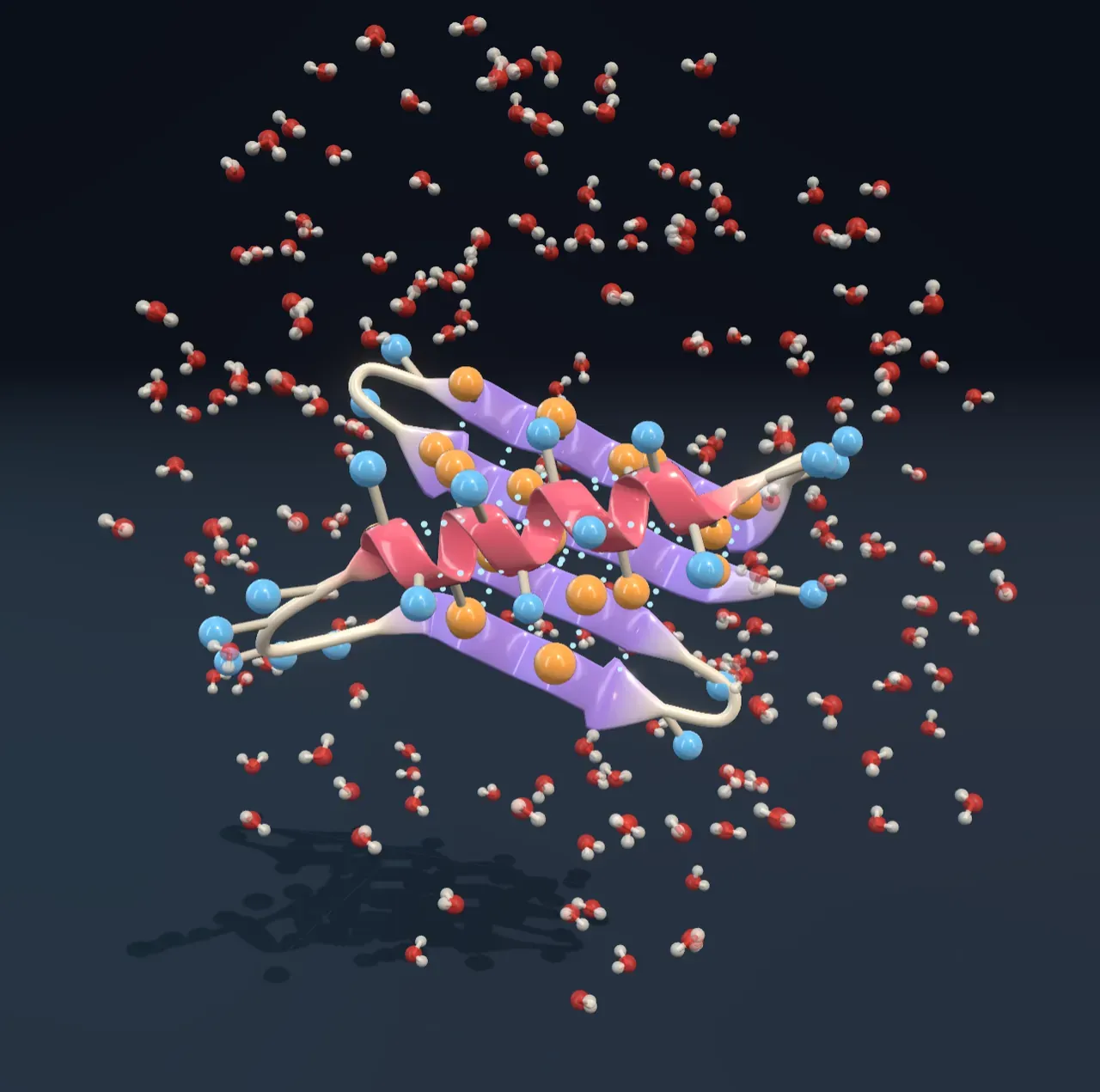
The Scene shows a small protein, folded, in water. The lavender and coral ribbon is the backbone of the chain, and the side chains stick out of it, each with a bead on its end.
Step 2 of 4
Bonds in a chain
The protein is built from 56 amino acids. The body uses 20 kinds of them, all built the same way: the same backbone piece, carrying a different side chain. Two amino acids join by a peptide bond, and each such bond releases one molecule of water. A joining that gives off water is called a condensation reaction. The reverse, in digestion, uses up water, and is called hydrolysis.
Let it fold is time here: it has taken the chain back to the start of its journey, fresh and loose, as it leaves the ribosome.
Step 3 of 4
Three chains
Nucleic acids are built from nucleotides. Each nucleotide holds a sugar, a phosphate and one of four bases, and in the chain they join, like amino acids, by condensation. Fats are the exception: they are not chains of repeating units, but middle-sized molecules, such as glycerol with three fatty acids attached.
Step 4 of 4
Oil and water
Every protein folds into one shape, always the same shape, and that shape is what lets it do its job. What decides it? Only the order of the amino acids in the chain. Some side chains are oily, and water pushes them away. Others like water.
Let it fold is locked; your prediction will open it.
Loading the interactive version…
Loading the interactive version…
Each step sets up the Scene for you, and a control marked “fixed” stays put for that step.
Practice · Choose
Starch, in potatoes and rice, is a long chain. What units is it built from?
Practice · Choose
Starch, in potatoes and rice, is a long chain. What units is it built from?
Practice · Calculate
The protein in the Scene is a chain of 56 amino acids. How many peptide bonds join them?
Practice · Calculate
The protein in the Scene is a chain of 56 amino acids. How many peptide bonds join them?
Practice · Choose
For each of these chains, what unit is it built from? Choose the correct pair.
Practice · Choose
For each of these chains, what unit is it built from? Choose the correct pair.
Practice · Predict, then look
The chain is fresh and loose. Its side chains are of two kinds: oily (amber), which water pushes away, and water-loving (blue). When it folds in water, where will the oily ones end up?
Practice · Predict, then look
The chain is fresh and loose. Its side chains are of two kinds: oily (amber), which water pushes away, and water-loving (blue). When it folds in water, where will the oily ones end up?
Lesson complete. Every practice question here is done.