Pressure, temperature and a catalyst in the Haber process, which makes the ammonia for fertilisers: why squeeze, why not cool all the way, and what the catalyst does not do.
Step 1 of 5 · Squeezing
Step 1 of 5
Squeezing
In a reaction between gases, pressure is one more condition you can change. Squeeze the gas into a smaller volume and the concentration of every gas rises, and Le Chatelier’s principle says the mix will shift to the side that lowers the pressure: the side with fewer gas molecules. In that is the side.
You cannot squeeze the flask, but you can seal in a denser gas: NO₂ sealed in. Temperature is fixed.
Step 2 of 5
A quarter
It works the other way too: a thin gas, like a gas at low pressure, shifts to the side with more molecules.
Step 3 of 5
The Haber process
Early in the 20th century Fritz Haber and Carl Bosch found a way to bind the nitrogen of the air to hydrogen and make ammonia, . Most of the world’s fertiliser is made from it, and about half the nitrogen in each of our bodies has passed through such a plant.
The questions from here on are about the Haber process, not the flask. Use the same rules.
Step 4 of 5
A compromise
A plant asks not only how much product there is at equilibrium, but also how long it takes to get there.
Step 5 of 5
The catalyst
The Haber reactor holds iron, as a catalyst. In the Lesson on catalysts you saw what a catalyst does to the hump on the energy profile.
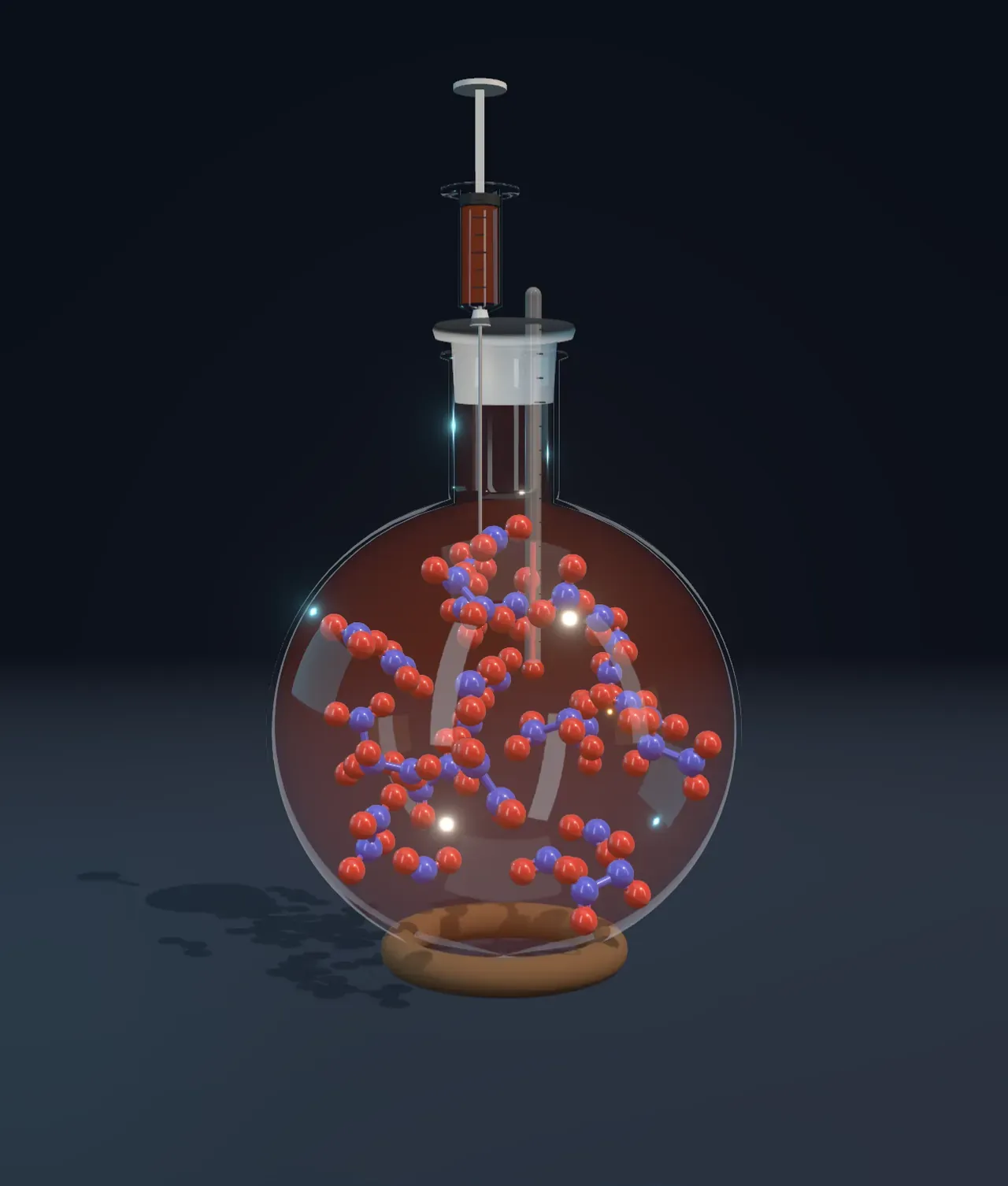
Loading the interactive version…
Loading the interactive version…
Each step sets up the Scene for you, and a control marked “fixed” stays put for that step.
Practice · Predict, then look
The flask holds 20 mmol/L, and about of the nitrogen is in . What will happen to that share when you seal in gas four times as dense, 80 mmol/L, at the same temperature?
Practice · Predict, then look
The flask holds 20 mmol/L, and about of the nitrogen is in . What will happen to that share when you seal in gas four times as dense, 80 mmol/L, at the same temperature?
Practice · Reach the target
Change NO₂ sealed in so that at equilibrium a quarter of the nitrogen, , is in , then press Check.
Practice · Reach the target
Change NO₂ sealed in so that at equilibrium a quarter of the nitrogen, , is in , then press Check.
Practice · Choose
Ammonia, the raw material of most fertilisers, is made by the Haber process: , . Under which conditions is there the most ammonia at equilibrium?
Practice · Choose
Ammonia, the raw material of most fertilisers, is made by the Haber process: , . Under which conditions is there the most ammonia at equilibrium?
Practice · Choose
If cooling gives more ammonia, why do plants run the Haber process at about 450 °C and not at room temperature?
Practice · Choose
If cooling gives more ammonia, why do plants run the Haber process at about 450 °C and not at room temperature?
Practice · Choose
What does the iron catalyst in the Haber process do to the amount of ammonia at equilibrium?
Practice · Choose
What does the iron catalyst in the Haber process do to the amount of ammonia at equilibrium?
Lesson complete. Every practice question here is done.