A reaction that runs both ways
Nitrogen dioxide, NO₂, is a brown gas: it is the colour of the haze over a city on a smoggy day. Two of its molecules can join into one molecule of dinitrogen tetroxide, N₂O₄, which is colourless. That N₂O₄ can just as easily break apart into two NO₂ again. Chemists write the pair of reactions with a double arrow:
2NO₂ ⇌ N₂O₄
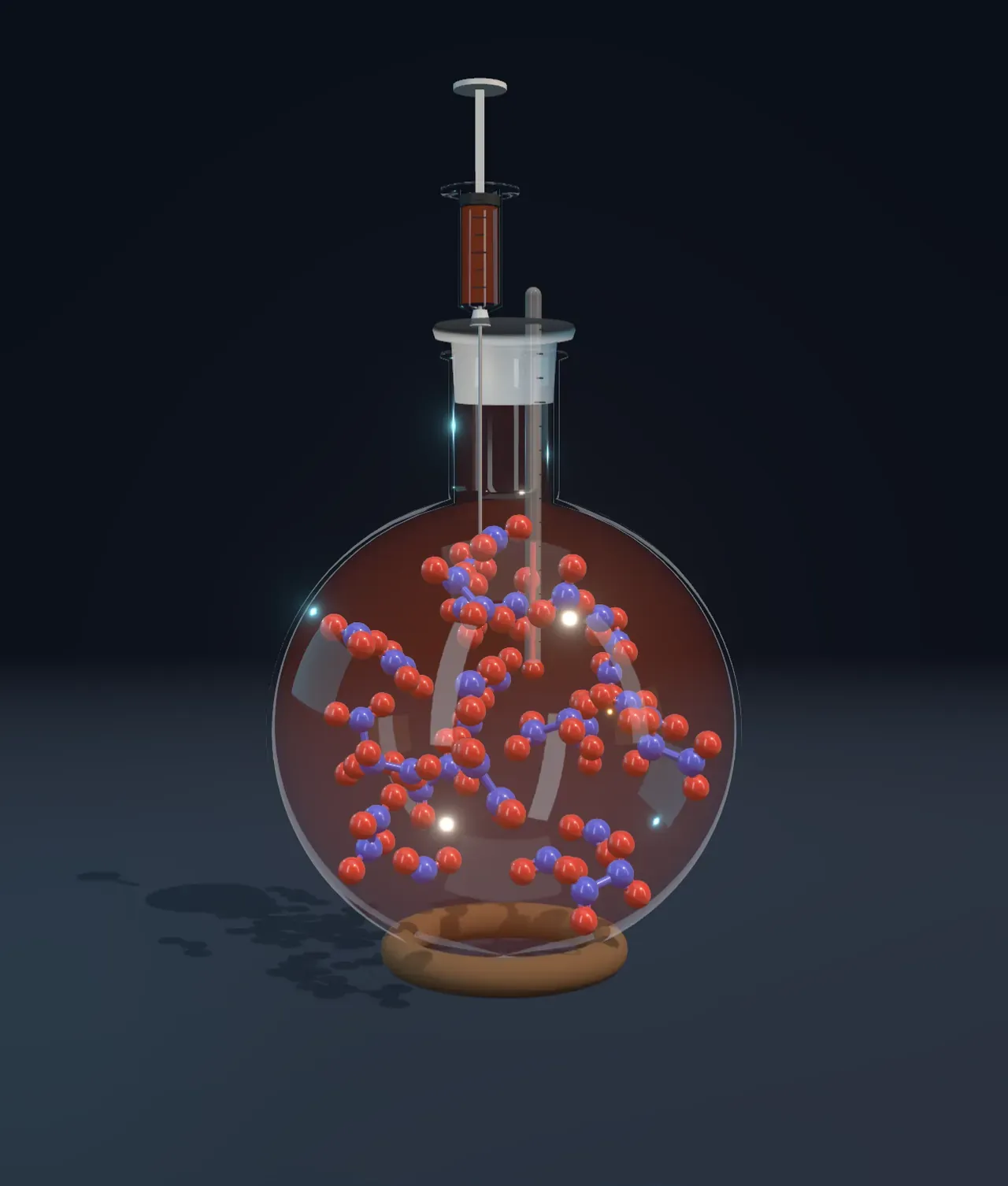
Seal some NO₂ in a flask and it starts to pair up, so the brown fades. But it never fades completely. After a short while the colour stops changing, even though nothing has run out. The flask has reached equilibrium.
Two rates that meet
Watch the left card as you move the Time slider, which runs time forward, from Start, the moment the flask is sealed. At first the flask holds only NO₂, so pairing (the forward reaction) is fast and splitting (the back reaction) cannot happen at all: there is no N₂O₄ to split. Pairing needs two NO₂ molecules to meet, so as NO₂ is used up it slows down. Splitting needs only one N₂O₄, so as N₂O₄ builds up it speeds up.
The two rates move towards each other until they are equal. From then on, every second, as many pairs form as split, and the amounts stop changing. Nothing has stopped: look at the molecules in the flask, where an amber flash marks a pair joining and a blue flash a molecule splitting. This is why chemists call it a dynamic equilibrium.
Try it: slide Time to Start, then slowly towards Settled. On the right card, brown NO₂ falls and blue N₂O₄ rises until both lines go flat at the same moment the two rates on the left meet.
The equilibrium constant
At equilibrium the amounts always fit one rule. Divide the concentration of N₂O₄ by the square of the concentration of NO₂ and, at a given temperature, you get the same number, the equilibrium constant K, however much gas you started with. The square is there because the forward reaction needs two NO₂ molecules.
At 25 °C, K is about 170 litres per mole. The card shows this ratio as it changes, labelled Q, and you can watch Q climb from zero until it reaches K. Change NO₂ sealed in and the amounts at equilibrium change, but Q still settles on the same K.
Le Chatelier’s principle
Switch on Push in more NO₂ and a syringe pushes extra NO₂ into the settled flask. Time now runs from the push: slide it back to Start and forward again. The forward rate jumps, because pairing depends on how often NO₂ molecules meet, and for a while it outruns splitting. Some of the extra NO₂ pairs up until the two rates match again. The flask ends up browner than it was before the push, but paler than straight after it.
That pattern was noticed by the French chemist Henry Le Chatelier in 1884. Le Chatelier’s principle says that when you disturb a system at equilibrium, it shifts in the direction that partly undoes the disturbance. Add NO₂ and some of it is used up.
Temperature works the same way. Pairing gives out heat, about 57 kilojoules for every mole of N₂O₄ formed, so splitting takes heat in. Warm the flask and the balance moves towards the side that absorbs heat: more N₂O₄ splits and the gas turns dark brown. Cool it and the balance moves towards N₂O₄, and the flask goes pale. Unlike adding gas, this changes K itself: about 1,300 litres per mole in ice water and only about 2 in boiling water.
Try it: choose Ice water, then Boiling water, and watch the colour of the flask. Then slide NO₂ sealed in from 20 to 80 mmol/L: with more gas a larger share of it is paired.
Equilibrium everywhere
Many reactions are reversible. Industrial chemists use Le Chatelier’s principle to get more of what they want. In the Haber process, which makes ammonia for fertiliser from nitrogen and hydrogen, high pressure pushes the balance towards ammonia, and the ammonia is cooled out of the gas so that more forms. Your blood holds a balance between dissolved carbon dioxide and carbonic acid that keeps its acidity steady, and haemoglobin picks up oxygen in the lungs and lets it go in the muscles because the balance shifts with how much oxygen is around.
A catalyst does not move an equilibrium. It speeds up the forward and back reactions by the same factor, so the mixture gets to the same balance sooner.
What this model leaves out
The flask contains a few dozen molecules standing in for trillions, and the time axis is stretched so that the mixture settles while you watch; the real gases settle in a tiny fraction of a second. The equilibrium constant comes from measured values of the heat and entropy of the reaction, treated as fixed across the temperature range, and the gases are treated as ideal. Real NO₂ also takes part in other reactions with air and water that a sealed, dry flask avoids. The molecules here fly straight between the walls without bumping into each other, and the swaps that keep happening at equilibrium are drawn at an illustrative pace.