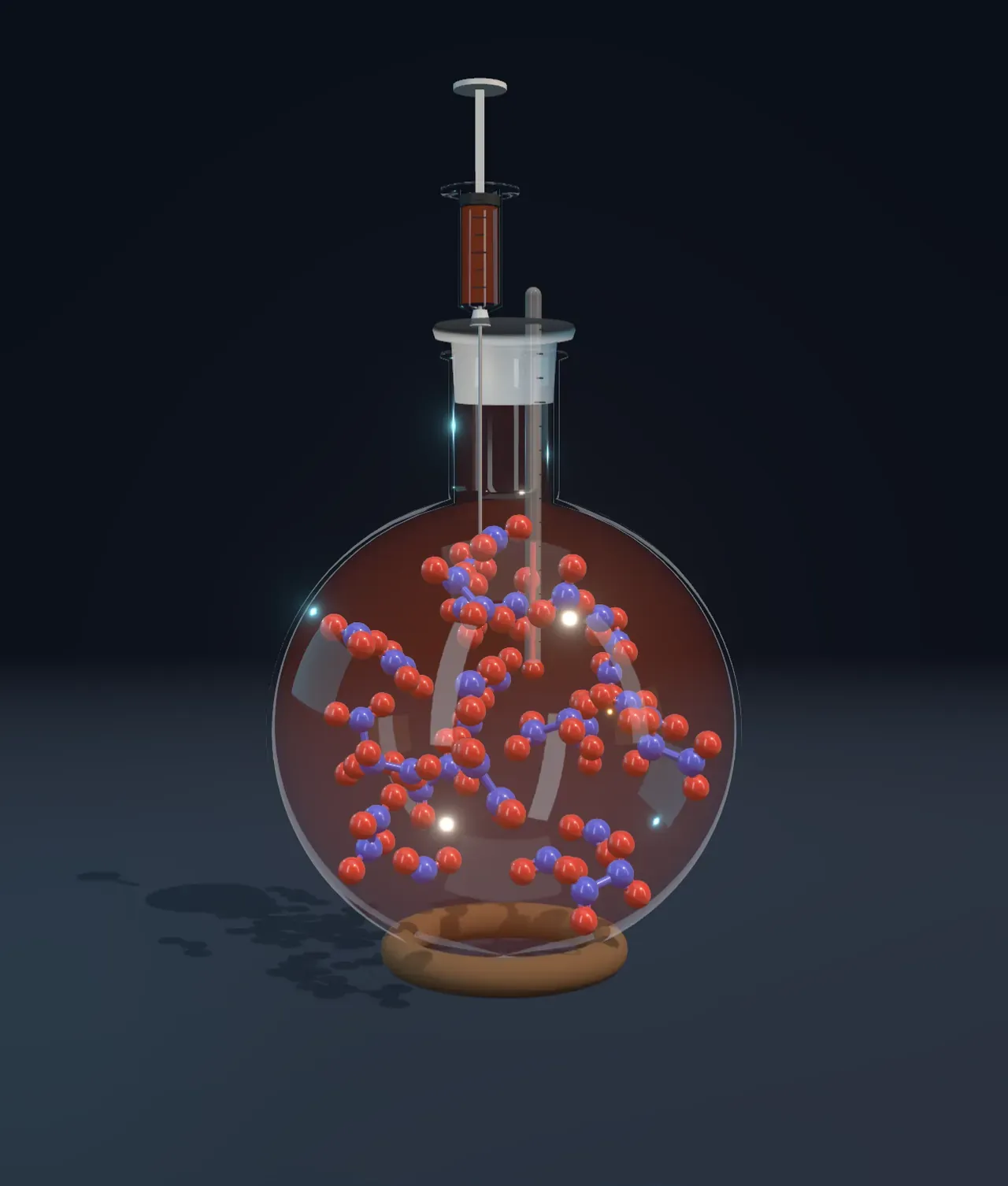
A reaction that runs both ways and never reaches an end: a brown gas that pairs up and splits back, until the mixture stops changing.
Step 1 of 5 · Both ways
Step 1 of 5
Both ways
Until now every reaction ran forwards until one reactant was used up. But some reactions make a product that can break back down to the reactants. Such a reaction is called reversible, and its equation has a double arrow, .
The flask holds nitrogen dioxide, : a brown, poisonous gas that engines make and that gives city smog its colour. Two molecules can join into one molecule of , which is colourless, and that can split again:
Step 2 of 5
Watching the colour
The flask’s colour shows how much it holds: the more of the nitrogen is in , the paler the flask. Time runs from Start, the moment the flask is sealed. The charts beside the Scene draw the rates and the concentrations over time.
Step 3 of 5
Counting the nitrogen
Nitrogen is neither lost nor made: it only moves between and . So at every moment equals what was sealed in. Square brackets mean a concentration, in mol/L or mmol/L.
Step 4 of 5
More in, more out
NO₂ sealed in sets how much gas the flask holds. Time is now fixed at equilibrium.
Step 5 of 5
From the other side
You can reach equilibrium from the products’ side too.
Loading the interactive version…
Loading the interactive version…
Each step sets up the Scene for you, and a control marked “fixed” stays put for that step.
Practice · Choose
You seal brown gas in a flask. molecules pair up into , a colourless gas, and each pair can also split back: . What will the flask hold after an hour?
Practice · Choose
You seal brown gas in a flask. molecules pair up into , a colourless gas, and each pair can also split back: . What will the flask hold after an hour?
Practice · Predict, then look
Time is at Start, just sealed: the flask is all brown. What will happen to the colour as time runs on?
Practice · Predict, then look
Time is at Start, just sealed: the flask is all brown. What will happen to the colour as time runs on?
Practice · Calculate
You sealed in 40 mmol/L of . At equilibrium the chart shows about 15.2 mmol/L of . How much is left?
Practice · Calculate
You sealed in 40 mmol/L of . At equilibrium the chart shows about 15.2 mmol/L of . How much is left?
Practice · Reach the target
Change NO₂ sealed in so that at equilibrium the flask holds 24 mmol/L of , then press Check.
Practice · Reach the target
Change NO₂ sealed in so that at equilibrium the flask holds 24 mmol/L of , then press Check.
Practice · Choose
Instead of 40 mmol/L of you seal in, at the same temperature, 20 mmol/L of pure : the same nitrogen. What will the flask hold at equilibrium?
Practice · Choose
Instead of 40 mmol/L of you seal in, at the same temperature, 20 mmol/L of pure : the same nitrogen. What will the flask hold at equilibrium?
Lesson complete. Every practice question here is done.