Two rates that meet: why nothing changes though the molecules never stop, what is equal at equilibrium and what is not, and the equilibrium constant K.
Step 1 of 5 · Two rates
Step 1 of 5
Two rates
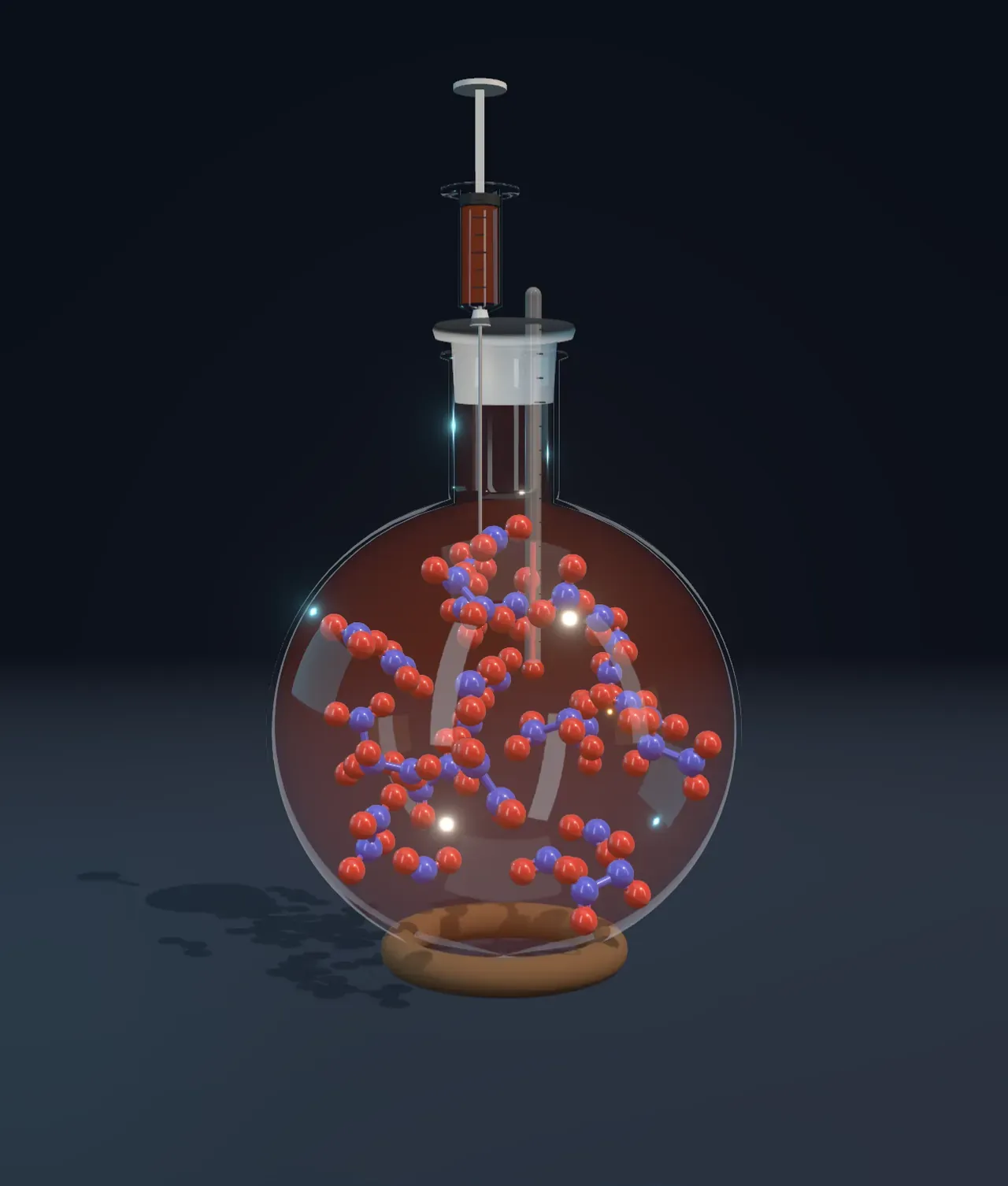
Two reactions run in the flask at once: pairing, , and splitting, . Each has its own rate. By collision theory, the pairing rate goes as , because each pairing needs two molecules to meet, and the splitting rate goes as .
In the top chart beside the Scene the orange line is pairing and the blue line is splitting.
Step 2 of 5
The molecules never stop
When the rates are equal, each second exactly as many pairs form as split, so no concentration changes. That state is called dynamic equilibrium: “equilibrium” because nothing changes, and “dynamic” because everything keeps moving.
Step 3 of 5
What is equal
The word “equilibrium” sometimes misleads: it sounds as if something in the flask were split half and half. Compare the two charts beside the Scene, and see exactly what meets and what only stops changing.
Step 4 of 5
The equilibrium constant
At equilibrium , so the ratio
is a fixed number that depends only on the temperature: the equilibrium constant. In the expression the products go on top and the reactants underneath, each concentration to the power of its coefficient in the equation. Here Temperature is fixed at 348 K, 75 °C.
Step 5 of 5
Which way the mix moves
You can work out the same expression at any moment, even before equilibrium. Then it is called the reaction quotient, . The line under the bottom chart compares with . Here Time is fixed at an early moment, before the flask has settled.
Loading the interactive version…
Loading the interactive version…
Each step sets up the Scene for you, and a control marked “fixed” stays put for that step.
Practice · Predict, then look
Just after sealing, pairing is 28 times faster than splitting. What will happen to the two rates as time runs on?
Practice · Predict, then look
Just after sealing, pairing is 28 times faster than splitting. What will happen to the two rates as time runs on?
Practice · Choose
The flask is at equilibrium, and its colour no longer changes. What are the molecules doing?
Practice · Choose
The flask is at equilibrium, and its colour no longer changes. What are the molecules doing?
Practice · Choose
What is equal at equilibrium?
Practice · Choose
What is equal at equilibrium?
Practice · Calculate
At 348 K the flask has settled at and , in mol/L. Work out the equilibrium constant, , in L/mol, then compare with the line under the chart.
Practice · Calculate
At 348 K the flask has settled at and , in mol/L. Work out the equilibrium constant, , in L/mol, then compare with the line under the chart.
Practice · Choose
Shortly after sealing, the line under the chart shows and . Which way will the mix move?
Practice · Choose
Shortly after sealing, the line under the chart shows and . Which way will the mix move?
Lesson complete. Every practice question here is done.