What happens when you disturb an equilibrium: add a reactant, heat it or cool it. The system shifts to reduce the disturbance, and only temperature changes K.
Step 1 of 5 · Adding a reactant
Step 1 of 5
Adding a reactant
In 1884 the French chemist Henri Le Chatelier stated a rule that predicts what an equilibrium will do when you disturb it: a system at equilibrium whose conditions change shifts in the direction that reduces the change.
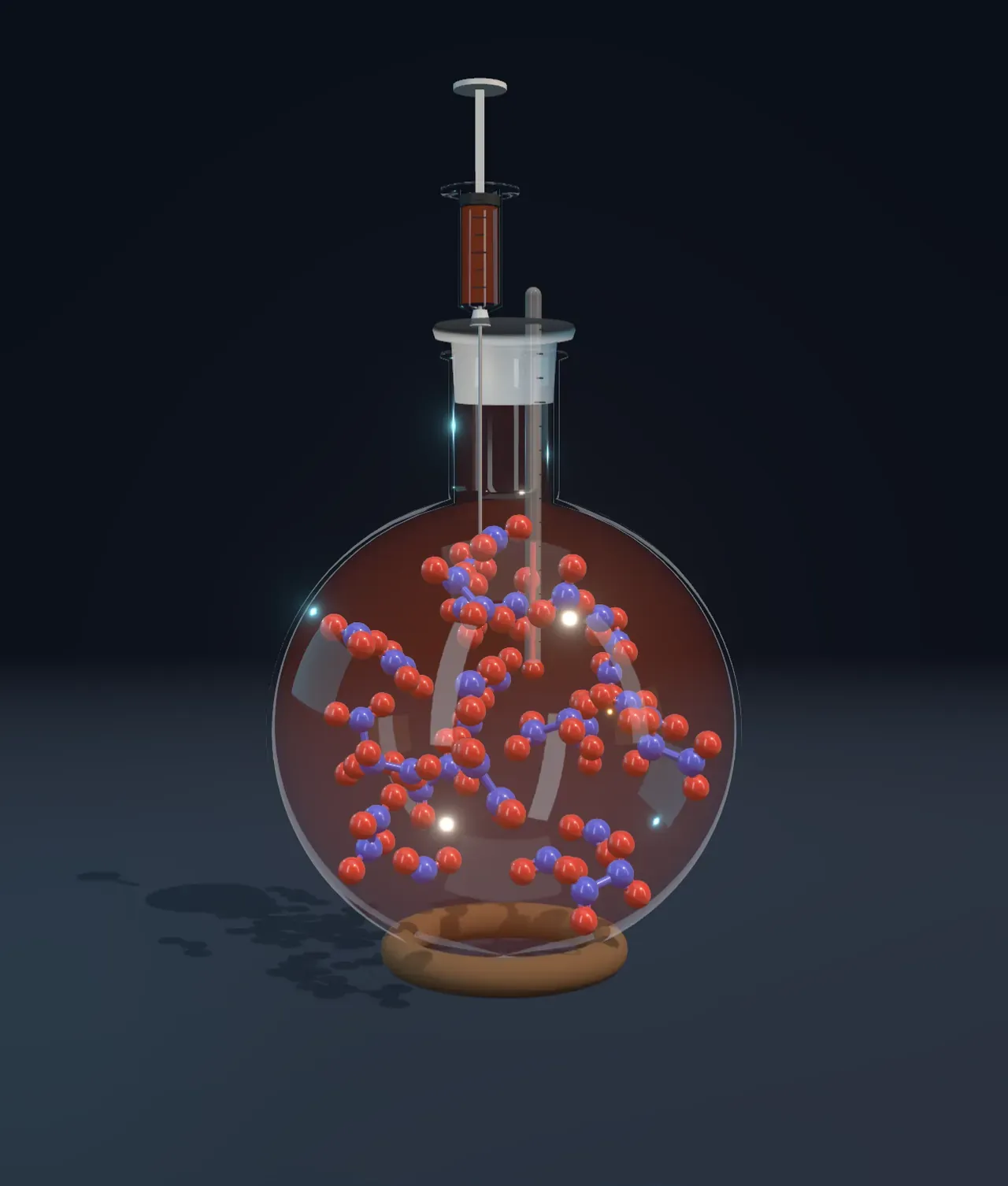
In the Scene, the Push in more NO₂ switch works a syringe that pushes more into the settled flask: half as much again as was sealed in at the start. Time now stands at the equilibrium before the push. Predict, then watch the syringe push it in.
Step 2 of 5
The same constant
After the push the flask settles at a new equilibrium. The concentrations differ from before the push. Does the constant?
Step 3 of 5
The moment of the push
Why does the mix move towards in particular? The answer is in the rates. Push in more NO₂ is on, and Time is fixed at Start: exactly the moment of the push.
Step 4 of 5
Heating it
Pairing gives out heat, so splitting takes heat in. When you heat, the “change” is heat coming in, and Le Chatelier’s principle says which way the system will shift. Here Time is fixed at equilibrium.
Step 5 of 5
Half and half
Temperature is the one change that moves itself: heating lowers the of a reaction that gives out heat, and cooling raises it. That makes this flask a thermometer: its colour at equilibrium tells the temperature.
Loading the interactive version…
Loading the interactive version…
Each step sets up the Scene for you, and a control marked “fixed” stays put for that step.
Practice · Predict, then look
The flask is at equilibrium, with 9.5 mmol/L of . A syringe pushes in more , and jumps to 29.5 mmol/L. What will happen next?
Practice · Predict, then look
The flask is at equilibrium, with 9.5 mmol/L of . A syringe pushes in more , and jumps to 29.5 mmol/L. What will happen next?
Practice · Choose
After the push the flask has settled at a new equilibrium, with more and more . What happened to the equilibrium constant, ?
Practice · Choose
After the push the flask has settled at a new equilibrium, with more and more . What happened to the equilibrium constant, ?
Practice · Choose
Push in more NO₂ is on and Time is at Start: the moment of the push. Which rate jumped, by the rates chart?
Practice · Choose
Push in more NO₂ is on and Time is at Start: the moment of the push. Which rate jumped, by the rates chart?
Practice · Predict, then look
Pairing, , gives out 57 kJ/mol, and splitting takes it in. What will happen to the colour at equilibrium when you heat the flask from 298 K to 348 K?
Practice · Predict, then look
Pairing, , gives out 57 kJ/mol, and splitting takes it in. What will happen to the colour at equilibrium when you heat the flask from 298 K to 348 K?
Practice · Reach the target
Change Temperature so that at equilibrium exactly half the nitrogen is in and half in , then press Check.
Practice · Reach the target
Change Temperature so that at equilibrium exactly half the nitrogen is in and half in , then press Check.
Lesson complete. Every practice question here is done.