A family of compounds, each one CH₂ longer than the last: how the molar mass climbs in equal steps, why the boiling point climbs too, and which alkane is the first to be liquid at room temperature.
Step 1 of 5 · A series
Step 1 of 5
A series
The alkanes form a homologous series: a family of compounds with the same general formula, in which each member is one group longer than the one before. Members of the series react in the same ways, and their physical properties change step by step along it. Carbon atoms and End group are now fixed at octane.
Step 2 of 5
One step
Since every step in the series adds exactly , the molar mass climbs in equal steps. The Scene shows heptane; change Carbon atoms and compare.
Step 3 of 5
Boiling points
Compare boiling points will go from One molecule to Boiling points, and chart the boiling points of three families against chain length. Before you move it, guess the trend.
Step 4 of 5
Side by side
To boil, molecules have to come apart from each other, not break up. The attraction between alkane molecules is weak, and acts only where they touch. Compare boiling points is now at Side by side: a neighbouring molecule lies beside octane, and the points of contact flicker.
Step 5 of 5
At room temperature
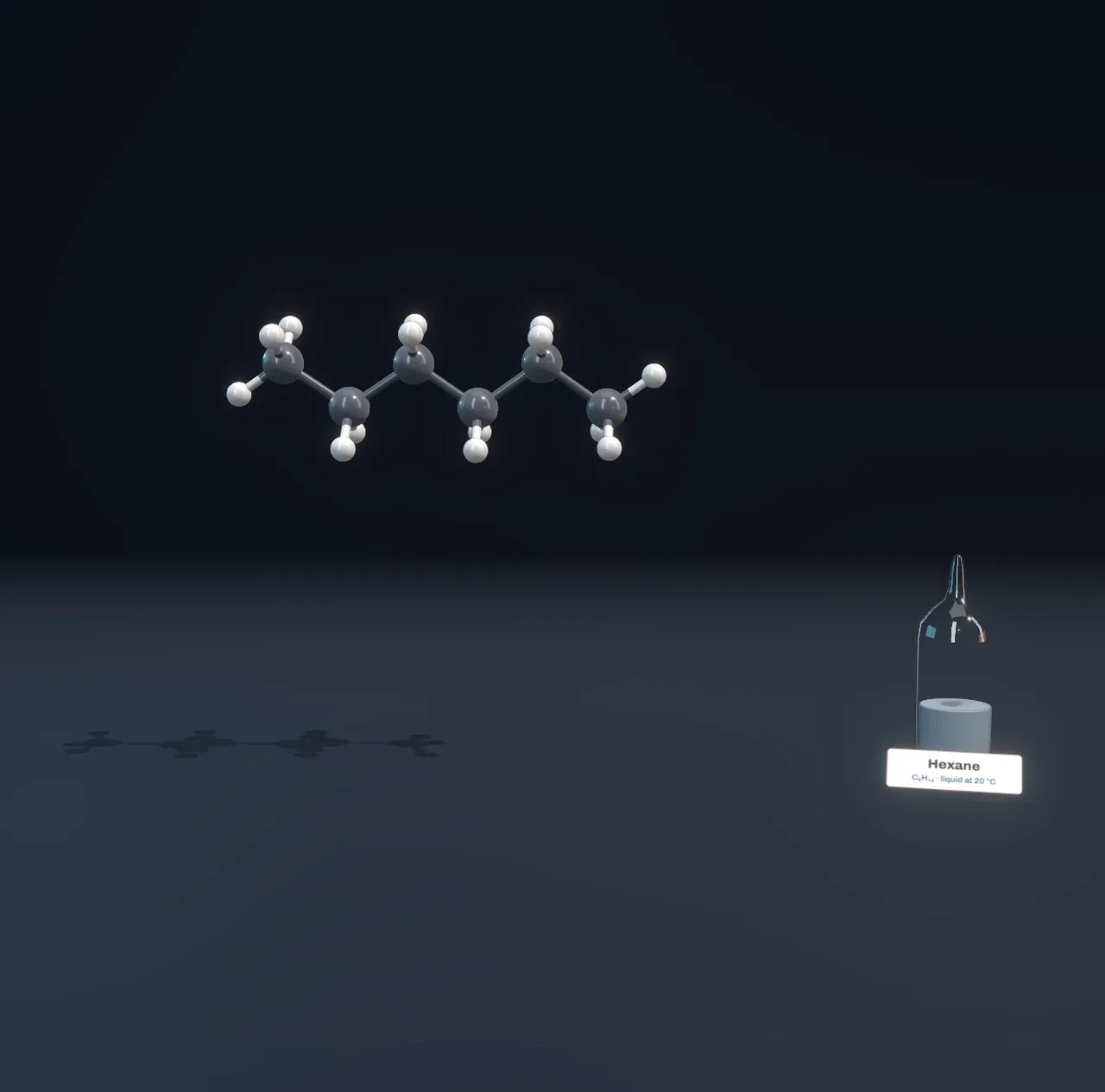
Beside the molecule stands a sample of the substance at 20 °C, showing whether it is a gas, a liquid or a solid. End group is fixed at alkane, and Carbon atoms starts at methane.
Loading the interactive version…
Loading the interactive version…
Each step sets up the Scene for you, and a control marked “fixed” stays put for that step.
Practice · Calculate
What is the molar mass of octane, the alkane with 8 carbons? , .
Practice · Calculate
What is the molar mass of octane, the alkane with 8 carbons? , .
Practice · Calculate
Each member of the alkanes’ homologous series is one group longer than the one before. By how much does the molar mass grow at each step? , .
Practice · Calculate
Each member of the alkanes’ homologous series is one group longer than the one before. By how much does the molar mass grow at each step? , .
Practice · Predict, then look
Methane, , boils at −162 °C. What happens to the boiling point as the chain grows, carbon by carbon?
Practice · Predict, then look
Methane, , boils at −162 °C. What happens to the boiling point as the chain grows, carbon by carbon?
Practice · Choose
With Compare boiling points at Side by side, a neighbouring molecule appears, and the hydrogens touching it light up. Why does octane boil higher than butane?
Practice · Choose
With Compare boiling points at Side by side, a neighbouring molecule appears, and the hydrogens touching it light up. Why does octane boil higher than butane?
Practice · Reach the target
Methane, ethane, propane and butane are gases at room temperature. End group is fixed at alkane. Change Carbon atoms until the sample beside the molecule is liquid at 20 °C with a boiling point below 40 °C, then press Check.
Practice · Reach the target
Methane, ethane, propane and butane are gases at room temperature. End group is fixed at alkane. Change Carbon atoms until the sample beside the molecule is liquid at 20 °C with a boiling point below 40 °C, then press Check.
Lesson complete. Every practice question here is done.