What happens when one hydrogen is swapped for OH or COOH: alcohols and carboxylic acids, hydrogen bonds that send the boiling point leaping, and why ethanol is not a base.
Step 1 of 5 · The hydroxyl group
Step 1 of 5
The hydroxyl group
A functional group is an atom or group of atoms in an organic compound that sets most of its properties. Swap one hydrogen of an alkane for a hydroxyl group, , and you get an alcohol: methane becomes methanol, and ethane ethanol, the alcohol in wine and beer. Carbon atoms and End group are now fixed at ethane.
Step 2 of 5
The same mass
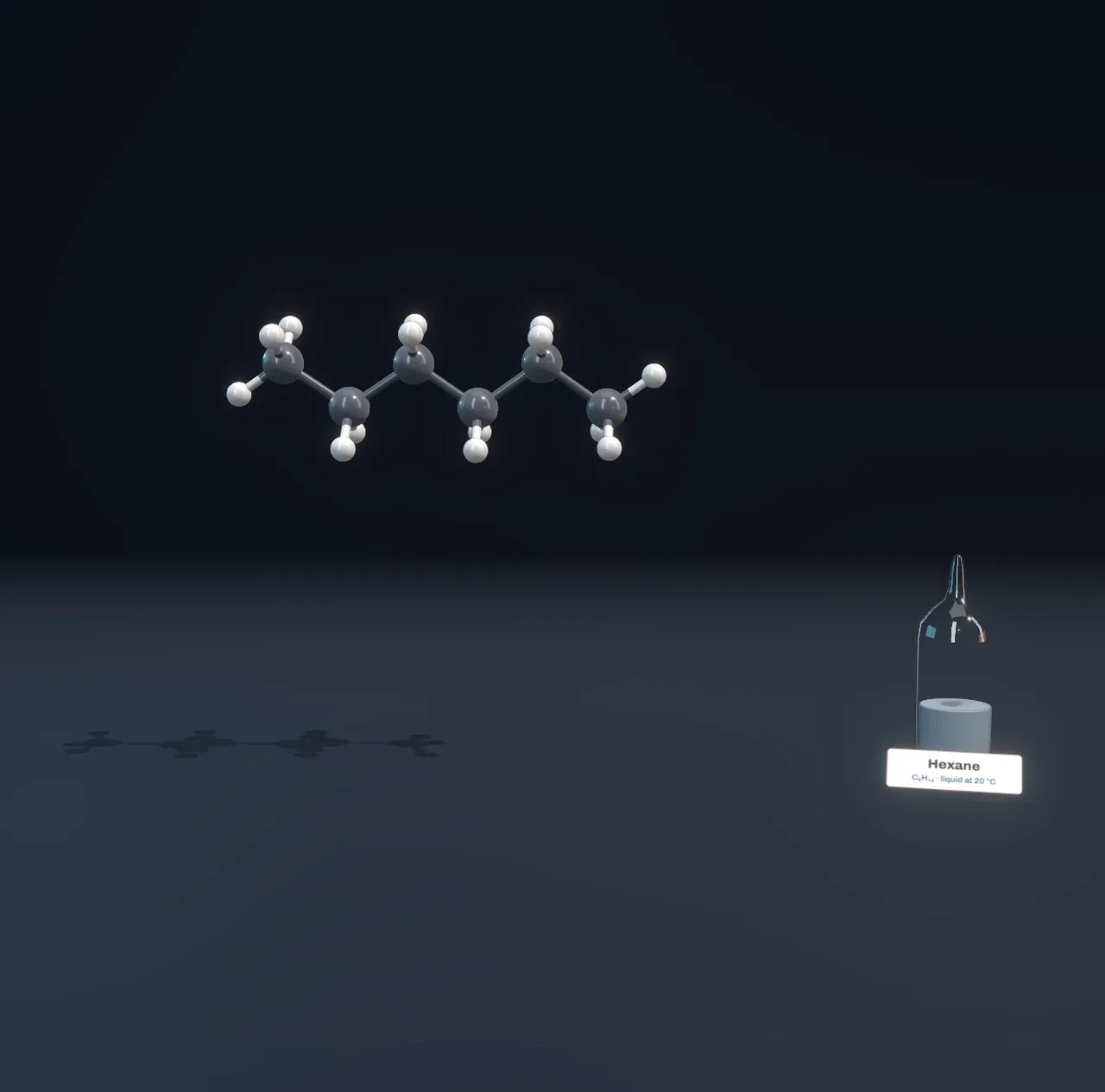
Oxygen pulls electrons hard, so in the hydrogen is left slightly positive. Such a hydrogen is pulled hard to the oxygen of a neighbouring molecule: a hydrogen bond, several times stronger than the pull between alkanes. To see how much it matters, compare ethanol with an alkane of about the same mass. End group is fixed at alkane.
Step 3 of 5
Ethanol
Compare boiling points is at Side by side: a neighbour lies beside the ethanol, and the hydrogen bond is marked in amber. Alcohols form a homologous series of their own, .
Step 4 of 5
Not a base
in a formula recalls bases such as , but the likeness misleads. What matters is the kind of bond.
Step 5 of 5
Acids
When the end of the chain carries a carboxyl group, , the compound is a carboxylic acid. Ethanoic acid, , is the acid in vinegar. Here the hydrogen of the can come free in water, a little, so the solution is acidic. The Scene shows ethanoic acid beside a neighbour.
Loading the interactive version…
Loading the interactive version…
Each step sets up the Scene for you, and a control marked “fixed” stays put for that step.
Practice · Predict, then look
Ethane, , is a gas at room temperature. What will happen to the sample when you swap the hydrogen on the end for , giving ethanol?
Practice · Predict, then look
Ethane, , is a gas at room temperature. What will happen to the sample when you swap the hydrogen on the end for , giving ethanol?
Practice · Reach the target
Ethanol has a molar mass of 46 g/mol and boils at 78 °C. End group is fixed at alkane. Find, with Carbon atoms, the alkane whose molar mass is closest to ethanol’s, then press Check.
Practice · Reach the target
Ethanol has a molar mass of 46 g/mol and boils at 78 °C. End group is fixed at alkane. Find, with Carbon atoms, the alkane whose molar mass is closest to ethanol’s, then press Check.
Practice · Calculate
What is the molar mass of ethanol, ? , , .
Practice · Calculate
What is the molar mass of ethanol, ? , , .
Practice · Choose
Both sodium hydroxide, , and ethanol, , have in their formula. Is a solution of ethanol in water basic?
Practice · Choose
Both sodium hydroxide, , and ethanol, , have in their formula. Is a solution of ethanol in water basic?
Practice · Choose
Ethanoic acid, , boils at 118 °C, and ethanol at 78 °C. Why does the acid boil higher?
Practice · Choose
Ethanoic acid, , boils at 118 °C, and ethanol at 78 °C. Why does the acid boil higher?
Lesson complete. Every practice question here is done.