A backbone of carbon
Natural gas, camping gas, petrol, paraffin and candle wax look nothing alike, but they are made of the same two elements. Each is a mixture of hydrocarbons: molecules of carbon and hydrogen only. The simplest family is the alkanes, chains of carbon atoms joined by single bonds, with hydrogen on every spare place.
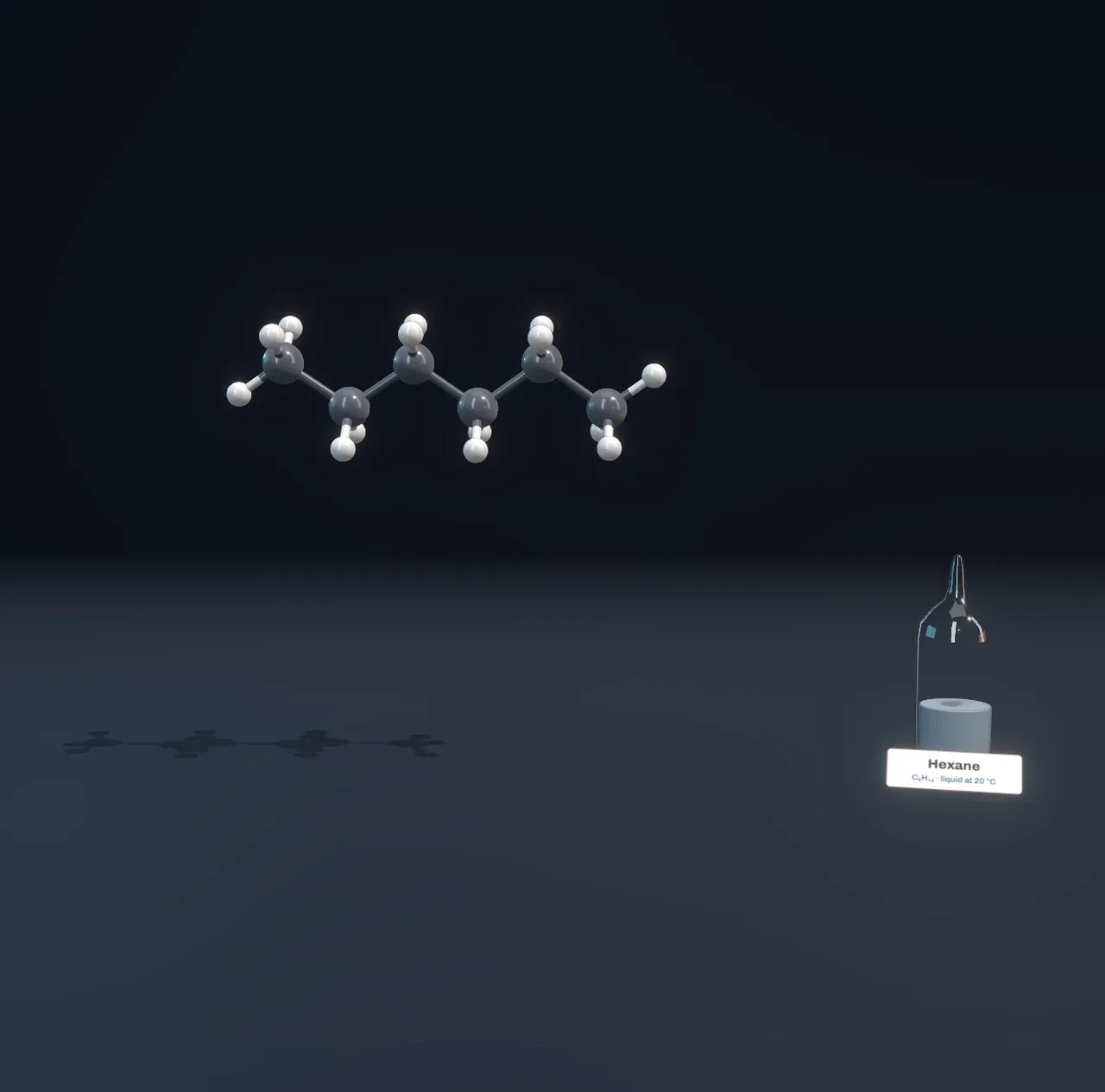
Carbon makes four bonds. In a chain, each inner carbon spends two of them on its neighbours in the chain and the other two on hydrogens; the end carbons carry three hydrogens. That gives the alkanes the formula CnH2n+2: methane CH₄, ethane C₂H₆, and so on up to dodecane C₁₂H₂₆ and far beyond. The four bonds point to the corners of a tetrahedron, so the chain is not straight but a zigzag, with one hydrogen above and one below the zigzag at every inner carbon.
This is the start of organic chemistry, the chemistry of carbon compounds. Carbon can build chains, branches and rings of almost any length, which is why there are millions of organic compounds and far fewer that contain none.
Longer chains boil higher
Try it: with End group on –H (alkane), slide Carbon atoms from 1 up to 12 and watch the sample in its glass.
Up to four carbons, methane to butane, the sample is a gas at room temperature: there is nothing to see in the glass. From pentane, five carbons, it is a liquid. Every carbon added raises the boiling point, from −162 °C for methane to 216 °C for dodecane. Petrol is mostly chains of five to ten carbons; kerosene and diesel are longer; paraffin wax is chains of twenty and more, long enough to be solid.
Nothing about the bonds inside the molecule changes. Boiling does not break a molecule apart; it pulls whole molecules away from each other. So what changes is how strongly one molecule holds on to the next.
What holds two molecules together
Step Compare boiling points to Side by side. A second, identical molecule slides in beside the first, and the places where their hydrogens touch light up.
Even in a molecule with no charge, the electrons are always moving. At any instant they may bunch a little to one side, making a fleeting negative end and a positive end, and that pushes the electrons of the molecule next door the opposite way. The two flickering imbalances attract. This weak pull, called the London dispersion force, acts only where molecules touch, so it adds up along their length. A long chain lying alongside another touches it in many more places than a short one, and it takes more heat to pull it free. Count the contacts at 3 carbons and at 12.
Swap one end
Try it: set Carbon atoms to 2 and switch End group between –H (alkane), –OH (alcohol) and –COOH (carboxylic acid).
A functional group is a small cluster of atoms that gives a family of compounds its character. Swap one hydrogen on the end of ethane for an –OH group and the gas becomes ethanol, the alcohol in drinks and hand gel, a liquid that boils at 78 °C. Swap the end for a –COOH group and it becomes ethanoic acid, the acid in vinegar, boiling at 118 °C. The chain is the same; the end decides the family and much of the behaviour.
Oxygen pulls shared electrons towards itself much harder than carbon or hydrogen does. In an O–H group that leaves the hydrogen almost bare and slightly positive, and it is drawn strongly to a lone pair on an oxygen of the next molecule: a hydrogen bond, the amber dashes in the Scene. It is many times stronger than one dispersion contact. A carboxylic acid has an O–H too, plus a C=O whose oxygen is a second strong target; in the liquid, acid molecules pair up face to face, held by two hydrogen bonds. That is why the acid boils highest, then the alcohol, then the alkane.
Reading the boiling points
Step Compare boiling points to Boiling points. The chart beside the Scene plots all three families against chain length, with the dashed line at 20 °C: anything below the line is a gas in the room.
All three lines climb, because every family gets more dispersion contacts as it gets longer. But they draw together. Changing –H to –OH lifts the boiling point by 226 °C for one carbon and only 43 °C for twelve: in a long chain the single hydrogen bond at the end matters less and less against the many contacts along the chain. A long-chain alcohol or acid behaves more and more like the alkane it is built on, which is why fats and waxes, mostly long chains with a functional group at one end, feel greasy and do not mix with water.
What this model leaves out
The atoms are drawn as small balls on sticks so that the bonds show; real atoms overlap and fill the space between them. Real chains are not held flat. They twist about each single bond, and in a liquid they writhe and tangle constantly.
A molecule in a liquid is surrounded by neighbours on every side, not just one, and they are always moving. The Scene lays one neighbour alongside so that the contacts and the hydrogen bond can be counted; the line drawn for a contact is a picture of an attraction, not a bond. The contacts counted are only those between hydrogens that come within 2.75 Å of each other in this one arrangement, so methane, which touches its neighbours only fleetingly, shows none at all. Real carboxylic acids pair up head to head with two hydrogen bonds, which the side-by-side layout cannot show.
Only straight chains with the group on the end carbon are shown. Branched chains, double bonds and rings, the other half of hydrocarbon chemistry, change the shape and with it the boiling point: branched molecules are more compact, touch less and boil lower. The boiling and melting points are measured values at one atmosphere, rounded; they are not computed by the model.