A tree with a conditional chance on every branch: split a hall of $1000$ people into ill and healthy, then by test result, multiply along a path, add paths, and draw marbles without putting back.
Step 1 of 5 · Splitting by illness
Step 1 of 5
Splitting by illness
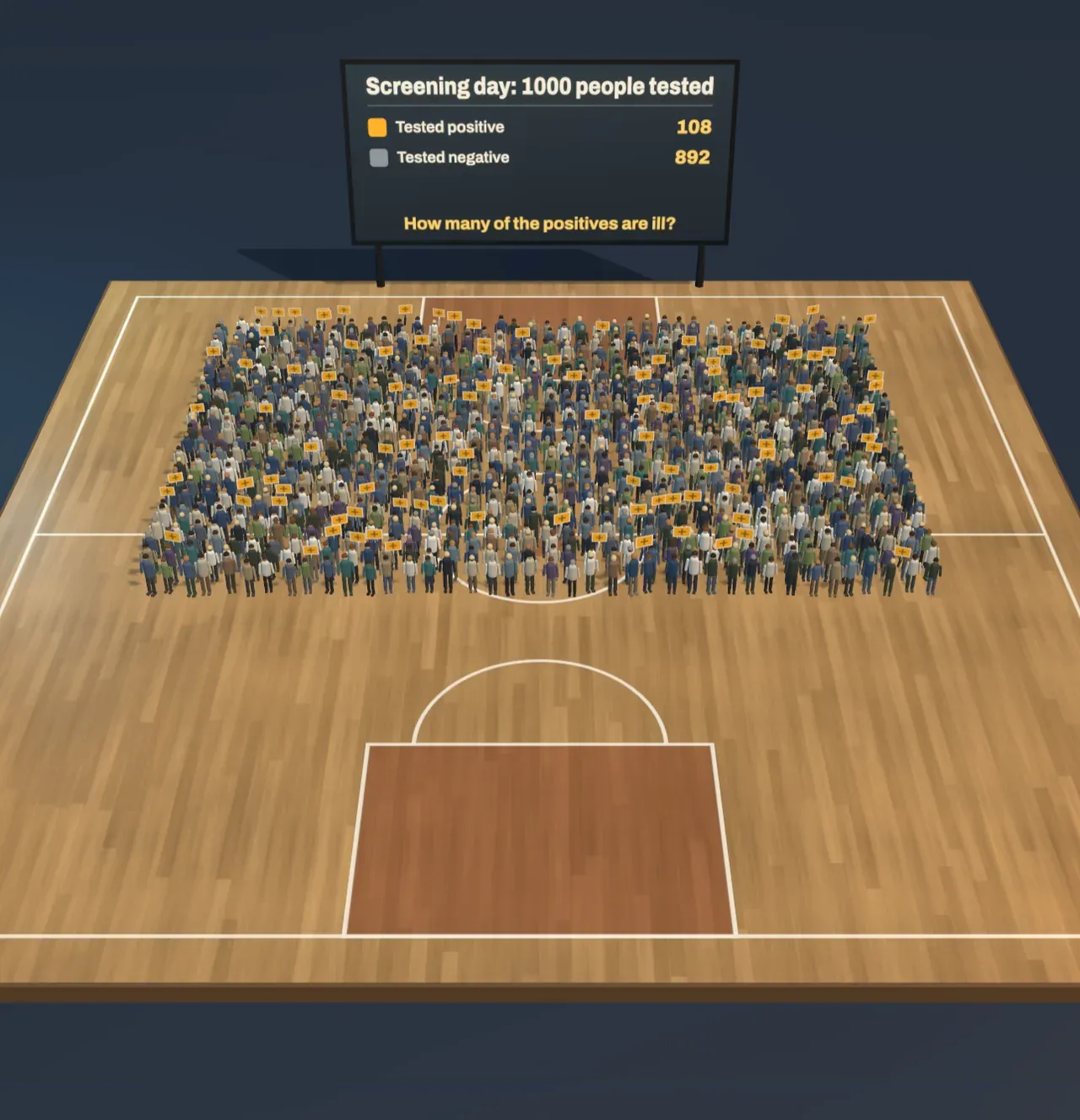
In a sports hall people stand and take a test for a disease. The chart beside the Scene is a tree of the situation: from the root, , two branches go out, ill and healthy, and from each of those two more, a positive and a negative result. Instead of chances, the branches carry numbers of people, which makes the sums much easier.
Here How common the disease is is , and Test accuracy : the test catches of the ill and clears of the healthy. The ill are shown in red.
The rate on every second branch is a conditional chance: is the chance of a positive result given that the person is ill.
Step 2 of 5
The other branch
The healthy take the test too, and it gets of them wrong. Someone healthy who tests positive is a false positive. Someone ill who tests negative is a false negative.
Step 3 of 5
Every positive
The board now walks every positive out to the two mats at the front: the ill on the left, the healthy on the right. Two paths on the tree end in a positive result, and the number of positives is the sum of both.
Step 4 of 5
Without putting back
The same trees work for any experiment in stages. On every branch write the chance given everything that happened earlier on the path, and multiply along a path:
This is the multiplication rule in full. When the stages are independent, , and it goes back to the simple rule. When you draw marbles from a bag without putting them back, the second stage depends on the first.
Step 5 of 5
Along a path
Back to the hall, this time with a disease that affects . The path “ill, then positive” is two branches in a row, so multiply the two rates.
Loading the interactive version…
Loading the interactive version…
Each step sets up the Scene for you, and a control marked “fixed” stays put for that step.
Practice · Calculate
There are people in the hall, and of them are ill. The test catches of the ill. How many people are ill and test positive?
Practice · Calculate
There are people in the hall, and of them are ill. The test catches of the ill. How many people are ill and test positive?
Practice · Calculate
The test clears of the healthy, and gets of them wrong. How many healthy people test positive?
Practice · Calculate
The test clears of the healthy, and gets of them wrong. How many healthy people test positive?
Practice · Calculate
One person is picked at random from the hall. What is the chance their result is positive? Give it as a per cent, the number only.
Practice · Calculate
One person is picked at random from the hall. What is the chance their result is positive? Give it as a per cent, the number only.
Practice · Calculate
A bag holds marbles, of them red. You draw two marbles one after the other, without putting back. What is the chance both are red? Give it as a per cent, the number only.
Practice · Calculate
A bag holds marbles, of them red. You draw two marbles one after the other, without putting back. What is the chance both are red? Give it as a per cent, the number only.
Practice · Calculate
Now of the hall are ill, and the test is still accurate. What is the chance that a random person is both ill and positive? Give it as a per cent, the number only.
Practice · Calculate
Now of the hall are ill, and the test is still accurate. What is the chance that a random person is both ill and positive? Give it as a per cent, the number only.
Lesson complete. Every practice question here is done.