Triangles on a ball and on a saddle: angles that do not add up to 180 degrees, the Gauss–Bonnet theorem that ties them to the area, and parallel lines that close in or spread apart.
Step 1 of 4 · A triangle on a ball
Step 1 of 4
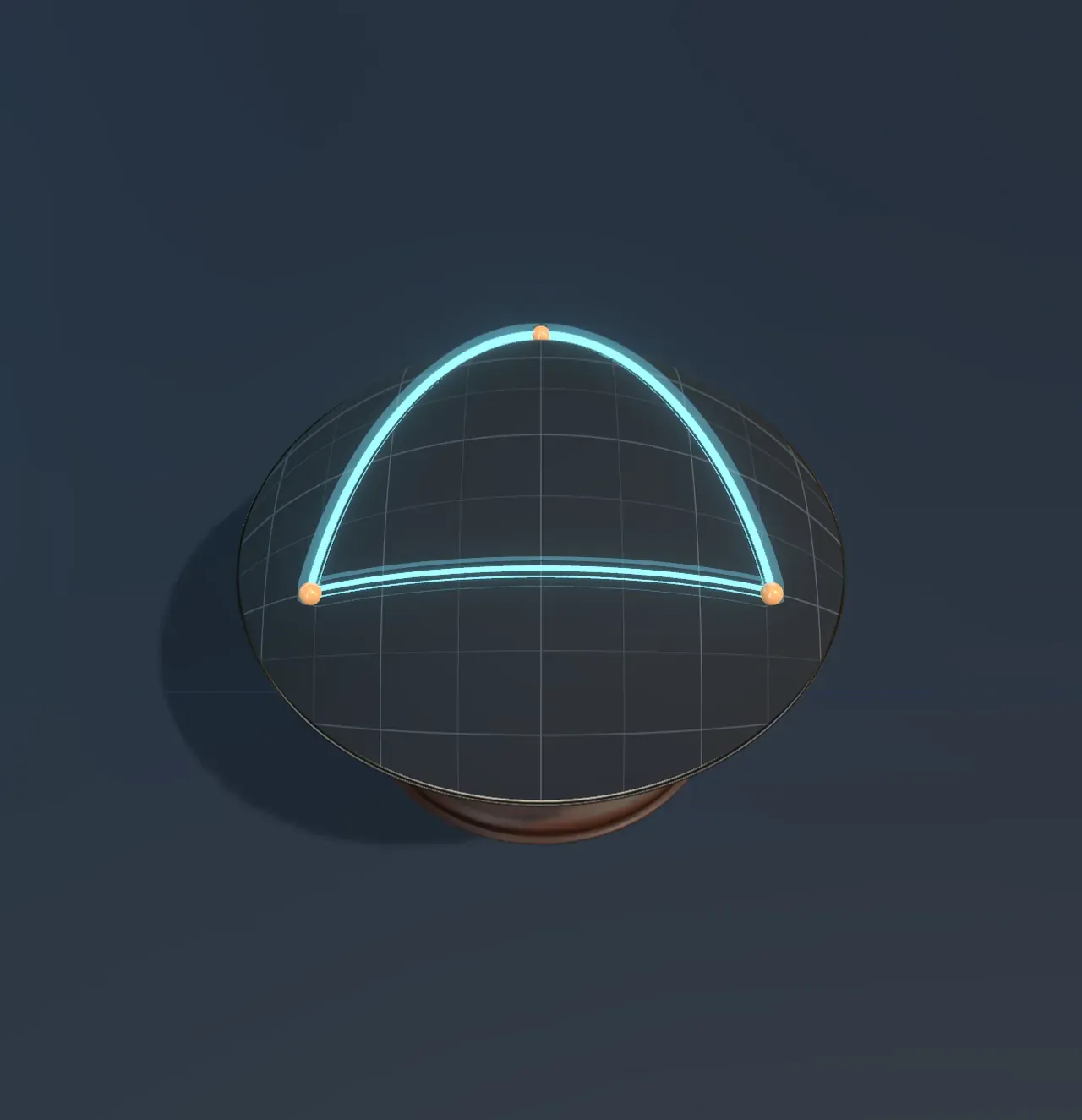
A triangle on a ball
On a flat plane every triangle’s angles add up to . The proof rests on Euclid’s parallel postulate: through a point off a line passes just one line that never meets it. A curved surface has no straight lines; instead it has geodesics: the shortest paths along the surface. On a ball these are arcs of a great circle.
Curvature K is fixed now on a ball, .
Step 2 of 4
The Gauss–Bonnet theorem
On a surface of constant curvature, the difference between the angle sum and equals the curvature times the area:
The angles here are in radians, which is why it has and not . On a ball and the excess is positive; on a saddle , and the sum is less than . At the Angles stage the board shows each angle and the sum.
Step 3 of 4
A small triangle
Triangle size is free now, and the curvature stays .
Step 4 of 4
Parallels
At the Parallels stage two lines leave the same base line at right angles. On a Flat surface they stay a fixed distance apart, as Euclid required. On a ball they close in and meet, like lines of longitude at the pole.
Try it: after checking, switch between Saddle, Flat and Ball, and compare the gap at the lines’ ends.
Loading the interactive version…
Loading the interactive version…
Each step sets up the Scene for you, and a control marked “fixed” stays put for that step.
Practice · Predict, then look
On the ball, each side of the triangle is the shortest path between two corners along the surface. What will its angles add up to?
Practice · Predict, then look
On the ball, each side of the triangle is the shortest path between two corners along the surface. What will its angles add up to?
Practice · Calculate
On this ball , and the angle sum is on the board. By the Gauss–Bonnet theorem, , with the angles in radians. What is the triangle’s area, in square grid units?
Practice · Calculate
On this ball , and the angle sum is on the board. By the Gauss–Bonnet theorem, , with the angles in radians. What is the triangle’s area, in square grid units?
Practice · Predict, then look
The triangle is large now, and its angle sum is far from . What will happen to the sum when you make the triangle very small, on the same ball?
Practice · Predict, then look
The triangle is large now, and its angle sum is far from . What will happen to the sum when you make the triangle very small, on the same ball?
Practice · Predict, then look
On a flat plane, two lines that leave the same base line at right angles stay the same distance apart. What will happen to them on a Saddle?
Practice · Predict, then look
On a flat plane, two lines that leave the same base line at right angles stay the same distance apart. What will happen to them on a Saddle?
Lesson complete. Every practice question here is done.