A rule that needs a flat page
Every school geometry book proves that the three angles of a triangle add up to 180°. Tear the corners off a paper triangle and lay them side by side, and they make a straight line. The rule goes back to Euclid’s Elements, written in Alexandria around 300 BC, which builds all of flat geometry, Pythagoras’ theorem included, from a handful of starting assumptions.
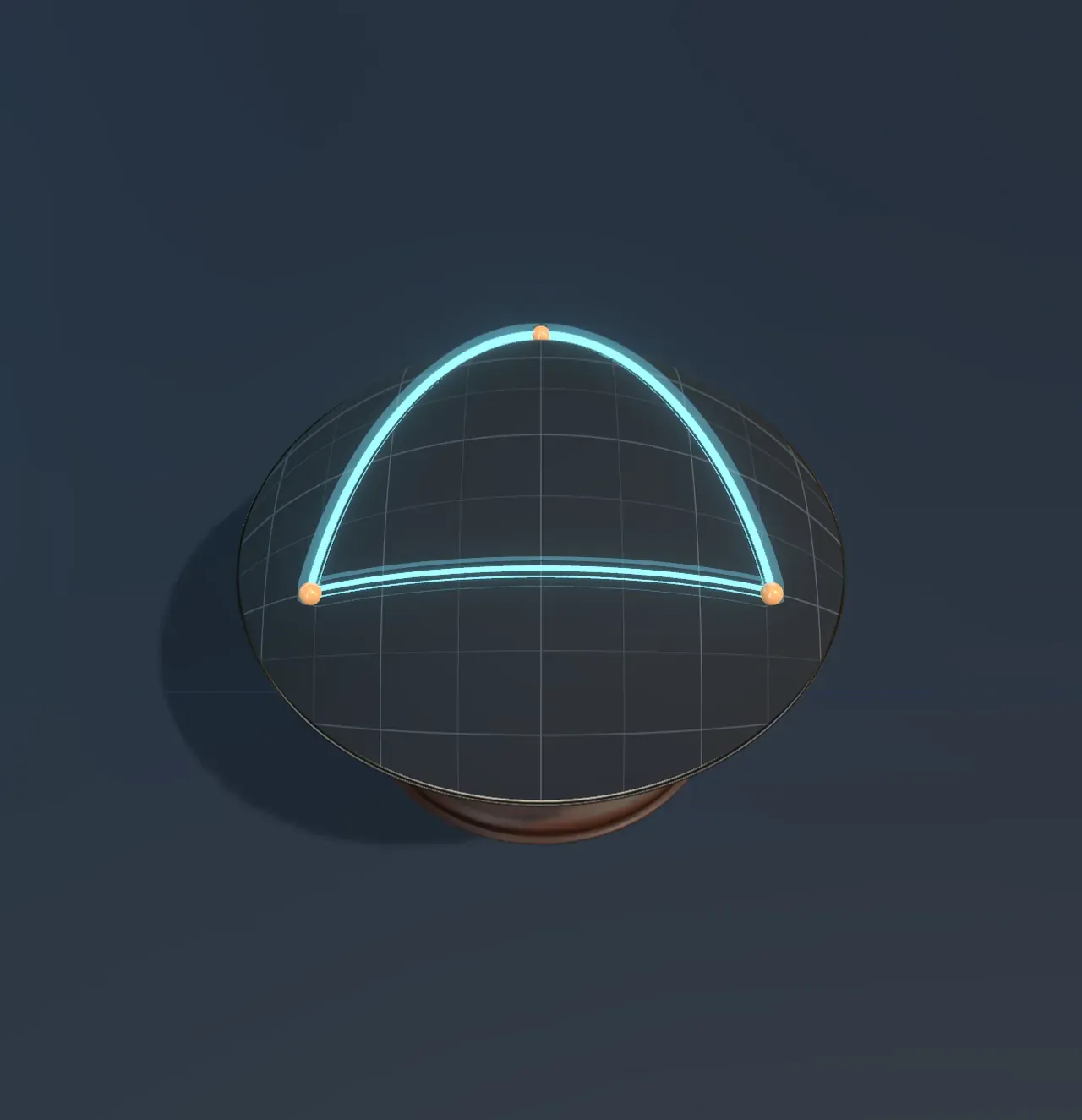
The Scene draws a triangle on a shell that can be bent. Its sides are not ruled lines but the shortest paths between the corners along the surface, the way a taut string would lie if it had to stay on the shell. Such a path is called a geodesic. On a flat sheet it is a straight line; on a ball it is an arc of a great circle, a circle as big as the ball itself, like the equator. Long-haul flights follow great circles, which is why a flight from London to Los Angeles passes over Greenland.
Try it: step Measure the triangle to Angles. On the shell as it starts, gently curved like part of a ball, each corner is 74.0° and the three add up to 221.9°. Press Flat on Curvature K and they add up to exactly 180°.
Three right angles on a ball
The Earth gives the clearest example. Start at the North Pole and walk south along a line of longitude to the equator. Turn left through 90° and walk a quarter of the way around the equator. Turn left through 90° again and walk north, back to the pole. You have walked a triangle with three straight sides, as straight as the surface allows, and three right angles: 270°.
How far the sum overshoots depends on the triangle’s size compared with the ball. That triangle covers an eighth of the globe, and the extra 90° is a quarter turn. A triangle half as wide covers a quarter as much area and overshoots by about a quarter as much. A triangle drawn across a football field overshoots by a few billionths of a degree, which is why builders and surveyors can use flat geometry on a round Earth. The rule, found by Albert Girard in 1629, is that the sum exceeds 180° by the triangle’s area divided by the square of the ball’s radius, with the angle measured in radians (one radian is about 57.3°).
Try it: press Ball, set Triangle size to 1.9, and each angle is 89.6°, nearly the three right angles of an eighth of the ball. Slide it down to 0.6 and the sum drops to 186.9°: shrink a triangle and it looks flatter.
Saddles: less than 180°
Now bend the shell the other way. A saddle curves up in one direction and down in the other, like a riding saddle or a crisp from a tube. The triangle grows thin and its corners sharp: the angles add up to less than 180°, and the bigger the triangle, the less they add up to. This is hyperbolic geometry.
A saddle surface has more room than a flat one. A circle drawn on it, all its points the same distance from a centre, is longer than 2π times that distance, and its edge has to ripple to fit in ordinary space. Lettuce leaves, sea slugs and the frilled edges of corals grow this way, packing extra edge into a small space. In 1997 the mathematician Daina Taimiņa found that crochet makes the shape too: add stitches at a steady rate, row after row, and the fabric ruffles into a hyperbolic plane.
Try it: press Saddle and set Triangle size to 2.2. Each corner is 49.5°, and the three add up to 148.5°.
Curvature, measured from inside
The number on the slider is the Gaussian curvature K, named after Carl Friedrich Gauss, who studied it in 1827. At any point of a surface, the sheet bends most in one direction and least in the direction across it. Multiply those two bends together, each measured as one over the radius of the circle that fits the surface best in that direction, and you get K. A ball bends the same way in every direction, so K is positive: 1/R² for a ball of radius R. A saddle bends opposite ways, so the product is negative. A cylinder bends in only one direction, so K is zero, the same as a flat page.
Gauss proved something surprising, which he called his Theorema Egregium, the “remarkable theorem”: K can be found without ever leaving the surface. Bending a sheet without stretching it never changes its K. That is why a sheet of paper rolls into a tube but cannot wrap a ball without crumpling, and why every flat map of the Earth stretches some countries.
One way to measure K from inside is to draw a triangle and add up its angles. For any triangle on a surface whose curvature is the same everywhere,
angle sum − 180° = K × area
with the right-hand side in radians. Step Measure the triangle to Angles and the chart beside the Scene plots the sum against the area of every triangle the Scene can draw on the current surface: they lie on one straight line through 180°, rising for a ball and falling for a saddle, steeper as K grows. Where the curvature changes from place to place, the excess is the total curvature inside the triangle; that more general version is the Gauss–Bonnet theorem.
Two thousand years of parallels
Euclid’s fifth assumption, the parallel postulate, is longer and less obvious than the others. In its most quoted form: through a point not on a given line, exactly one line can be drawn that never meets it. For two thousand years mathematicians tried to prove it from the other assumptions and failed. Around 1830 Nikolai Lobachevsky in Kazan and János Bolyai in Hungary each published a geometry in which the postulate is false, and many lines through the point miss the given line. Gauss had reached the same idea and kept it to himself. Their geometry turned out to be the geometry of the saddle, and in 1868 Eugenio Beltrami showed it is exactly as consistent as Euclid’s. In 1854 Bernhard Riemann extended Gauss’s curvature to spaces of any number of dimensions, the higher dimensions that the mind cannot picture but mathematics handles with ease.
The last stop of the Reveal tests the postulate on the shell. Two shortest paths cross a base line at right angles, 1.6 apart, so on paper they are parallel and stay 1.6 apart for ever.
Try it: step Measure the triangle to Parallels. On the Flat shell the lines end 1.60 apart. Press Ball and they close in to 0.71 apart at the edge; carried on, they would meet 3.14 from the base line, as lines of longitude, all at right angles to the equator, meet at the poles. Press Saddle and they spread to 1.96.
On a ball there are no parallels at all: any two great circles cross. On a saddle there are infinitely many lines through a point that never meet a given line. Only on a flat surface is there exactly one.
Curved space
Non-Euclidean geometry began as a puzzle about a postulate and became physics. Einstein’s general theory of relativity, completed in 1915, describes gravity as the curvature of space and time: planets follow the straightest paths through a spacetime that the Sun’s mass has curved. The effect on time is measurable in everyday technology: the clocks on GPS satellites run faster than clocks on the ground, mostly because they sit higher in Earth’s gravity, and the system corrects for it.
Space as a whole could be curved too. Measurements of the cosmic microwave background, the oldest light there is, compare the true size of patterns in it with how big they look across the sky: in effect, the angles of a triangle billions of light years across. They add up to 180° as far as anyone can measure, so on the largest scales we can see, space is flat to within about half a per cent. Whether it is exactly flat, or curved too gently to detect, remains open. Which way a shape bends is a question of geometry; topology is the study of what is left when bending and stretching are allowed and only holes and edges count.
What this model leaves out
The shell is one of three surfaces whose curvature is the same at every point: part of a ball, a flat disc, or a piece of a saddle cut from a surface of revolution with a narrow waist, centred on the top of the waist. In 1901 David Hilbert proved that a complete hyperbolic plane cannot sit smoothly in ordinary three-dimensional space; only pieces of it can. That is why the saddle stops at K = −0.1 while the ball goes to 0.25, and why its edge rises so steeply. A hyperbolic surface is usually studied through flat maps instead, such as the Poincaré disc that M. C. Escher used for his Circle Limit woodcuts.
The triangle is always equilateral, with its corners the same distance from the centre, so its three angles are equal; the angle-sum rule holds for any shape of triangle. The shell is drawn as a rigid sheet that changes shape when the slider moves; a real sheet of paper or metal would have to stretch to go from flat to curved, which is the point of Gauss’s theorem. The chalk grid is ruled along the base line, so its squares are exact only along that line and shrink or grow away from it. Finally, a bent two-dimensional surface in three-dimensional space is an analogy for curved space, not a picture of it: the curvature of space is measured from inside, by triangles and parallel lines, with no outside direction for it to bend into.