Lesson 2 of 3
Ice ages and Milankovitch cycles.
Three slow changes in the Earth's orbit and axis change the summer sunlight in the far north. Work out the distance to the Sun and the gap in sunlight, see why the summer and not the winter decides the ice, and line summer sunlight up with the ice ages of the last 400,000 years.
Step 1 of 7 · An oval orbit
Step 1 of 7
An oval orbit
Twenty thousand years ago ice sheets up to three kilometres thick covered most of Canada and northern Europe. Within about ten thousand years most of that ice melted. That was only the latest of many ice ages: Antarctic ice cores show cold spells of about years, broken by short warm ones, the interglacials. We live in one.
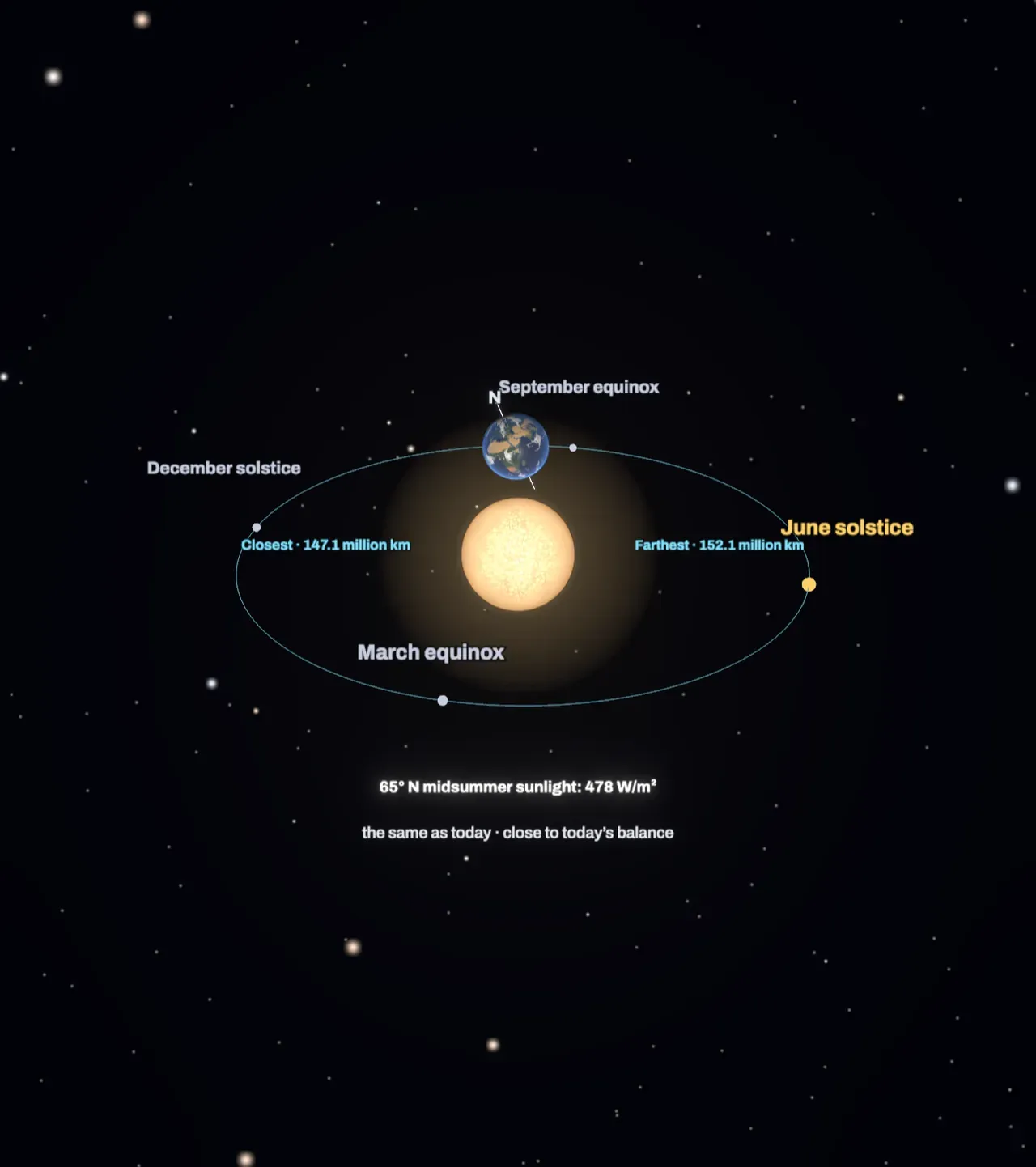
The Serbian engineer Milutin Milankovitch spent decades calculating, by hand, how the pull of the other planets slowly changes the Earth’s orbit and spin. The first change: eccentricity, how oval the orbit is. It drifts between almost a perfect circle and about , over cycles of about and years. In the Scene the Sun sits at one focus of a true ellipse.
Step 2 of 7
Closest in winter
The second change: axial tilt, which swings between about 22.1° and 24.5° and back every years. Today it is 23.44°. In the Unit on the Earth, the Moon and the Sun we saw that this tilt makes the seasons.
Step 3 of 7
The most oval orbit
The more oval the orbit, the bigger the difference between the point closest to the Sun, perihelion, and the farthest, aphelion.
Step 4 of 7
Northern summers
The third change: precession, the slow wobble of the axis, like a spinning top’s, which moves perihelion all the way round the calendar every to years. Today the Earth is closest in early January.
Milankovitch’s key idea: ice sheets do not grow because winters are cold. They grow when summers are too weak to melt the winter’s snow. The north is what matters, because that is where the big continents reach close to the pole. So the yardstick is midsummer sunlight at a high northern latitude, 65° north, and the Scene draws the northern ice cap by it.
Step 5 of 7
A weak summer
The three cycles push northern summer sunlight each its own way. Precession is locked at 270°: the closest point in the northern winter.
Step 6 of 7
The record
The chart beside the Scene adds up the three cycles, through the same sunlight calculation, into summer sunlight at 65° north for each moment of the last 400,000 years. Below it runs the temperature from Antarctic ice cores, with the interglacials shaded in orange. In 1976 James Hays, John Imbrie and Nicholas Shackleton found the , and -year rhythms in the chemistry of ocean-floor mud.
Step 7 of 7
Farthest out
When the orbit is at its most oval, the Earth comes nearer the Sun on one side and goes farther from it on the other.
Loading the interactive version…
Loading the interactive version…
Each step sets up the Scene for you, and a control marked “fixed” stays put for that step.
Practice · Calculate
The Eccentricity is locked at today’s value, . The Earth’s mean distance from the Sun, the orbit’s semi-major axis, is about 149.6 million kilometres. How close to the Sun is the Earth at its closest point, perihelion?
Practice · Calculate
The Eccentricity is locked at today’s value, . The Earth’s mean distance from the Sun, the orbit’s semi-major axis, is about 149.6 million kilometres. How close to the Sun is the Earth at its closest point, perihelion?
Practice · Choose
The Earth is closest to the Sun in early January. Why is January the middle of winter in the northern hemisphere?
Practice · Choose
The Earth is closest to the Sun in early January. Why is January the middle of winter in the northern hemisphere?
Practice · Calculate
The Eccentricity is locked at , the most oval the orbit gets. How many times more sunlight does the Earth receive at its closest point than at its farthest?
Practice · Calculate
The Eccentricity is locked at , the most oval the orbit gets. How many times more sunlight does the Earth receive at its closest point than at its farthest?
Practice · Predict, then look
Everything at today’s values: the Earth is closest in January, and midsummer sunlight at 65° north is about 478 W/m². Move Precession: closest point to June. What will happen to the northern ice cap?
Practice · Predict, then look
Everything at today’s values: the Earth is closest in January, and midsummer sunlight at 65° north is about 478 W/m². Move Precession: closest point to June. What will happen to the northern ice cap?
Practice · Reach the target
Precession: closest point is locked at 270°, in the northern winter. Change the Eccentricity and the Axial tilt so that midsummer sunlight at 65° north falls to about 430 W/m², a weak summer that starts an ice age, and press Check.
Practice · Reach the target
Precession: closest point is locked at 270°, in the northern winter. Change the Eccentricity and the Axial tilt so that midsummer sunlight at 65° north falls to about 430 W/m², a weak summer that starts an ice age, and press Check.
Practice · Choose
Choose 400,000 years of ice under Years of ice. The chart shows summer sunlight at 65° north beside the temperature from Antarctic ice cores. What is true of the ice ages?
Practice · Choose
Choose 400,000 years of ice under Years of ice. The chart shows summer sunlight at 65° north beside the temperature from Antarctic ice cores. What is true of the ice ages?
Practice · Calculate
Eccentricity is locked at , the most oval the orbit gets. The Earth’s mean distance from the Sun, the semi-major axis, is 1 AU. How far is it from the Sun at its farthest point, ?
Practice · Calculate
Eccentricity is locked at , the most oval the orbit gets. The Earth’s mean distance from the Sun, the semi-major axis, is 1 AU. How far is it from the Sun at its farthest point, ?
Lesson complete. Every practice question here is done.