Every repeated measurement gives a slightly different reading: the spread of one reading, the standard error of the mean and its √n, and a systematic error that no number of measurements fixes.
Step 1 of 6 · The spread of one reading
Step 1 of 6
The spread of one reading
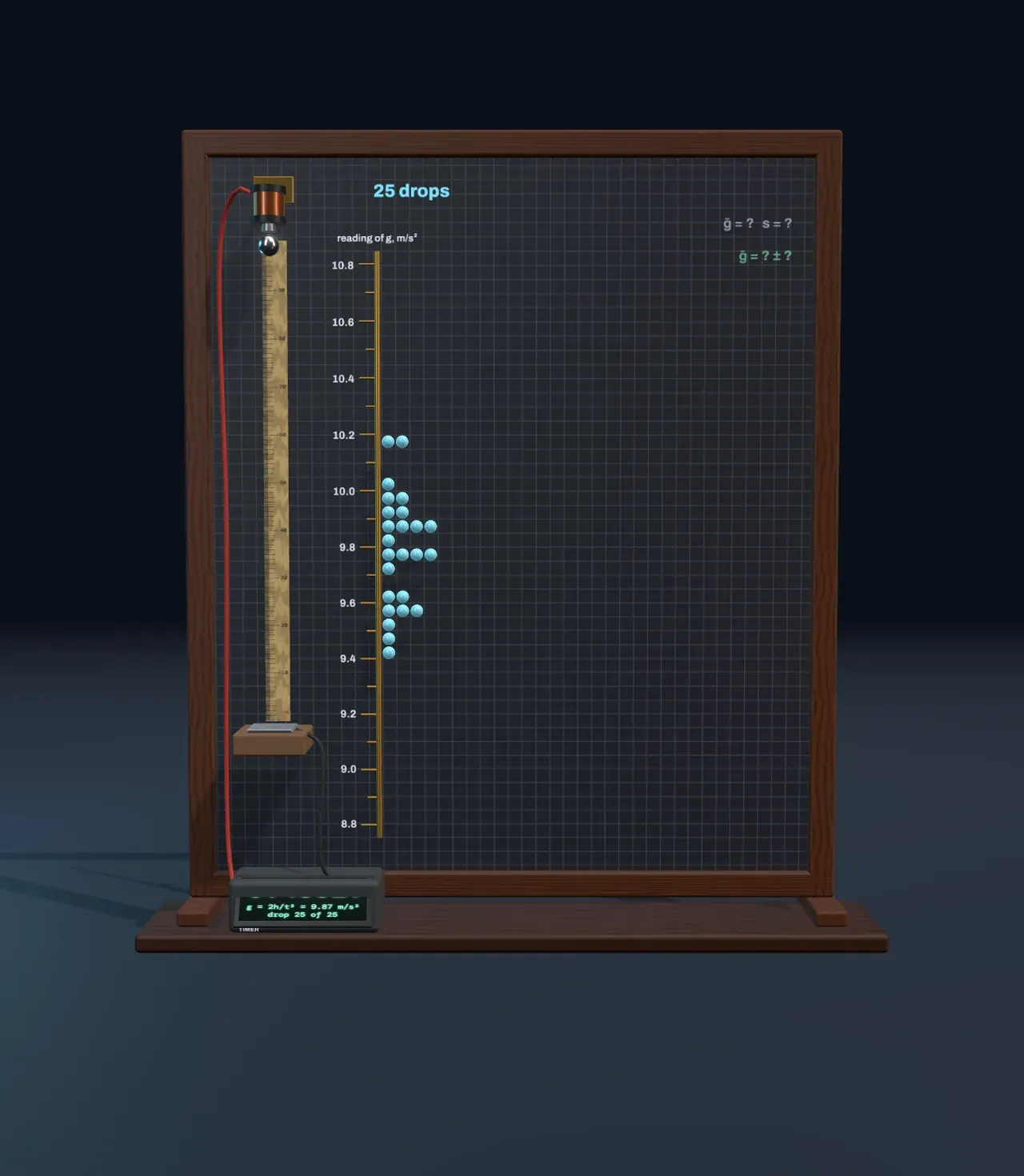
A steel ball hangs from an electromagnet, 1.000 m above a contact pad. Cut the current, and a timer measures how long the ball takes to fall. The time gives the acceleration of free fall: , so . Every drop gives a slightly different reading, and each reading becomes a ball on the board, in the column of its value: a histogram lying on its side.
Errors that change from drop to drop, sometimes up and sometimes down, are random errors. The spread measures their size: roughly how far one reading lies from the mean . At Spread the board fits a bell curve to the pile and prints and . Timing jitter and Magnet delay are fixed. Predict what will happen to the width of the pile with four times the drops.
Step 2 of 6
The standard error
What the experiment wants is , and its best estimate is the mean. The mean is far steadier than any single reading, because the random errors in it partly cancel: some readings are high, some low, and the more of them there are, the better they balance. The uncertainty of the mean is its standard error:
The board does not show it yet. Work it out from the spread on the board.
Step 3 of 6
The square root of n
At Error bar a bar of one standard error each way appears beside the pile, with thin whiskers out to two. The amber ticks beside it are the means of more runs of the same number of drops: the standard error is roughly how far another run’s mean would land from this one. Change Drops and find how many it takes to halve the bar.
Step 4 of 6
The true value
At True value a rose line marks the accepted value of , 9.81 m/s², which a real experimenter would not know in advance. With drops it is inside the bar. Predict what will happen at drops, when the bar halves.
Step 5 of 6
Systematic error
The reason is the Magnet delay: leftover magnetism holds the ball for an instant after the current is cut, so every fall is timed too long. An error that pushes every reading the same way is a systematic error. It does not cancel in the mean, because it does not change from drop to drop. Now the delay is 5 ms, and Work out the true value is fixed at Error bar, so the board does not give the answer away.
Try it: after checking, step Work out the true value to True value. The whole pile slides down by the amount you worked out, and the bar misses the line.
Step 6 of 6
Precision and accuracy
A careful timer, Timing jitter at 2 ms, shrinks the random error: the pile is half as wide. But the 1.5 ms delay is still there. Random error spoils precision, how close the readings are to one another, and more measurements cure it. Systematic error spoils accuracy, how close they are to the truth, and more measurements do not help. Finding it takes a change of method: drop from several heights, or calibrate against something whose answer is known.
Loading the interactive version…
Loading the interactive version…
Each step sets up the Scene for you, and a control marked “fixed” stays put for that step.
Practice · Predict, then look
With drops, the readings’ Spread is s = 0.20 m/s². What will happen to the width of the pile when we go to drops?
Practice · Predict, then look
With drops, the readings’ Spread is s = 0.20 m/s². What will happen to the width of the pile when we go to drops?
Practice · Calculate
drops, and the readings’ spread is s = 0.20 m/s². What is the standard error of the mean?
Practice · Calculate
drops, and the readings’ spread is s = 0.20 m/s². What is the standard error of the mean?
Practice · Reach the target
With drops the standard error is 0.04 m/s². Change Drops until it halves, to about 0.02 m/s², and press Check.
Practice · Reach the target
With drops the standard error is 0.04 m/s². Change Drops until it halves, to about 0.02 m/s², and press Check.
Practice · Predict, then look
With drops the true value, 9.81 m/s², is inside the error bar. We go to drops. Will it still agree?
Practice · Predict, then look
With drops the true value, 9.81 m/s², is inside the error bar. We go to drops. Will it still agree?
Practice · Calculate
The magnet lets go of the ball 5 ms late, so every fall is timed 5 ms too long. Without the delay, a 1.000 m fall takes 0.4515 s. By how much does the delay alone lower every reading of ?
Practice · Calculate
The magnet lets go of the ball 5 ms late, so every fall is timed 5 ms too long. Without the delay, a 1.000 m fall takes 0.4515 s. By how much does the delay alone lower every reading of ?
Practice · Choose
With Timing jitter at 2 ms, the pile is narrow and the error bar small, but the true value lies outside two error bars. How would you describe this measurement?
Practice · Choose
With Timing jitter at 2 ms, the pile is narrow and the error bar small, but the true value lies outside two error bars. How would you describe this measurement?
Lesson complete. Every practice question here is done.