When the fan pushes, the velocity changes by the same amount every second. What acceleration is, how to work out a velocity with it, and why a negative acceleration does not always mean slowing down.
Step 1 of 6 · A growing velocity
In the last Lesson the fan was off and the velocity never changed. Now it comes on and pushes the cart with a steady force, forward or back, and the velocity starts to change.
Step 1 of 6
A growing velocity
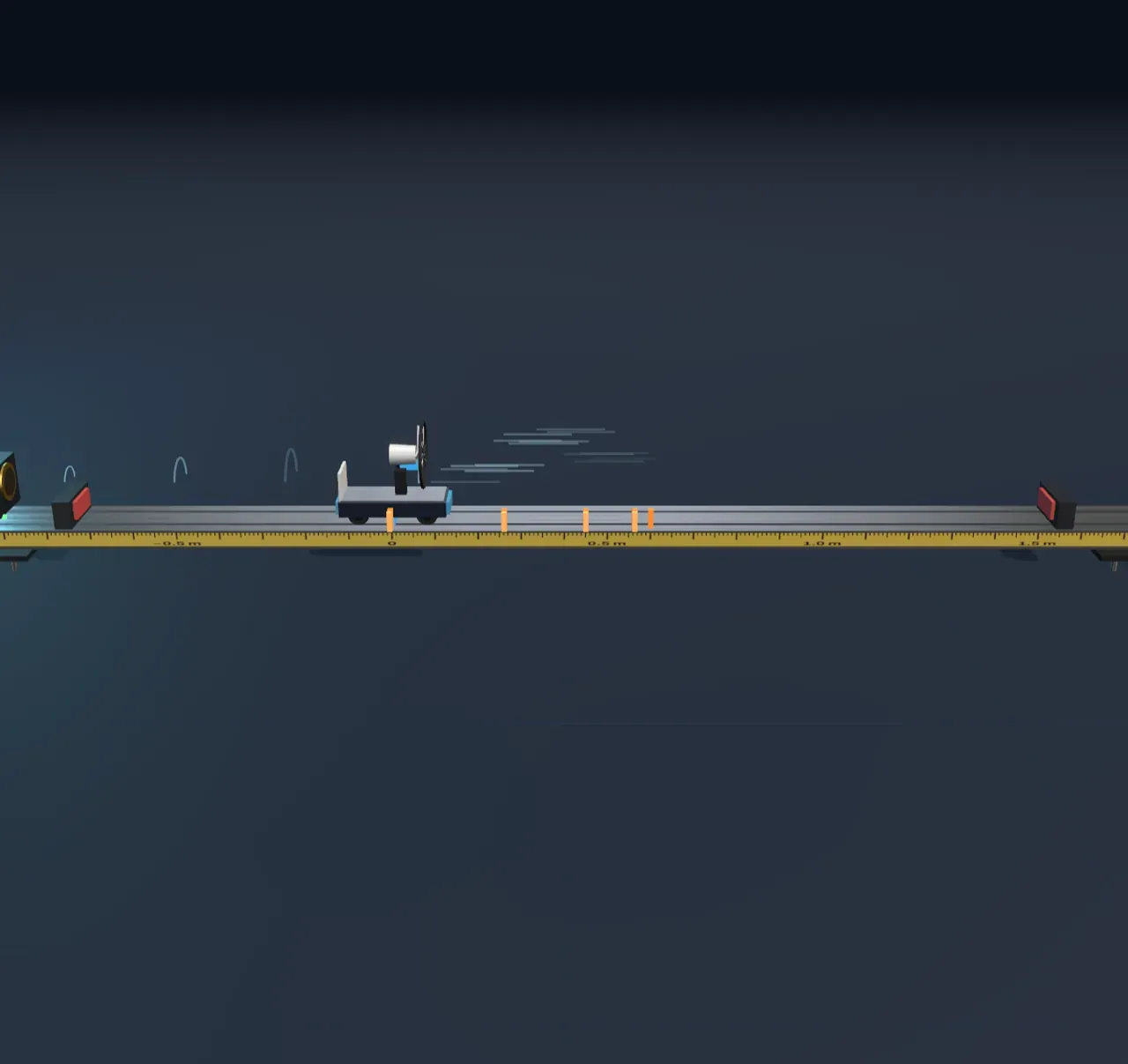
The cart sets off from rest on the start line, and the fan pushes it forward. Every second its velocity grows by 0.2 m/s. How fast the velocity changes is the acceleration:
A change in velocity in metres per second, divided by a time in seconds: the unit is m/s², metres per second every second. Here a = 0.2 m/s².
The position graph is no longer straight: each second the cart covers more ground than in the second before, and the curve gets ever steeper. The orange marks on the track spread further apart.
Step 2 of 6
A cart that is already moving
Now the cart crosses the start line already moving at 0.2 m/s, and the fan adds 0.15 m/s to that every second. The velocity after a time is the starting velocity plus what has been added:
A straight line again: on a velocity–time graph, is the intercept on the vertical axis and the acceleration is the slope. From rest , which leaves .
Step 3 of 6
A push against the motion
All three graphs are shown now, one under another on the same time axis: position, velocity and acceleration. The cart crosses the start line at 0.6 m/s, away from the sensor, and the fan is off.
In a moment the fan will come on and push backwards, towards the sensor, with an acceleration of −0.3 m/s², the whole time. Predict what the cart will do.
Step 4 of 6
Negative acceleration, and a cart that speeds up
With a Starting velocity of 0.6 m/s and an Acceleration of −0.3 m/s², the cart slowed down because its velocity and acceleration had opposite signs: the velocity was positive, and the acceleration was making it smaller. After the turn the velocity is negative, and the negative acceleration makes its size grow: the cart speeds up, backwards.
Now the cart is rolling back, towards the sensor, at 0.1 m/s, and the fan is off. In a moment it will come on and push towards the sensor as well, with an acceleration of −0.1 m/s². Predict: will the cart speed up or slow down?
Step 5 of 6
At the turning point
The rule: a cart speeds up when its velocity and acceleration have the same sign, and slows down when their signs are opposite. The acceleration on its own does not say whether the cart is slowing down; only comparing it with the velocity does.
In this run, starting at 0.6 m/s with an acceleration of −0.3 m/s², the cart stops for an instant two seconds in, at the top of the position graph’s arch, and there the velocity graph crosses zero. Look at the acceleration graph at that moment.
Step 6 of 6
Summary
- Acceleration is the rate at which velocity changes, , in m/s².
- With constant acceleration the velocity changes as : the velocity graph is a straight line and its slope is the acceleration.
- A cart speeds up when its velocity and acceleration have the same sign, and slows down when their signs are opposite. At the turning point the velocity is zero, and the acceleration is not.
Try it: change Starting velocity and Acceleration, and find a run where the cart starts off towards the sensor, stops and comes forward again. What do the signs have to be?
Loading the interactive version…
Loading the interactive version…
Each step sets up the Scene for you, and a control marked “fixed” stays put for that step.
Practice · Calculate
The cart sets off from rest, and the fan gives it an acceleration of 0.2 m/s². What is its velocity after three seconds?
Practice · Calculate
The cart sets off from rest, and the fan gives it an acceleration of 0.2 m/s². What is its velocity after three seconds?
Practice · Calculate
The cart crosses the start line at 0.2 m/s, and the fan gives it an acceleration of 0.15 m/s² in the same direction. What is its velocity after two seconds?
Practice · Calculate
The cart crosses the start line at 0.2 m/s, and the fan gives it an acceleration of 0.15 m/s² in the same direction. What is its velocity after two seconds?
Practice · Predict, then look
The cart is moving at 0.6 m/s away from the sensor. The fan will come on and push it towards the sensor, with an acceleration of −0.3 m/s², for the whole run. What will the cart do?
Practice · Predict, then look
The cart is moving at 0.6 m/s away from the sensor. The fan will come on and push it towards the sensor, with an acceleration of −0.3 m/s², for the whole run. What will the cart do?
Practice · Predict, then look
The cart is rolling towards the sensor at 0.1 m/s, that is v = −0.1 m/s. The fan will come on and push towards the sensor too, with an acceleration of −0.1 m/s². What will happen to the cart?
Practice · Predict, then look
The cart is rolling towards the sensor at 0.1 m/s, that is v = −0.1 m/s. The fan will come on and push towards the sensor too, with an acceleration of −0.1 m/s². What will happen to the cart?
Practice · Choose
In this run the cart stops for an instant after two seconds, and there it starts to come back. What is its acceleration at that moment?
Practice · Choose
In this run the cart stops for an instant after two seconds, and there it starts to come back. What is its acceleration at that moment?
Lesson complete. Every practice question here is done.