From the area under the velocity graph to three equations that solve any motion with constant acceleration: where the object is, when it stops, and why twice the speed means four times the braking distance.
Step 1 of 6 · Position from the area
So far you have read positions and velocities off the graphs. Here the graphs become three equations, which work even with no graph at all: a car braking, a train pulling out of a station, any object moving in a straight line with constant acceleration.
Step 1 of 6
Position from the area
With constant acceleration the velocity graph is a straight line from up to . The area under it, up to a time , is a rectangle with a triangle on top:
- The rectangle: height and width , area .
- The triangle: base and height , area .
The area is the displacement, so the position is
where is the starting position. In the scene . When the acceleration is negative the triangle is negative too, and it takes away from the displacement.
Step 2 of 6
When it stops
At the turning point the velocity is zero. So its time comes from the velocity equation, with :
That is a linear equation with one unknown: .
Step 3 of 6
Stopping on a mark
Together the two equations let you plan a run. If the cart has to stop at a given time, ties the starting velocity to the acceleration. If it also has to stop at a given place, fixes both. Work it out first, and only then move Starting velocity and Acceleration.
Step 4 of 6
Without the time
Sometimes the time is unknown and does not matter, for example when you want to know how many metres a car needs to stop. Solve the velocity equation for and put that into the position equation, and you are left with an equation without time:
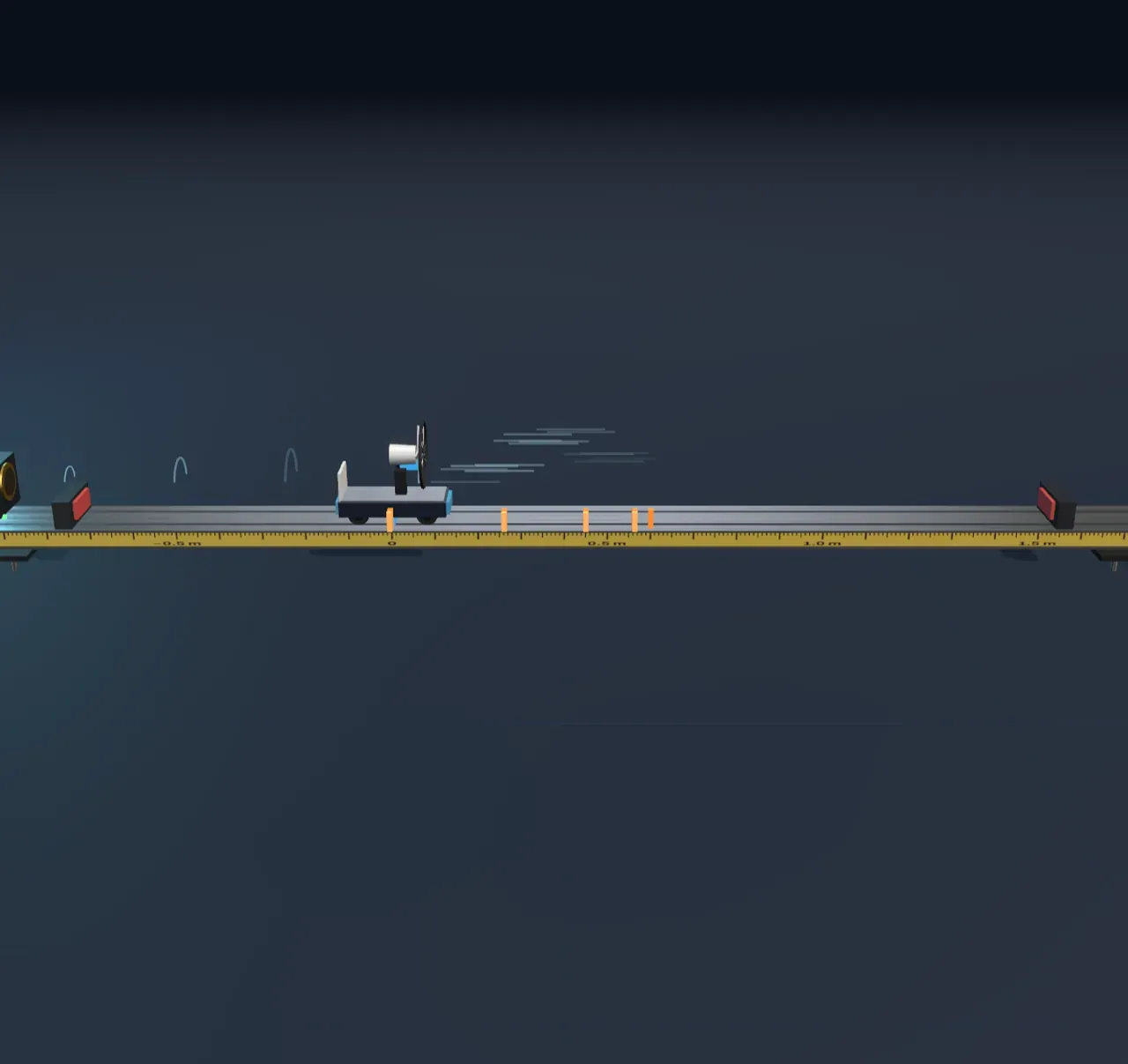
When the object stops, , and the stopping distance is . For the run on screen, 0.6 m/s and −0.3 m/s², that is metres: exactly the top of the arch.
Step 5 of 6
Twice the speed
Now the cart crosses the start line at 0.3 m/s, and the fan pushes back at −0.3 m/s². It stops after one second, 0.15 m from the start line. In a moment it will set off at twice the speed, with the same push. Predict how far it will get before it stops.
Step 6 of 6
Summary
For motion with constant acceleration , from position with starting velocity :
- Choose the equation by what you know and what you want: without the time, the third one.
- At the turning point , and the stopping distance is : twice the speed, four times the distance.
- In the projectile motion Unit the same equations describe a ball’s vertical motion, with the acceleration of free fall, .
Loading the interactive version…
Loading the interactive version…
Each step sets up the Scene for you, and a control marked “fixed” stays put for that step.
Practice · Calculate
The cart crosses the start line at 0.4 m/s, with an acceleration of −0.1 m/s². What is its position after three seconds?
Practice · Calculate
The cart crosses the start line at 0.4 m/s, with an acceleration of −0.1 m/s². What is its position after three seconds?
Practice · Calculate
The cart crosses the start line at 0.75 m/s, and the fan pushes back with an acceleration of −0.25 m/s². After how long does it stop?
Practice · Calculate
The cart crosses the start line at 0.75 m/s, and the fan pushes back with an acceleration of −0.25 m/s². After how long does it stop?
Practice · Reach the target
Set up a run in which the cart stops after exactly 1.5 s, 0.45 m from the start line. Change Starting velocity and Acceleration, and press Check.
Practice · Reach the target
Set up a run in which the cart stops after exactly 1.5 s, 0.45 m from the start line. Change Starting velocity and Acceleration, and press Check.
Practice · Calculate
A car travelling at 20 m/s (about 72 km/h) brakes with a constant acceleration of −5 m/s². How many metres does it cover before it stops?
Practice · Calculate
A car travelling at 20 m/s (about 72 km/h) brakes with a constant acceleration of −5 m/s². How many metres does it cover before it stops?
Practice · Predict, then look
At 0.3 m/s and with a backward push of −0.3 m/s², the cart stops 0.15 m from the start line. Now it will set off at 0.6 m/s, twice as fast, with the same push. How far from the start line will it stop?
Practice · Predict, then look
At 0.3 m/s and with a backward push of −0.3 m/s², the cart stops 0.15 m from the start line. Now it will set off at 0.6 m/s, twice as fast, with the same push. How far from the start line will it stop?
Lesson complete. Every practice question here is done.