Pressure is force spread over an area: a gas that pushes because its particles strike the walls, Boyle's law, particles that speed up as the square root of temperature, the gas law, and pressure that grows with depth under water.
Step 1 of 7 · Hits on the walls
Step 1 of 7
Hits on the walls
The air around you presses on every square centimetre of your skin with the weight of about a kilogram, and you don’t feel it, because it presses equally from every direction, and from inside you too. You feel it only when it is unbalanced: ears popping in a lift, or a can crushed when the air is pumped out of it.
Pressure is force spread over an area:
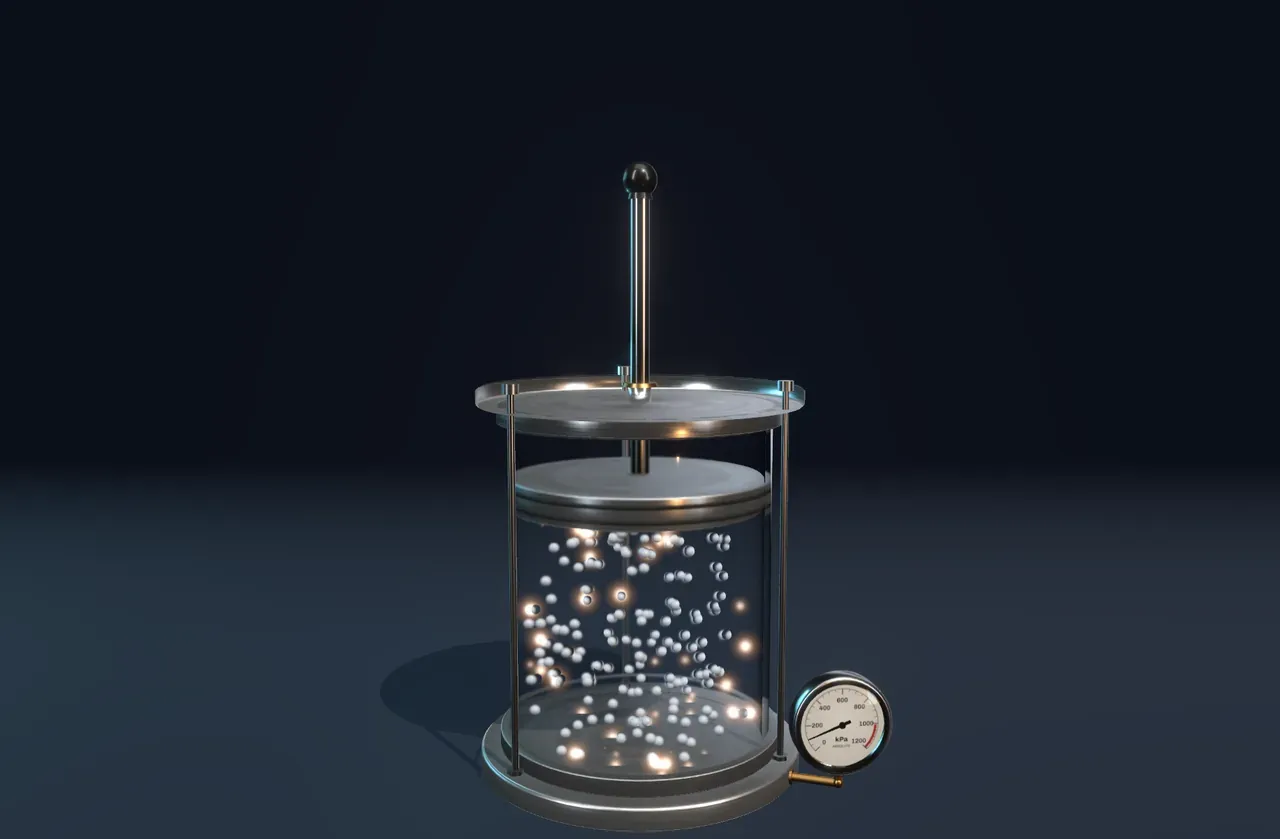
It is measured in pascals, one newton on every square metre. The air’s pressure at sea level is about 101 kPa, one atmosphere. The Scene has gas in a cylinder under a piston, and Show the wall hits is On: each flash is a particle striking the wall. The gauge beside the cylinder shows the pressure.
Step 2 of 7
Squeeze it
Push the piston down and the same particles have less room: they cross the cylinder faster, reach the walls more often, and there is less wall to share the hits over. Robert Boyle found in the 1660s that at a fixed temperature the pressure times the volume stays the same:
The Temperature is fixed at 300 K now, and the piston is at the top: Volume is 100%.
Step 3 of 7
Heat it
Heat the gas and the particles move faster. Not all at one speed: some dawdle and some race. But the temperature in kelvin grows in step with their average kinetic energy, . The gas here has been heated to 600 K, twice 300 K, and the Temperature is fixed.
Step 4 of 7
The gas law
Heated at a fixed volume, the particles hit the walls both more often and harder, and the two together double the pressure when the temperature doubles. Put both laws together and you have the gas law:
with the temperature in kelvin. That is why a tyre’s pressure is higher after a long drive, and why a sealed can heated in a fire can explode.
Step 5 of 7
Two atmospheres
Now it is up to you: both the Volume and the Temperature are free.
Step 6 of 7
Pressure with depth
Liquids press too, and their pressure grows with depth, because each layer carries the weight of everything above it:
is the air’s pressure on the surface, the liquid’s density and the depth. Ten metres of water add almost exactly one more atmosphere. That is why dams are thickest at the base, and why divers rise slowly.
Step 7 of 7
Hits in a hot gas
Back to the gas in the cylinder. Show the wall hits marks every hit of a particle on the wall with a flash. The gas has been heated to 600 K, and the volume has not changed.
Loading the interactive version…
Loading the interactive version…
Each step sets up the Scene for you, and a control marked “fixed” stays put for that step.
Practice · Choose
What makes the pressure the gas in the cylinder puts on the piston?
Practice · Choose
What makes the pressure the gas in the cylinder puts on the piston?
Practice · Predict, then look
The Volume is 100%, and the gauge reads about 71 kPa. The piston is pushed down to 50%, without changing the Temperature. Predict: what will the gauge read?
Practice · Predict, then look
The Volume is 100%, and the gauge reads about 71 kPa. The piston is pushed down to 50%, without changing the Temperature. Predict: what will the gauge read?
Practice · Calculate
The gas is heated from 300 K to 600 K. How many times faster do the particles typically move?
Practice · Calculate
The gas is heated from 300 K to 600 K. How many times faster do the particles typically move?
Practice · Predict, then look
The gas is at 70% Volume and 300 K, and the gauge reads about 101 kPa, one atmosphere. It is squeezed to 35% and heated to 600 K. Predict: what will the gauge read?
Practice · Predict, then look
The gas is at 70% Volume and 300 K, and the gauge reads about 101 kPa, one atmosphere. It is squeezed to 35% and heated to 600 K. Predict: what will the gauge read?
Practice · Reach the target
Change the Volume and the Temperature until the pressure is two atmospheres.
Practice · Reach the target
Change the Volume and the Temperature until the pressure is two atmospheres.
Practice · Choose
Every ten metres of water adds a pressure of about one atmosphere. What is the absolute pressure on a diver 20 m deep in the sea?
Practice · Choose
Every ten metres of water adds a pressure of about one atmosphere. What is the absolute pressure on a diver 20 m deep in the sea?
Practice · Calculate
The gas is at 70% Volume, and it is heated from 300 K to 600 K. How many times as many hits does each small patch of wall get each second?
Practice · Calculate
The gas is at 70% Volume, and it is heated from 300 K to 600 K. How many times as many hits does each small patch of wall get each second?
Lesson complete. Every practice question here is done.