Rain and rivers wear down a whole upland over two million years. Tell weathering from erosion, work out how much faster land wears in a monsoon, compare granite with sandstone, and follow the worn rock to the sea.
Step 1 of 6 · Weathering and erosion
Step 1 of 6
Weathering and erosion
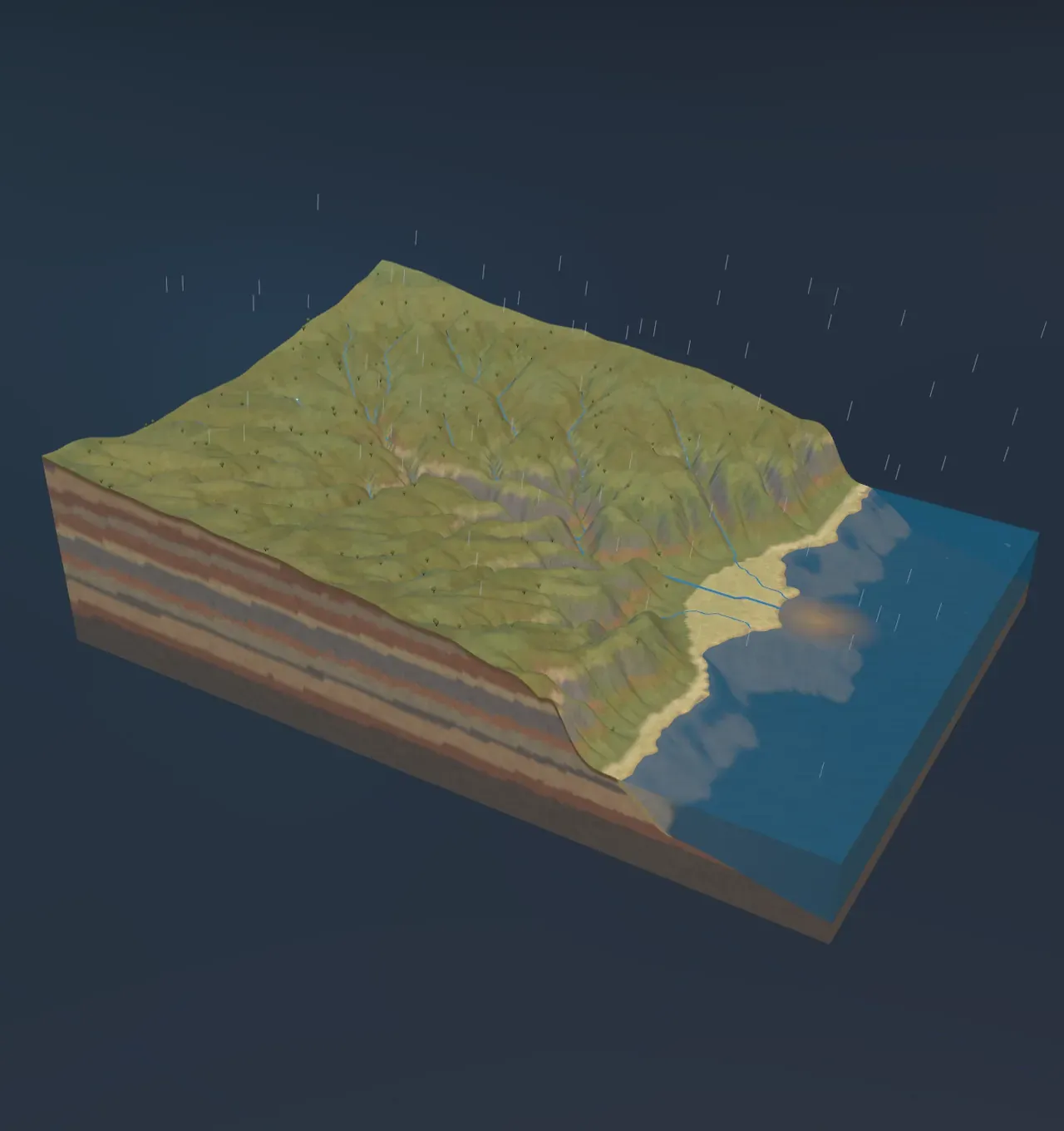
In the last Lesson the granite was raised to the surface and crumbled into sand. Here you see it happen on the scale of a whole landscape. In the Scene there is an upland by the sea, some tens of square kilometres, and Years runs from Young upland to 2 million years. Two processes work on it: weathering and erosion.
Step 2 of 6
The rivers cut down
Years is back near the start. The rain gathers into streams, the streams into rivers, and the water runs downhill to the sea. On the way it carries sand and gravel, and grinds its bed with them like sandpaper.
Step 3 of 6
Rain and pace
How fast the land wears depends on two things: the rain, which supplies the rivers’ water, and the rock’s strength, how hard it is to break. Rainfall and Rock strength are locked.
Step 4 of 6
Hard rock
Rainfall is back at 800 mm a year, a temperate climate, and Rock strength at 60 MPa, sandstone. The chart beside the Scene shows the main river’s bed against the surface of the young upland.
Step 5 of 6
Wear the upland down
A desert gets little rain, and granite is among the strongest rocks. So in such a landscape sharp cliffs and narrow canyons survive for millions of years, as in Makhtesh Ramon.
Step 6 of 6
To the sea
Years is at 2 million years. Where the river meets the sea it slows and drops what it carries, and a delta grows out into the water. A plume of mud trails from it out to sea.
Loading the interactive version…
Loading the interactive version…
Each step sets up the Scene for you, and a control marked “fixed” stays put for that step.
Practice · Choose
Water gets into a crack in a rock, freezes, expands and splits it, and the pieces stay where they are. Later rain washes them into a stream, which carries them off. Which part is weathering and which erosion?
Practice · Choose
Water gets into a crack in a rock, freezes, expands and splits it, and the pieces stay where they are. Later rain washes them into a stream, which carries them off. Which part is weathering and which erosion?
Practice · Choose
At this stage the rivers are cutting valleys into the upland. Where does a river cut fastest?
Practice · Choose
At this stage the rivers are cutting valleys into the upland. Where does a river cut fastest?
Practice · Calculate
Rainfall is locked at 2500 mm a year, a monsoon, and Rock strength at 60 MPa, sandstone. In the Scene the pace at which the land wears grows with the square root of the rain, and falls in inverse proportion to the rock’s strength. How many times faster does the land wear here than with 800 mm a year on the same rock?
Practice · Predict, then look
After million years of temperate rain on sandstone, the upland has worn into broad valleys. Predict: how will the same upland look after the same time if Rock strength is 180 MPa, granite?
Practice · Predict, then look
After million years of temperate rain on sandstone, the upland has worn into broad valleys. Predict: how will the same upland look after the same time if Rock strength is 180 MPa, granite?
Practice · Reach the target
In a desert, on granite, the upland has hardly worn at all. Change Rainfall and Rock strength until the upland is worn down to low, rounded hills, fast wearing, and press Check.
Practice · Reach the target
In a desert, on granite, the upland has hardly worn at all. Change Rainfall and Rock strength until the upland is worn down to low, rounded hills, fast wearing, and press Check.
Practice · Choose
After two million years about 5.8 km³ of rock has been worn from the upland. What became of most of it?
Practice · Choose
After two million years about 5.8 km³ of rock has been worn from the upland. What became of most of it?
Lesson complete. Every practice question here is done.