A glowing gas gives out only certain wavelengths: jumps between the atom's energy levels. Each element gives a barcode of its own, and that is how we know what stars are made of, even from the dark lines in their light.
Step 1 of 6 · A barcode
Step 1 of 6
A barcode
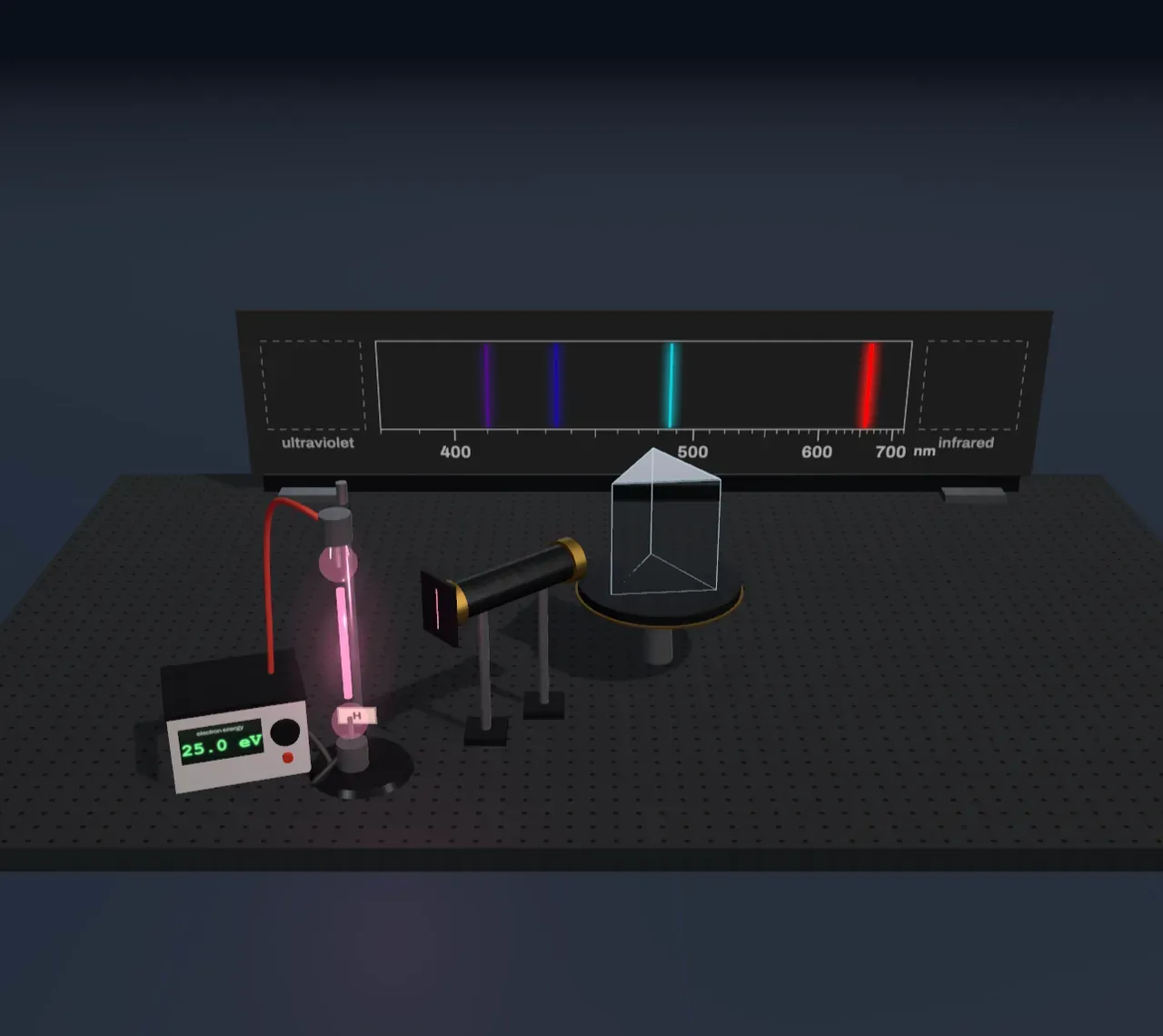
A hot solid or a dense gas gives a continuous spectrum, like the lump in the last Lesson. A thin gas behaves differently. In the Scene there is a tube of hydrogen: a high voltage speeds electrons through the gas, and they collide with the atoms. The light passes through a prism, which spreads it out by wavelength on the screen.
Step 2 of 6
The energy of a photon
In the Unit on modern physics we saw that light comes in photons, , and that an atom has fixed energy levels. A collision lifts an electron to a high level, and it comes back down in one jump or several, and each jump gives out one photon with the difference between the levels:
Show the energy jumps shows hydrogen’s ladder of levels and the jump behind each line. Gas in the tube is locked.
Step 3 of 6
Enough energy
A line appears only when the collisions can lift atoms to its upper level. Electron energy is the energy each electron brings to a collision, and for now it is too low. The ladder of Show the energy jumps shows the levels.
Step 4 of 6
Fingerprints
Each element has different levels, so a different barcode. This is spectroscopy: identifying a substance by its light, even from far away. Gas in the tube is now hidden. Look at the barcode.
Step 5 of 6
An element from the Sun
Gas in the tube is locked on helium, and Show the energy jumps shows its levels. The strong yellow line at 587.6 nm was first found in sunlight, before anyone had seen this element on Earth.
Step 6 of 6
Dark lines
In 1814 Joseph von Fraunhofer saw that the rainbow of sunlight is crossed by hundreds of thin dark lines. Forty-five years later Kirchhoff and Bunsen realised that sodium’s dark lines in the Sun are exactly where sodium’s bright lines are in a flame.
Loading the interactive version…
Loading the interactive version…
Each step sets up the Scene for you, and a control marked “fixed” stays put for that step.
Practice · Choose
A tube of hydrogen glows, and the prism spreads its light out. On the screen there are only a few coloured lines, not a continuous rainbow. Why?
Practice · Choose
A tube of hydrogen glows, and the prism spreads its light out. On the screen there are only a few coloured lines, not a continuous rainbow. Why?
Practice · Calculate
Hydrogen’s strong red line comes from the jump from level , 12.09 eV above the ground state, to , at 10.20 eV. What is its wavelength? .
Practice · Calculate
Hydrogen’s strong red line comes from the jump from level , 12.09 eV above the ground state, to , at 10.20 eV. What is its wavelength? .
Practice · Reach the target
The electrons in the tube now bring 8 eV to a collision, not enough to excite a single atom. Raise Electron energy until exactly one visible line appears, and press Check.
Practice · Reach the target
The electrons in the tube now bring 8 eV to a collision, not enough to excite a single atom. Raise Electron energy until exactly one visible line appears, and press Check.
Practice · Choose
The gas in the tube is hidden. Its barcode: a pair of close yellow lines at 589 nm, far brighter than all the rest, and a few faint lines. What gas is in the tube?
Practice · Choose
The gas in the tube is hidden. Its barcode: a pair of close yellow lines at 589 nm, far brighter than all the rest, and a few faint lines. What gas is in the tube?
Practice · Calculate
In 1868 a yellow line was found in sunlight at 587.6 nm that no known element gave. That is how helium was discovered. What is the energy of a photon in that line? .
Practice · Calculate
In 1868 a yellow line was found in sunlight at 587.6 nm that no known element gave. That is how helium was discovered. What is the energy of a photon in that line? .
Practice · Choose
When sunlight is spread out in a good spectroscope, its rainbow is full of thin dark lines. What are they?
Practice · Choose
When sunlight is spread out in a good spectroscope, its rainbow is full of thin dark lines. What are they?
Lesson complete. Every practice question here is done.