A star shines by nuclear fusion, and its mass decides everything: how bright it is, how long it lives, and how it ends, as a white dwarf, a neutron star or a black hole.
Step 1 of 6 · A ball of gas
Step 1 of 6
A ball of gas
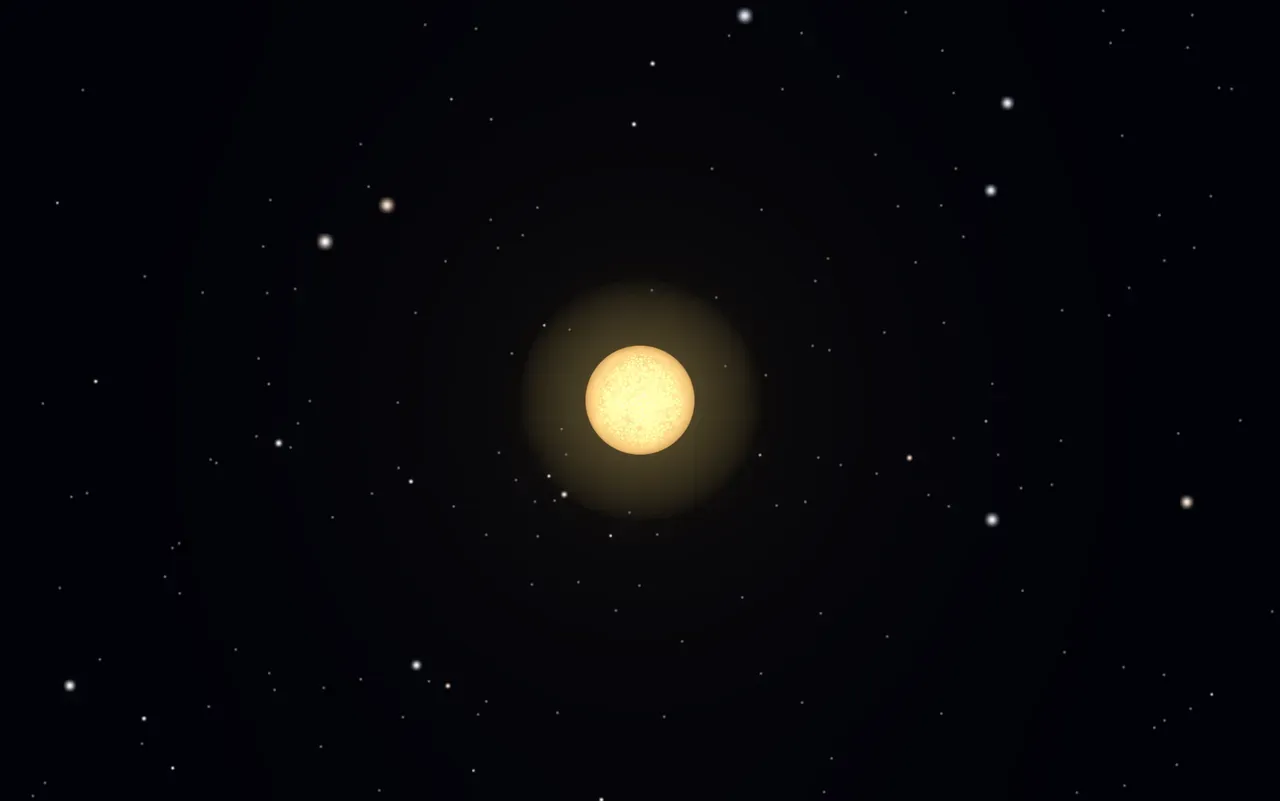
A star is born when a cloud of gas and dust collapses under its own gravity. The collapse squeezes and heats the centre, until it is hot enough to light a reaction no bonfire could imitate. Age the star is a timeline here, from Birth to End. It is now at the long, steady stage, and the star has the mass of the Sun.
Step 2 of 6
Mass and power
Gravity squeezes the star inward, and the pressure of the hot gas in the core pushes outward. In a heavier star gravity is stronger, so the core has to be hotter and denser to hold it up, and fusion there runs far faster. On the main sequence, the stage when a star fuses hydrogen in its core, its power grows roughly like
Here and are the Sun’s power and mass. Starting mass is locked at solar masses.
Step 3 of 6
Heavy and brief
A heavy star has more fuel, but it burns it faster. Predict which wins.
Step 4 of 6
How long
The time on the main sequence is the fuel divided by the rate of burning, . The Sun will spend about ten billion years there, so
The Scene shows this lifetime in billions of years. Starting mass is locked.
Step 5 of 6
The end of the Sun
Age the star has reached the end. When the hydrogen in the core runs out, fusion moves to a shell round it, and the star swells and cools into a red giant. What happens next depends on the mass.
Step 6 of 6
Heavy endings
A heavy star fuses helium into carbon, and then heavier and heavier elements, up to iron. Fusing iron gives out no energy, so the core loses its support and collapses all at once. The collapse blasts the rest of the star outward in a supernova, scattering into space the elements made inside it. The carbon in our bodies and the iron in our blood were made in stars like that.
Loading the interactive version…
Loading the interactive version…
Each step sets up the Scene for you, and a control marked “fixed” stays put for that step.
Practice · Choose
The Sun has shone for about billion years, at almost the same power. Where does its energy come from?
Practice · Choose
The Sun has shone for about billion years, at almost the same power. Where does its energy come from?
Practice · Calculate
Starting mass is locked at solar masses. On the main sequence, a star’s power grows roughly like . How many times brighter than the Sun does it shine?
Practice · Calculate
Starting mass is locked at solar masses. On the main sequence, a star’s power grows roughly like . How many times brighter than the Sun does it shine?
Practice · Predict, then look
The Sun will spend about ten billion years on the main sequence. A star of solar masses has times the fuel. How long will it live compared with the Sun?
Practice · Predict, then look
The Sun will spend about ten billion years on the main sequence. A star of solar masses has times the fuel. How long will it live compared with the Sun?
Practice · Calculate
Starting mass is locked at solar masses. Using billion years, with in solar masses, how many billion years will the star spend on the main sequence?
Practice · Calculate
Starting mass is locked at solar masses. Using billion years, with in solar masses, how many billion years will the star spend on the main sequence?
Practice · Choose
Age the star has reached the end of the life of a star of one solar mass. What will be left of the Sun in about eight billion years?
Practice · Choose
Age the star has reached the end of the life of a star of one solar mass. What will be left of the Sun in about eight billion years?
Practice · Reach the target
Change Starting mass until the star ends its life in a supernova and leaves a neutron star, and press Check.
Practice · Reach the target
Change Starting mass until the star ends its life in a supernova and leaves a neutron star, and press Check.
Lesson complete. Every practice question here is done.