The distance ladder: parallax for nearby stars, parsecs and light years, and the inverse-square law with standard candles, Cepheids and supernovae, for distant galaxies.
Step 1 of 6 · Parallax
Step 1 of 6
Parallax
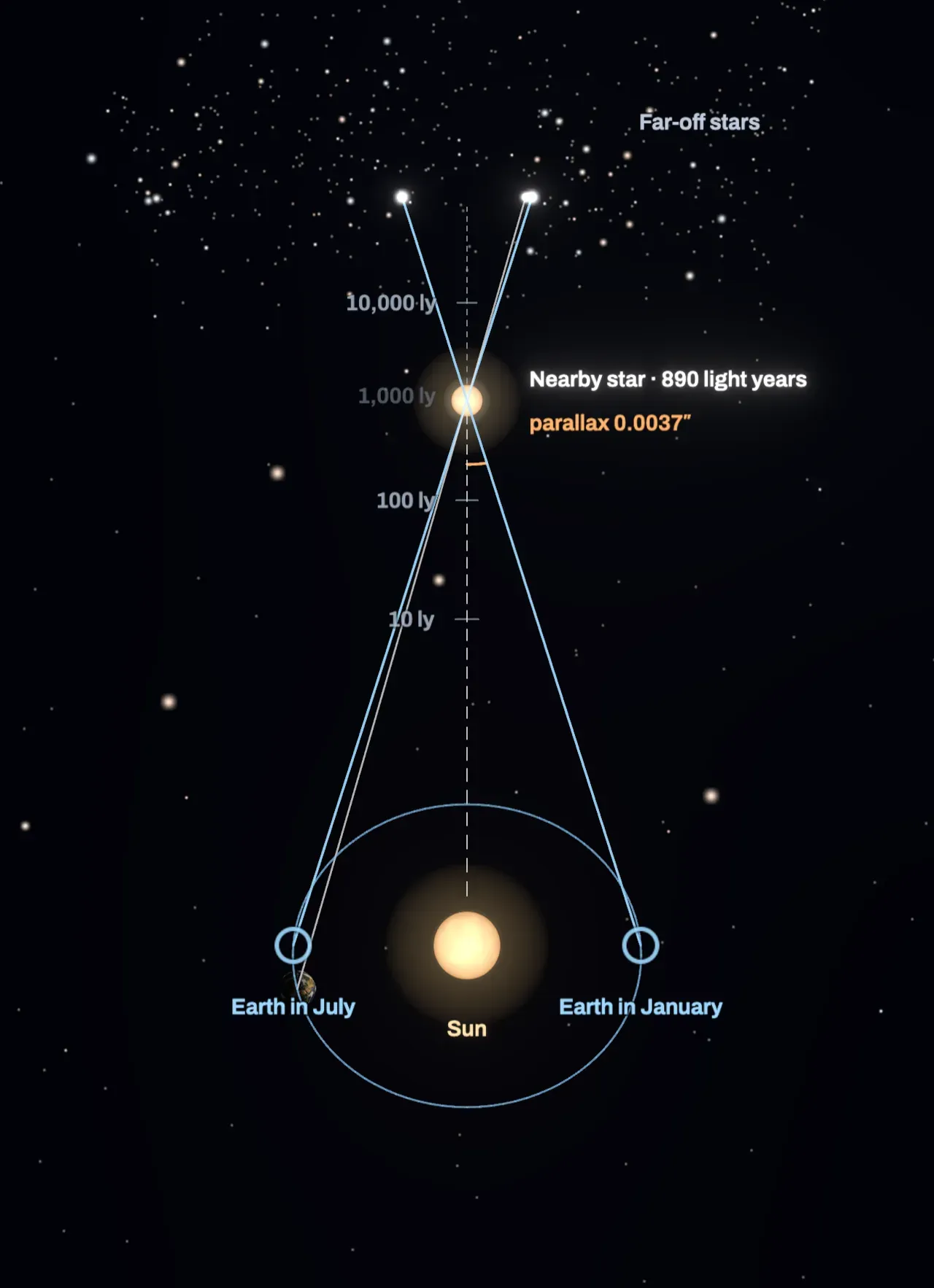
Hold a finger in front of your eyes, and close first one eye and then the other: the finger jumps against the room behind it. The closer it is, the more it jumps. This is parallax. The Earth does the same on a large scale: in January and in July it is on opposite sides of the Sun, apart, and a nearby star seems to move against the distant stars.
The parallax is half the angle through which the star moves, and it is very small: it is measured in arcseconds, of a degree. In the Scene the star is light years away, like Delta Cephei.
Step 2 of 6
Parsecs
The distance at which the parallax is exactly one arcsecond is called a parsec, from “parallax of one second”. One parsec is about light years, about . In parsecs the formula is simple:
with in parsecs and in arcseconds. Star distance is locked. The reading beside the Scene shows the parallax.
Step 3 of 6
The nearest star
In 1838 Friedrich Bessel measured the parallax of a star for the first time. Today the Gaia satellite measures the parallaxes of more than a billion stars, out to thousands of light years. Star distance is now that of Alpha Centauri, our neighbour.
Step 4 of 6
Standard candles
Farther out, parallax is lost. What is left is brightness. The light of a source giving out a power spreads over a sphere, so at a distance each square metre receives
If you know , the brightness gives . A source like that is called a standard candle. Climb the ladder has reached Cepheids: stars that swell and shrink, their brightness rising and falling with a fixed period.
Step 5 of 6
The inverse-square law
The brightest standard candle is a Type Ia supernova: a white dwarf that has pulled matter from a companion star until it reached a critical mass and blew up. All these supernovae reach almost the same luminosity at their peak, billions of suns. Climb the ladder has reached the supernova stage, with a calibrating galaxy million light years from us, whose distance is known from its Cepheids. Galaxy distance is locked.
Step 6 of 6
A hundred times fainter
Each rung of the ladder is calibrated by the rung below it: parallax calibrates the Cepheids, and the Cepheids calibrate the supernovae. Star distance and Cepheid period are locked, leaving only Galaxy distance.
Loading the interactive version…
Loading the interactive version…
Each step sets up the Scene for you, and a control marked “fixed” stays put for that step.
Practice · Predict, then look
A nearby star seems to move against the background of distant stars between January and July, as the Earth goes to the other side of the Sun. The star is moved from to light years away, twice as far. What will happen to its parallax?
Practice · Predict, then look
A nearby star seems to move against the background of distant stars between January and July, as the Earth goes to the other side of the Sun. The star is moved from to light years away, twice as far. What will happen to its parallax?
Practice · Calculate
Star distance is locked at light years, like Delta Cephei. One parsec is light years. What is the star’s parallax, in arcseconds?
Practice · Calculate
Star distance is locked at light years, like Delta Cephei. One parsec is light years. What is the star’s parallax, in arcseconds?
Practice · Calculate
Proxima Centauri, the nearest star to the Sun, has the largest parallax ever measured: arcseconds. How far away is it?
Practice · Calculate
Proxima Centauri, the nearest star to the Sun, has the largest parallax ever measured: arcseconds. How far away is it?
Practice · Choose
Beyond a few thousand light years the parallax is too small to measure. Why do astronomers then look for pulsating stars of the Cepheid kind in particular?
Practice · Choose
Beyond a few thousand light years the parallax is too small to measure. Why do astronomers then look for pulsating stars of the Cepheid kind in particular?
Practice · Calculate
Type Ia supernovae all reach the same luminosity at their peak. The calibrating galaxy is million light years away, and the target’s Galaxy distance is locked at million. How many times fainter will the target’s supernova look?
Practice · Calculate
Type Ia supernovae all reach the same luminosity at their peak. The calibrating galaxy is million light years away, and the target’s Galaxy distance is locked at million. How many times fainter will the target’s supernova look?
Practice · Reach the target
A supernova in a distant galaxy looks times fainter than the one in the calibrating galaxy, million light years away. Change Galaxy distance until its supernova looks times fainter, and press Check.
Practice · Reach the target
A supernova in a distant galaxy looks times fainter than the one in the calibrating galaxy, million light years away. Change Galaxy distance until its supernova looks times fainter, and press Check.
Lesson complete. Every practice question here is done.