A light in the sky, but how far?
A point of light in the night sky tells you its direction and its brightness, and nothing more. A faint star might be an ordinary star nearby or a brilliant one far away. Nobody can stretch a tape measure to it or bounce radar off it: radar works for the Moon, the planets and some asteroids, and the nearest star is already 4.2 light years away, about 270,000 times as far as the Sun.
So astronomers measure the distances of the stars and galaxies in steps. The first step uses plain geometry and reaches only the nearest part of our own galaxy. Each step after it uses a kind of object whose true brightness is known, and the first examples of each kind are measured with the step below. That chain is the cosmic distance ladder.
Rung one: parallax
Hold up a thumb at arm’s length and look at it with one eye, then the other. It jumps against the wall behind, because each eye sees it from a slightly different place. Bring it closer and it jumps more. That jump is parallax, and it is how the eyes and the brain judge depth.
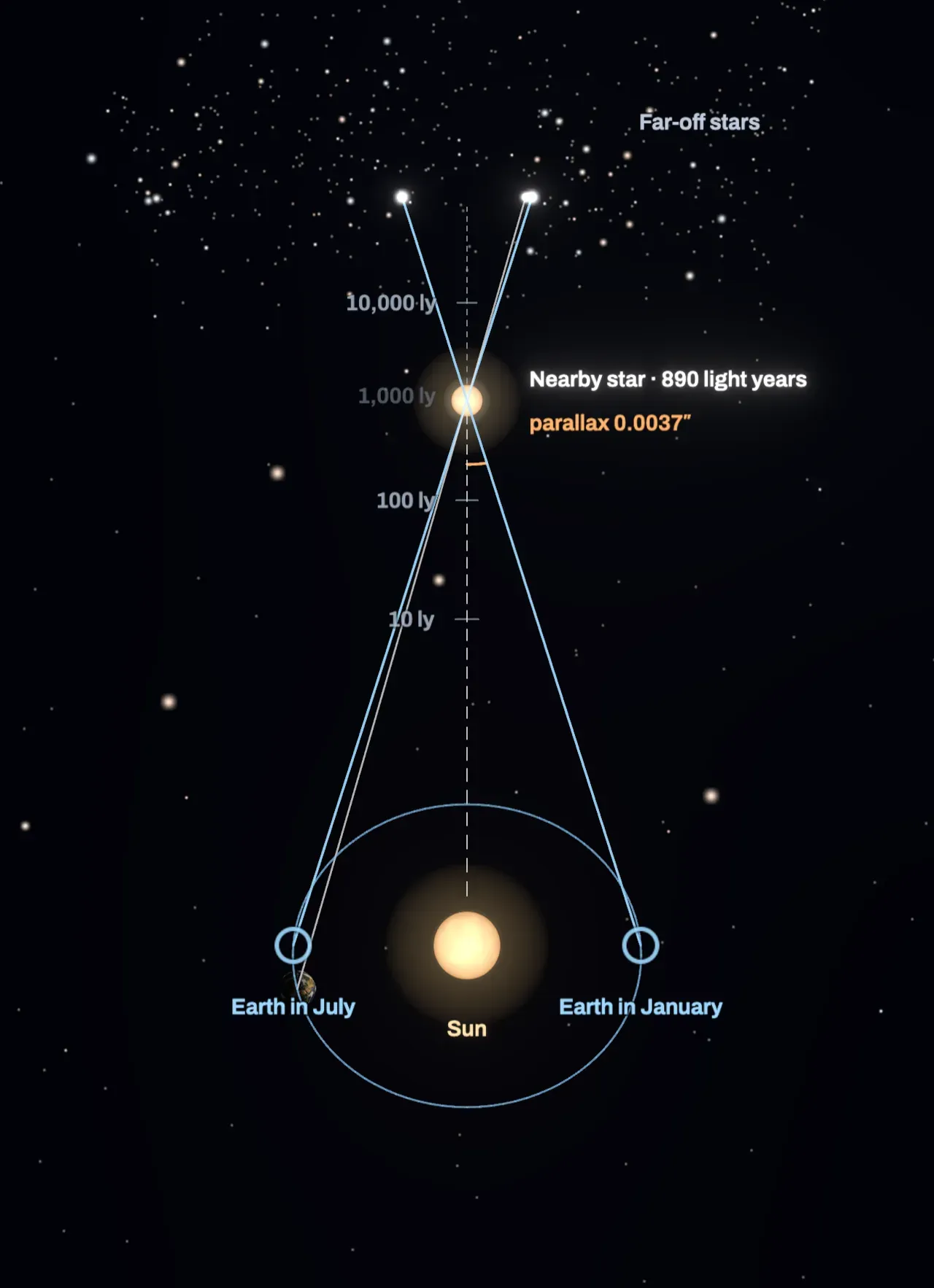
The stars do the same as the Earth goes round the Sun. Seen in January and again in July, from opposite sides of an orbit 300 million kilometres across, a nearby star shifts a tiny amount against the far more distant stars behind it. Half the shift is the star’s parallax angle, . Because the baseline is known, the angle gives the distance by geometry alone, with no assumption about what kind of star it is. Astronomers named a unit after it: a star with a parallax of one arcsecond (a 3,600th of a degree) is one parsec away, 3.26 light years, and
Even the nearest star has a parallax smaller than one arcsecond, the width of a coin seen from four kilometres away. The first successful measurements came only in 1838, when Friedrich Bessel found a shift of about a third of an arcsecond for the star 61 Cygni and put it about ten light years away. A century and a half later the Hipparcos satellite measured the parallaxes of more than a hundred thousand stars to about a thousandth of an arcsecond. The Gaia satellite, launched in 2013, has measured more than a billion, the brightest to about twenty millionths of an arcsecond.
Try it: drag Star distance from Alpha Centauri to Delta Cephei. The two sight lines from Earth in January and July close up, and the star’s two images on the far-off stars move together. At Centre of the Milky Way the chart shows the shift has fallen below what Gaia can measure well.
The smaller the angle, the larger the error in proportion. Gaia’s parallaxes give distances good to about ten per cent out to roughly 16,000 light years, a sixth of the way across the Milky Way. Beyond that the first rung runs out.
Rung two: Cepheid variables
Some stars pulse. A Cepheid variable is a yellow supergiant star, four to twenty times heavier than the Sun and hundreds to tens of thousands of times as luminous, that swells and shrinks with a steady rhythm, brightening quickly and fading slowly, over a few days to a few months. The first one known, Delta Cephei, was noticed in 1784 and gave the class its name.
In 1908 Henrietta Swan Leavitt, measuring photographic plates at Harvard College Observatory, studied the variable stars of the Small Magellanic Cloud, a small galaxy beside our own. All its stars are at about the same distance from us, so their brightness on the plates could be compared directly. Leavitt noticed, and in 1912 showed, that the brighter Cepheids took longer to pulse. The period gives away the true brightness: in visible light, a Cepheid that pulses ten times more slowly is about ten times more luminous. This is Leavitt’s law.
Her law said which Cepheids were brighter than which, but not by how much in absolute terms. To fix its scale, astronomers needed the true distance of some Cepheids, which is the job of the rung below. Gaia and the Hubble Space Telescope have now measured the parallaxes of hundreds of Cepheids in the Milky Way. Their distances give their luminosities, and those pin down the law.
After that, any Cepheid anywhere is a measuring stick. Time its pulse to learn its luminosity, measure how bright it looks, and the inverse-square law does the rest: light spreads over a sphere that grows with the square of the distance, so a star twice as far looks four times fainter.
This is how Edwin Hubble settled, in 1923 and 1924, what the Andromeda nebula is. He found Cepheids in it, timed them, and showed that they lie far outside the Milky Way: Andromeda is a galaxy of its own, now known to be 2.5 million light years away.
Try it: step Climb the ladder to Cepheids. The scene zooms out until the Solar System is a speck at the Sun’s place in the Milky Way. Change Cepheid period: a longer period makes the galaxy’s Cepheid pulse more slowly and shine brighter, and the chart reads its luminosity off Leavitt’s law. Then move Galaxy distance to Coma cluster.
Cepheids are bright, but not bright enough for everything. The Hubble Space Telescope can pick them out of the glow of their galaxy to about 100 million light years, the longest-period ones a little farther. The chart beside the scene shows how the reach grows with the period.
Rung three: exploding white dwarfs
A white dwarf is the hot core left when a star like the Sun dies, a body about the size of the Earth with more than half the mass of the Sun. Paired with a companion star, a white dwarf can gain matter until it nears about 1.4 times the Sun’s mass, or merge with a second white dwarf, and then carbon fusion runs away through the whole star and blows it apart. That explosion is a Type Ia supernova. For a few weeks it shines as brightly as a whole galaxy, at its peak about four to five billion times as bright as the Sun.
Type Ia supernovae are not all exactly alike. In the 1990s astronomers found that the brighter ones fade more slowly, so the shape of the light curve over the weeks after the peak corrects for the difference. Once corrected, their peak brightness varies by only about ten to fifteen per cent, so a single supernova gives a distance good to about seven per cent. That makes them a standard candle that can be seen across billions of light years.
Like Cepheids, they need a calibration. A supernova of this type goes off in a galaxy like ours only once every century or two, so astronomers wait for those few that happen in galaxies near enough for Cepheids. There, the Cepheids give the galaxy’s distance, the distance gives the supernova’s true brightness, and that brightness then measures every other Type Ia supernova. One seen a hundred times fainter than the calibrating one is ten times farther away.
Try it: step Climb the ladder to Supernovae. Both supernovae flare together, and the farther one looks fainter (the scene softens the difference so it stays visible). Move Galaxy distance from Virgo cluster to Two billion light years and read the chart: the supernova’s light falls by the square of the distance, and the distance follows from the square root.
Each rung holds up the next
Every rung above the first borrows its scale from the rung below. If the parallaxes of the Milky Way’s Cepheids came out a few per cent too large, the Cepheids would be judged a little nearer and fainter than they are, every galaxy measured with them would seem a little nearer, and so would every supernova calibrated in those galaxies. An error at the bottom runs all the way up the ladder. That is why astronomers keep re-measuring the bottom rungs, and why they look for more than one route up: eclipsing double stars in the Large Magellanic Cloud and the motions of gas around the black hole of the galaxy NGC 4258 give independent anchors for the Cepheids.
The top of the ladder is the expansion of the universe. Galaxies far away recede at speeds in proportion to their distance, so once supernovae have measured the distances of enough galaxies, a galaxy’s redshift alone gives its distance. The same supernova distances showed in 1998 that the expansion is speeding up. The ladder’s measurement of today’s expansion rate, about 73 kilometres a second for every megaparsec, disagrees with the 67 or so predicted from the early universe, and finding out which, if either, has a hidden error is one of the open questions of cosmology.
What this model leaves out
- Distances are squeezed. Each line of sight is drawn on a logarithmic scale, every tick ten times farther than the one before, so a star four light years away and one at 30,000 fit the same view. For the true sizes from atoms up to the observable universe, see the scale of the universe.
- The parallax angle is drawn enormous. The real shift of even the nearest star is under an arcsecond, millions of times too small to see in the scene. The far-off stars are shown as a band behind the near one. Gaia does not in fact measure against background stars: it measures the angles between stars in two fields of view far apart on the sky, which gives each star’s parallax directly.
- Brightness is compressed. On screen, faint Cepheids and supernovae are shown brighter than the inverse-square law would make them, so they stay visible. The charts follow the true law.
- The Cepheids are simplified. Leavitt’s law here is one straight line in visible light, for the absolute magnitude and the period in days, with no spread for colour, metal content or dust, and a Cepheid counts as seen while its average magnitude is brighter than 27. Real measurements use infrared light, where dust matters less, and correct for crowding by other stars.
- The supernovae are all the same. Each peaks at the same corrected brightness and follows one light curve. At two billion light years the expansion of space also makes “distance” mean several slightly different things; the scene uses the plain inverse-square law.
- Other rungs exist. Radar to the planets fixes the size of Earth’s orbit, the base of the whole ladder. The tip of the red giant branch, eclipsing binaries, masers and galaxy scaling relations give other steps that cross-check the ones shown.