A glowing body gives out a continuous spectrum that depends only on its temperature. Wien's law links the peak to the temperature, the Stefan–Boltzmann law the power, and together they read a star's temperature from its colour.
Step 1 of 6 · The colour of heat
Step 1 of 6
The colour of heat
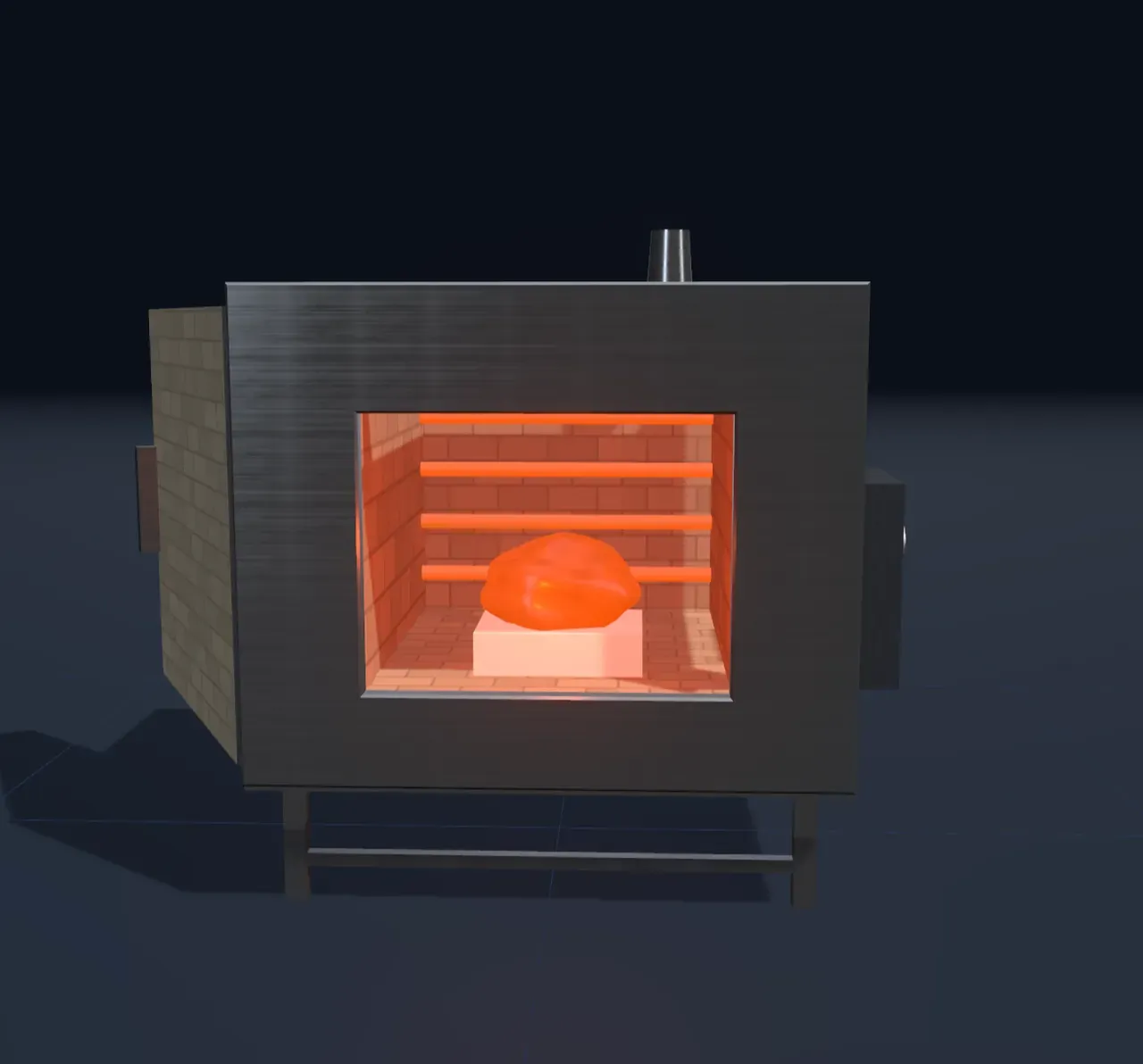
You cannot send a thermometer to a star, but you can take its light apart. In the Scene a lump of tungsten sits in an open furnace, glowing red at 950 K. Every warm body gives out electromagnetic waves, and what it gives out depends almost only on its temperature, not on the material: such a body is called a blackbody, because it absorbs all the light that falls on it. Stars are very close to blackbodies.
Change Temperature of the lump and watch the colour change: below about 800 K it does not glow at all, and then it goes red, orange, yellow and white.
Step 2 of 6
Wien’s law
Show the whole spectrum shows the whole curve, including the part the eye cannot see: how much light the lump gives out at each wavelength. The curve has a peak, and Wien’s displacement law says where:
Here is in kelvin. The peak goes inversely with the temperature: a body twice as hot gives out mostly at half the wavelength. Temperature of the lump is locked at 1300 K.
Step 3 of 6
Hotter and shorter
Predict what will happen to the curve as the lump heats up, then compare with the reading of the peak.
Step 4 of 6
One micrometre
Now turn Wien’s law round: if you know where the peak is, you know the temperature. That is how a star’s temperature is measured.
Step 5 of 6
The fourth power
As the lump heats up, the curve does not only move: it also grows enormously. The area under it is the total power each square metre gives out, and the Stefan–Boltzmann law says how much:
The power reading is beside the Scene. A whole star’s power is times its surface area, : a star can be bright because it is hot, or because it is huge.
Step 6 of 6
The Sun’s temperature
The furnace goes only up to 3000 K. Show the whole spectrum now adds, as a dashed line, the Sun’s curve for comparison. Use its peak.
Loading the interactive version…
Loading the interactive version…
Each step sets up the Scene for you, and a control marked “fixed” stays put for that step.
Practice · Choose
Orion has a red star, Betelgeuse, and a bluish-white one, Rigel. Which of them is hotter at its surface?
Practice · Choose
Orion has a red star, Betelgeuse, and a bluish-white one, Rigel. Which of them is hotter at its surface?
Practice · Calculate
Temperature of the lump is locked at 1300 K, and it glows orange-red. At what wavelength is the peak of its radiation? .
Practice · Calculate
Temperature of the lump is locked at 1300 K, and it glows orange-red. At what wavelength is the peak of its radiation? .
Practice · Predict, then look
The lump is red hot, at 950 K. It is heated to 1800 K, yellow hot. Which way will the peak of the curve move?
Practice · Predict, then look
The lump is red hot, at 950 K. It is heated to 1800 K, yellow hot. Which way will the peak of the curve move?
Practice · Reach the target
Change Temperature of the lump until the peak of its radiation is at exactly 1000 nm, one micrometre, and press Check.
Practice · Reach the target
Change Temperature of the lump until the peak of its radiation is at exactly 1000 nm, one micrometre, and press Check.
Practice · Predict, then look
At 1300 K each square metre of the lump gives out about 162 kW. The temperature is doubled to 2600 K. How many times more power will it give out?
Practice · Predict, then look
At 1300 K each square metre of the lump gives out about 162 kW. The temperature is doubled to 2600 K. How many times more power will it give out?
Practice · Calculate
Show the whole spectrum has added the curve of sunlight, and its peak is at about 502 nm, in blue-green light. What is the temperature of the Sun’s surface?
Practice · Calculate
Show the whole spectrum has added the curve of sunlight, and its peak is at about 502 nm, in blue-green light. What is the temperature of the Sun’s surface?
Lesson complete. Every practice question here is done.