Our nearest star from the inside: its layers from the core to the surface, the sunspots that come and go in an 11-year cycle, and the magnetic field that flips and makes them.
Step 1 of 5 · From the core to the surface
Step 1 of 5
From the core to the surface
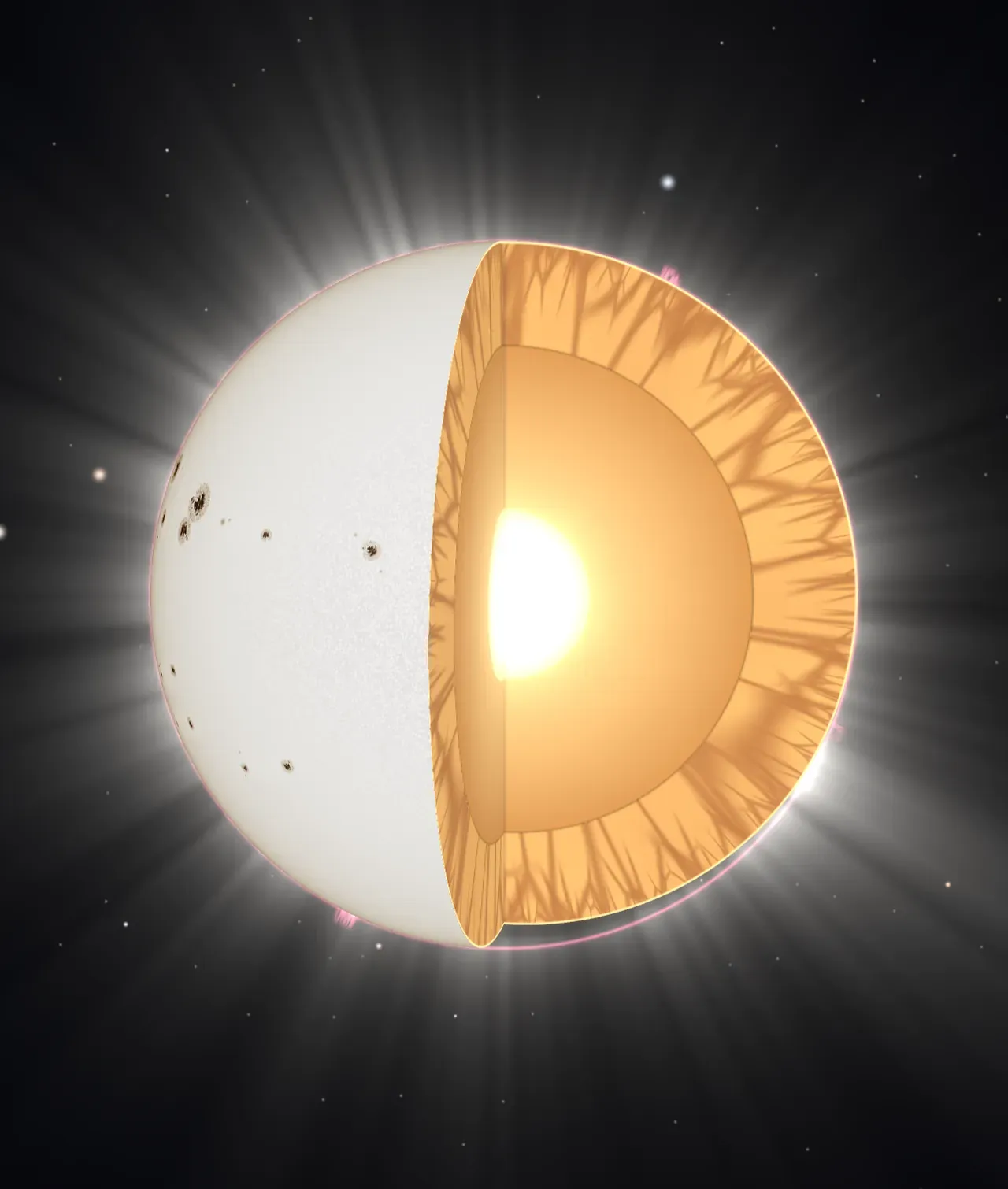
The Sun is a ball of plasma, hot, electrically charged gas, million kilometres across. A wedge is cut out of it in the Scene, so the layers show at their true depths: the core in the inner quarter of the radius, the radiative zone out to about of the radius, and the convection zone, where hot gas rises, cools and sinks, like water in a pan on a stove. Above it lie the surface, the photosphere, at about 5800 K, and the thin corona.
Turn the Scene and look at the wedge from a few directions.
Step 2 of 5
Dark spots
Through a telescope with the right filter, the Sun’s surface boils with granules, the tops of convection cells the size of a country, and sunspots are scattered across it. A big spot can be several times wider than the Earth, with a dark centre inside a lighter ring. Spots usually come in pairs, one leading and one following, and they drift across the disc as the Sun turns. That is how Galileo showed in 1612 that the Sun rotates.
Step 3 of 5
An 11-year cycle
In 1843 a German pharmacist, Heinrich Schwabe, who had counted sunspots on every clear day for seventeen years, noticed that their number rises and falls in a cycle. From one minimum, when the Sun can go weeks without a single spot, to the next takes about years on average. Years since solar minimum moves you through the cycle, and Peak sunspot number sets how strong the cycle is. Between 1645 and 1715, in the Maunder minimum, almost no spots were seen at all.
Step 4 of 5
The butterfly diagram
It is not only the number of spots that changes through the cycle, but also where they appear. The lower chart beside the Scene marks the spots’ latitudes at each time. A year has now passed since minimum. Predict how the bands will go on.
Step 5 of 5
A field that flips
Show the magnetic field is at Magnetic field. In each spot pair the field comes out of the Sun at one spot and goes back in at the other: they are the two feet of one magnetic loop. The Sun’s equator turns faster than its poles, in about days against about , and it winds the field lines round the Sun until they float up and break through the surface in pairs of spots.
Move Years since solar minimum slowly from to and watch the colour of the polar caps: sky blue where the field comes out of the Sun, amber where it goes in.
Loading the interactive version…
Loading the interactive version…
Each step sets up the Scene for you, and a control marked “fixed” stays put for that step.
Practice · Choose
The cut-away wedge shows the Sun’s layers at their true depths. In which layer does the Sun make its energy?
Practice · Choose
The cut-away wedge shows the Sun’s layers at their true depths. In which layer does the Sun make its energy?
Practice · Choose
In pictures of the Sun, sunspots look black. What are they really?
Practice · Choose
In pictures of the Sun, sunspots look black. What are they really?
Practice · Reach the target
The Sun is now at minimum. Move Years since solar minimum until the Sun reaches the peak of its cycle, the maximum, and press Check.
Practice · Reach the target
The Sun is now at minimum. Move Years since solar minimum until the Sun reaches the peak of its cycle, the maximum, and press Check.
Practice · Predict, then look
A year after minimum, the cycle’s first spots appear about degrees north and south of the equator. Where will the spots appear a few years later, near the end of the cycle?
Practice · Predict, then look
A year after minimum, the cycle’s first spots appear about degrees north and south of the equator. Where will the spots appear a few years later, near the end of the cycle?
Practice · Calculate
The field at the Sun’s poles flips around every sunspot maximum. After how many years does the Sun’s field point the way it did at the start of the cycle?
Practice · Calculate
The field at the Sun’s poles flips around every sunspot maximum. After how many years does the Sun’s field point the way it did at the start of the cycle?
Lesson complete. Every practice question here is done.