The trade winds have piled warm water in the western Pacific. Weaken them and watch the water and rain move east, strengthen them for a La Niña, and see how sea and air strengthen each other.
Step 1 of 6 · A normal year
Step 1 of 6
A normal year
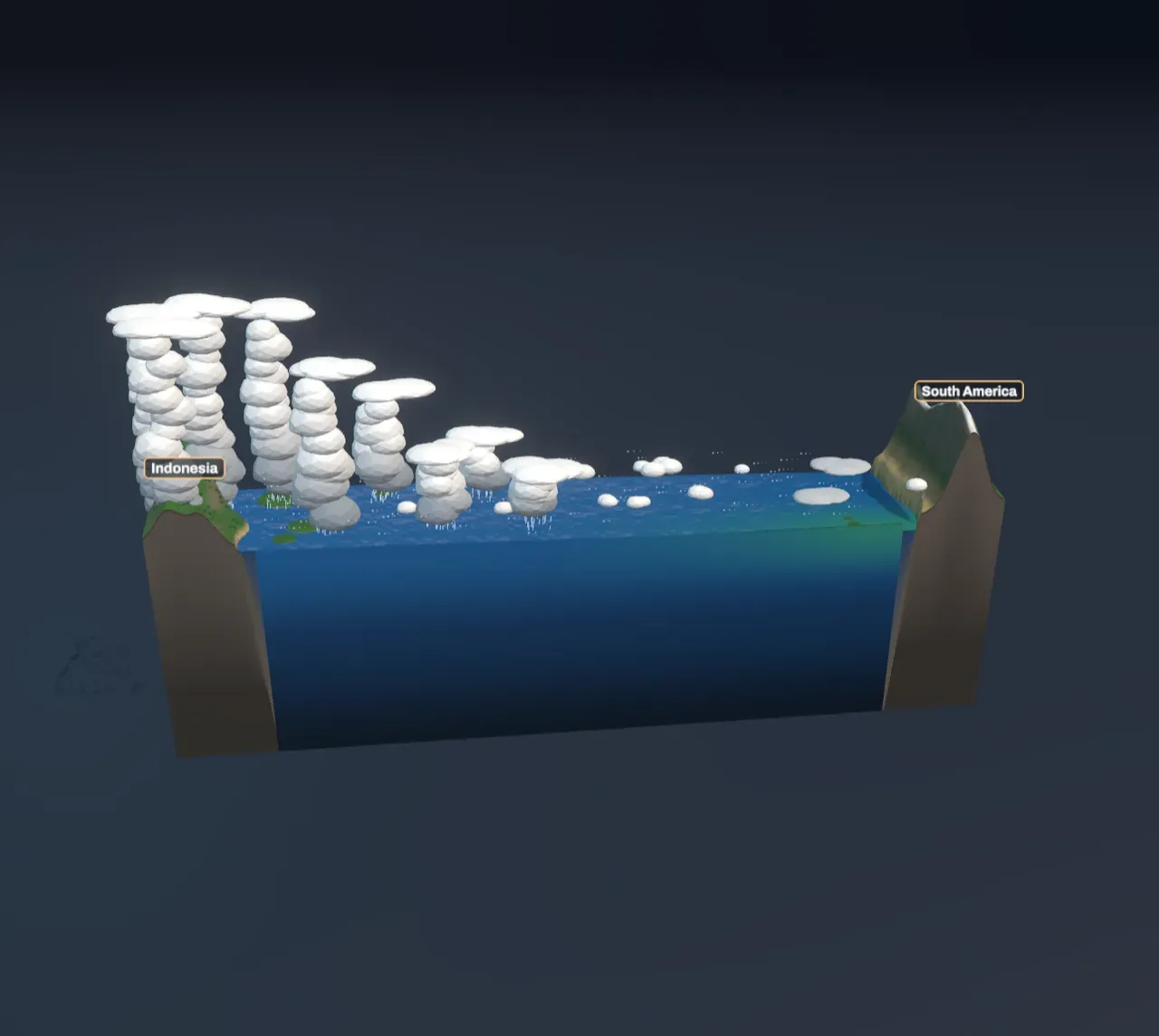
In the Scene there is a strip of the Pacific along the equator, from Indonesia in the west to South America in the east, 15,000 km. Trade winds blow from east to west at a normal year’s speed. In the west the skies are cloudy and wet, and in the east the sea is greenish and the skies dry.
Step 2 of 6
The thermocline
Show ocean and air has reached Ocean temperature: a cut down through the water. The warm top layer is much thinner in the east than in the west.
Step 3 of 6
The wind weakens
The trade winds are not constant. Every few years, irregularly, they weaken for many months.
Step 4 of 6
La Niña
El Niño and La Niña are the two ends of one swing, ENSO, which comes round every two to seven years. Forecasters define them by the sea temperature in the middle of the ocean, in a region called Niño 3.4.
Step 5 of 6
The air’s loop
The sea does not only respond to the wind: it also makes it. Over the warmest water the air warms and rises, and where it sinks, it flows along the surface back to where it rises. Trade winds are now weak.
Step 6 of 6
Far from the Pacific
El Niño is the largest year-to-year change in the Earth’s weather, and forecasters track it months ahead. In a strong year it changes the weather across half the world.
Loading the interactive version…
Loading the interactive version…
Each step sets up the Scene for you, and a control marked “fixed” stays put for that step.
Practice · Choose
In a normal year the sea near Indonesia is about 5 °C warmer than the sea near the Galápagos, though both lie on the equator. Why?
Practice · Choose
In a normal year the sea near Indonesia is about 5 °C warmer than the sea near the Galápagos, though both lie on the equator. Why?
Practice · Choose
Show ocean and air shows the ocean’s temperature at depth. What cools the sea’s surface in the east, off South America?
Practice · Choose
Show ocean and air shows the ocean’s temperature at depth. What cools the sea’s surface in the east, off South America?
Practice · Predict, then look
Predict: what will happen if Trade winds weaken from 5 m/s to 2 m/s?
Practice · Predict, then look
Predict: what will happen if Trade winds weaken from 5 m/s to 2 m/s?
Practice · Reach the target
A La Niña year is one in which the sea in the Niño 3.4 region, in the middle of the ocean, is at least 0.5 °C colder than normal. Change Trade winds until there is a La Niña, and press Check.
Practice · Reach the target
A La Niña year is one in which the sea in the Niño 3.4 region, in the middle of the ocean, is at least 0.5 °C colder than normal. Change Trade winds until there is a La Niña, and press Check.
Practice · Choose
Show ocean and air now shows the air’s loop over the ocean, in an El Niño year. Why does an El Niño that has started tend to grow stronger still, for months?
Practice · Choose
Show ocean and air now shows the air’s loop over the ocean, in an El Niño year. Why does an El Niño that has started tend to grow stronger still, for months?
Practice · Choose
In a strong El Niño year, which of these happen? Choose all the correct answers.
Practice · Choose
In a strong El Niño year, which of these happen? Choose all the correct answers.
Lesson complete. Every practice question here is done.