Under your feet, between the grains of sand, there is water. Use Darcy’s law to work out how slowly it creeps, find how much a well can give before it runs dry, and see what drought and over-pumping do to an aquifer.
Step 1 of 9 · Under the ground
Step 1 of 9
Under the ground
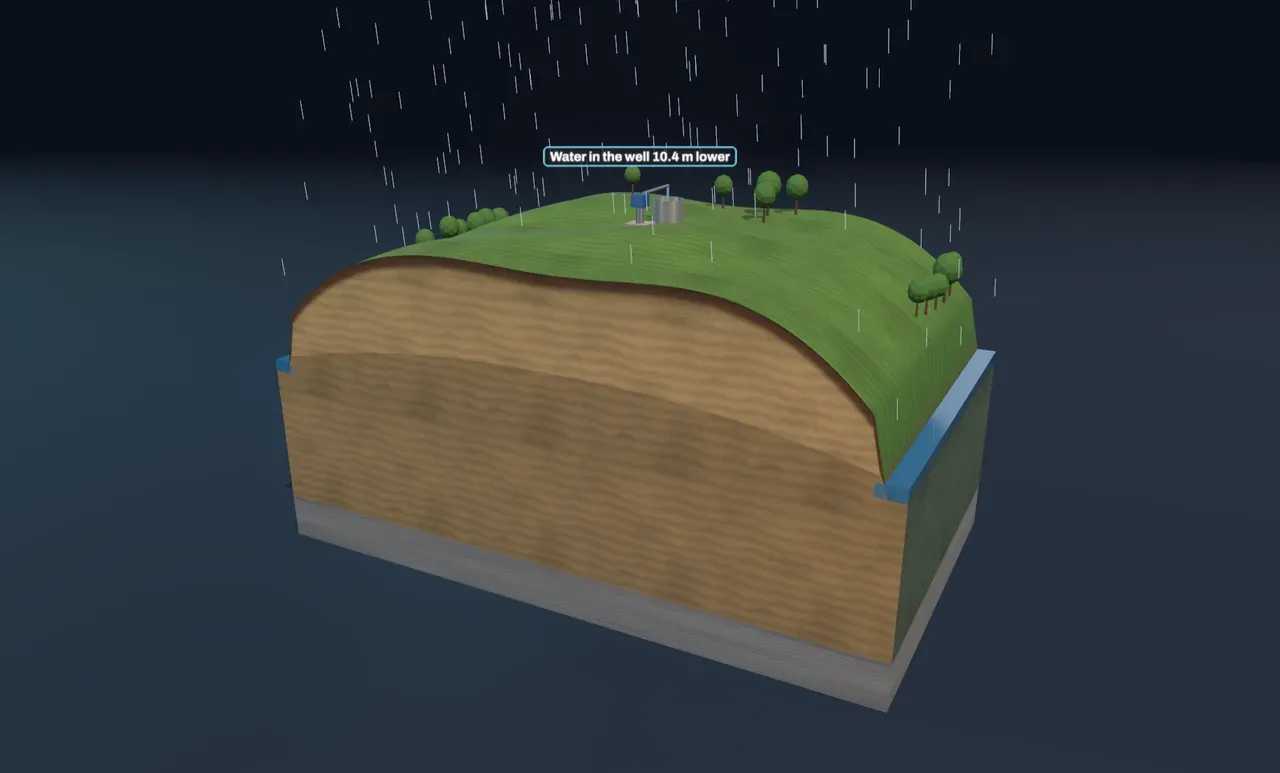
In the last Lesson some of the rain soaked into the ground. In the Scene there is a block of ground: a layer of fine sand, and below it clay that water cannot pass, between two streams 2 km apart. In the middle there is a well with a pump. Cut into the ground has taken away the dry sand back to the plane of the well, and what is left is the part soaked with water. Pumping rate is now zero.
Step 2 of 9
Rain and the water table
The rain soaking in reaches the water table, and the water flows slowly through the sand from the middle to the streams, which hold the water table at their level. So the water table is not flat: it is a low mound between the two streams, and a stream fed by groundwater keeps flowing even in summer.
Step 3 of 9
Darcy’s law
How fast does groundwater flow? In 1856 the French engineer Henry Darcy measured water flowing through columns of sand, and found that the flow grows with the hydraulic gradient , how far the water table falls in each metre of the way:
is the hydraulic conductivity: many metres a day in gravel, a few metres in fine sand, and almost zero in clay. Rainfall is locked.
Step 4 of 9
A cone round the well
When the pump runs, it takes water out of the well, and the water in the sand around flows towards it. To flow, the water table must slope down to the well, and so a cone forms round it. The more you pump, the deeper the cone, and the label over the well shows how far the water in it has dropped.
Step 5 of 9
A drought
Pumping rate is now 400 m³ a day, water for a town, and the well gives all of it.
Step 6 of 9
Over-pumping
In a drought, and with heavy pumping, the well runs dry and the cone is wide and deep. When more is pumped over time than the rain puts back, the water table falls year after year, and streams and springs fed by the groundwater dry up. Near the sea there is one more consequence.
Step 7 of 9
A wet year
More rain raises the mound of groundwater, and its slope down to the streams gets steeper.
Step 8 of 9
Pumping harder
The town grows and needs more water. It pumps more from the same well.
Step 9 of 9
Above the pump
A pump in a well needs water above it. If the level drops below it, it sucks air.
Loading the interactive version…
Loading the interactive version…
Each step sets up the Scene for you, and a control marked “fixed” stays put for that step.
Practice · Choose
Cut into the ground has taken away the dry sand above the water table. Where exactly is the groundwater?
Practice · Choose
Cut into the ground has taken away the dry sand above the water table. Where exactly is the groundwater?
Practice · Predict, then look
With no pumping, the rain raises the water table into a mound between the two streams. Predict: what will happen to that mound if Rainfall drops from 800 mm a year to a drought of 100 mm?
Practice · Predict, then look
With no pumping, the rain raises the water table into a mound between the two streams. Predict: what will happen to that mound if Rainfall drops from 800 mm a year to a drought of 100 mm?
Practice · Calculate
Rainfall is locked at 800 mm a year, with no pumping. In the middle the water table stands about 6 m above the streams, which are 1000 m away. The fine sand’s hydraulic conductivity is metres a day, and its porosity is . How long does the water take to creep from the middle to the stream?
Practice · Reach the target
Rainfall is locked at 800 mm a year. Raise Pumping rate to the most the well gives without running dry, to within 12 m³ a day, and press Check.
Practice · Reach the target
Rainfall is locked at 800 mm a year. Raise Pumping rate to the most the well gives without running dry, to within 12 m³ a day, and press Check.
Practice · Predict, then look
The town pumps 400 m³ a day, and the well gives all of it. Predict: what will happen if Rainfall drops to a drought of 100 mm a year and the town keeps asking for the same?
Practice · Predict, then look
The town pumps 400 m³ a day, and the well gives all of it. Predict: what will happen if Rainfall drops to a drought of 100 mm a year and the town keeps asking for the same?
Practice · Choose
Israel’s Coastal Aquifer meets the Mediterranean. Under the shore, the fresh groundwater floats on salty, heavier sea water. What happened where it was over-pumped for years?
Practice · Choose
Israel’s Coastal Aquifer meets the Mediterranean. Under the shore, the fresh groundwater floats on salty, heavier sea water. What happened where it was over-pumped for years?
Practice · Calculate
Rainfall is locked at 1600 mm a year, a very wet year, with no pumping. In the middle the water table stands 10.8 m above the streams, which are 1000 m away. What is the hydraulic gradient, ?
Practice · Calculate
Rainfall is locked at 1600 mm a year, a very wet year, with no pumping. In the middle the water table stands 10.8 m above the streams, which are 1000 m away. What is the hydraulic gradient, ?
Practice · Predict, then look
The Pumping rate is 200 m³ a day, and the water in the well has dropped 6.3 m. Predict: by how much will the water in the well drop when the town pumps twice as much, 400 m³ a day?
Practice · Predict, then look
The Pumping rate is 200 m³ a day, and the water in the well has dropped 6.3 m. Predict: by how much will the water in the well drop when the town pumps twice as much, 400 m³ a day?
Practice · Reach the target
Rainfall is locked at 800 mm a year. The pump hangs 15 m above the clay layer. Raise the Pumping rate until exactly 15 m of water stand in the well above the clay, and press Check.
Practice · Reach the target
Rainfall is locked at 800 mm a year. The pump hangs 15 m above the clay layer. Raise the Pumping rate until exactly 15 m of water stand in the well above the clay, and press Check.
Lesson complete. Every practice question here is done.