The wind turns the sea’s surface, and density drives a deep loop round the world. Find out which water sinks, find how much salt it takes, and see what meltwater does to the current that warms Europe.
Step 1 of 6 · Gyres
Step 1 of 6
Gyres
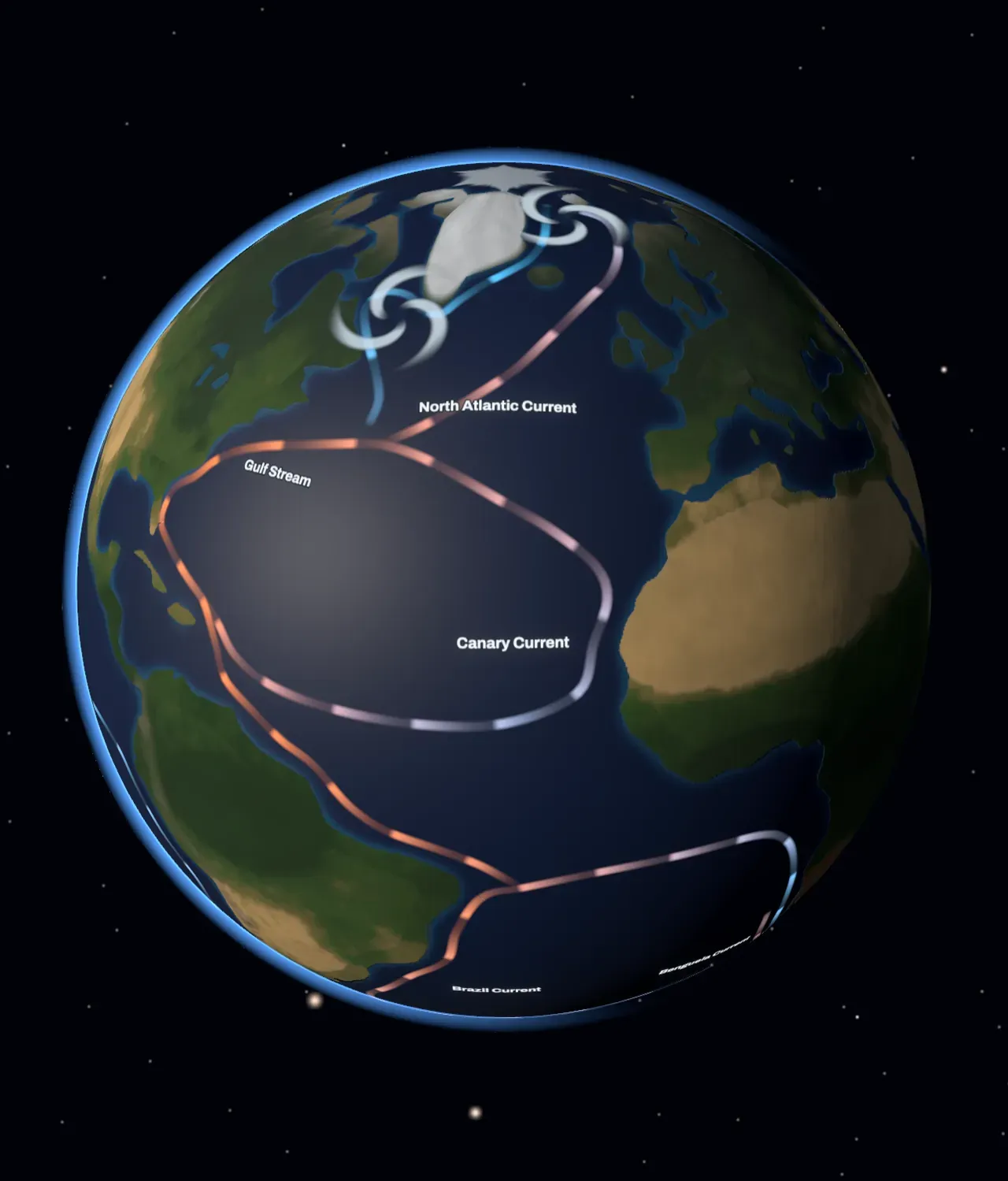
The water in the ocean moves all the time, and not only in waves. In the Scene there is the Earth, and the arrows on the sea are the surface currents: huge loops, one in every ocean. They carry warm water from the equator towards the poles and cold water back, and so heat too.
Step 2 of 6
Heavy water
Follow the deep loop has reached Sinking. The wind moves only the top few hundred metres. Below them, down to several kilometres, the water moves for another reason: density. Dense water sinks below lighter water, as oil floats on water, and so there is flow in the deep too.
Step 3 of 6
The Gulf Stream
In the North Atlantic, near Greenland, the surface water cools in winter almost to freezing, and when sea ice forms, its salt stays in the water below. The water becomes dense enough to sink to the floor. Water temperature and Salinity set the surface water there.
Step 4 of 6
How much salt it takes
To sink, the surface water must be denser than the deep water below it: about 4 °C and about 34.9 g/kg. Water temperature is locked.
Step 5 of 6
Meltwater
The water that sank does not vanish: it creeps south through the deep, and warm water from the south flows north on the surface to take its place. The Gulf Stream and the North Atlantic Current give their heat to the air, which is why winter in London is far milder than in Montreal, at about the same latitude.
Step 6 of 6
Round the world
Follow the deep loop shows the whole way. From Antarctica the densest water of all creeps along the floor, beneath the water from Greenland. Together they form one conveyor that links all the oceans.
Loading the interactive version…
Loading the interactive version…
Each step sets up the Scene for you, and a control marked “fixed” stays put for that step.
Practice · Choose
On the surface of every ocean the water turns in a huge loop, a gyre, like the Gulf Stream running up the coast of America. What drives these surface currents?
Practice · Choose
On the surface of every ocean the water turns in a huge loop, a gyre, like the Gulf Stream running up the coast of America. What drives these surface currents?
Practice · Choose
Dense water sinks below lighter water. Which water is densest?
Practice · Choose
Dense water sinks below lighter water. Which water is densest?
Practice · Predict, then look
In winter, in the Greenland Sea, the surface water is at about 1 °C with a salinity of 35 g/kg, and it sinks. Predict: what will happen if Water temperature there rises to 18 °C, as in the Gulf Stream?
Practice · Predict, then look
In winter, in the Greenland Sea, the surface water is at about 1 °C with a salinity of 35 g/kg, and it sinks. Predict: what will happen if Water temperature there rises to 18 °C, as in the Gulf Stream?
Practice · Reach the target
Water temperature is locked at 4 °C, a mild winter, and Salinity is at 33 g/kg, meltwater: the water does not sink. Raise Salinity until the water in the north sinks strongly, and press Check.
Practice · Reach the target
Water temperature is locked at 4 °C, a mild winter, and Salinity is at 33 g/kg, meltwater: the water does not sink. Raise Salinity until the water in the north sinks strongly, and press Check.
Practice · Predict, then look
The deep loop is running: water sinks in the north, and a warm current comes up from the south to take its place. Predict: what will happen if Greenland’s ice melts and the Salinity of the surface water there drops to 33 g/kg?
Practice · Predict, then look
The deep loop is running: water sinks in the north, and a warm current comes up from the south to take its place. Predict: what will happen if Greenland’s ice melts and the Salinity of the surface water there drops to 33 g/kg?
Practice · Choose
The water that sank near Greenland creeps south through the deep, round Antarctica and into the Indian and Pacific Oceans, where it slowly rises back to the surface. How long does a drop take to complete this loop?
Practice · Choose
The water that sank near Greenland creeps south through the deep, round Antarctica and into the Indian and Pacific Oceans, where it slowly rises back to the surface. How long does a drop take to complete this loop?
Lesson complete. Every practice question here is done.