Rivers in the sea
The ocean is never still. Off the coast of Florida a band of warm, blue water about 80 km wide runs north at up to 2 metres a second: the Gulf Stream. It carries about 30 million cubic metres of water every second, and gathers more as it goes, until, out in the open Atlantic, it carries more than 100 million. Oceanographers count these flows in sverdrups: 1 Sv is a million cubic metres a second. All the rivers on Earth together pour about 1.2 Sv into the sea.
Benjamin Franklin printed one of the first charts of the Gulf Stream in the 1770s, after noticing that mail ships sailing west to America took two weeks longer than merchant ships whose captains knew to keep out of it.
Gyres: currents the wind drives
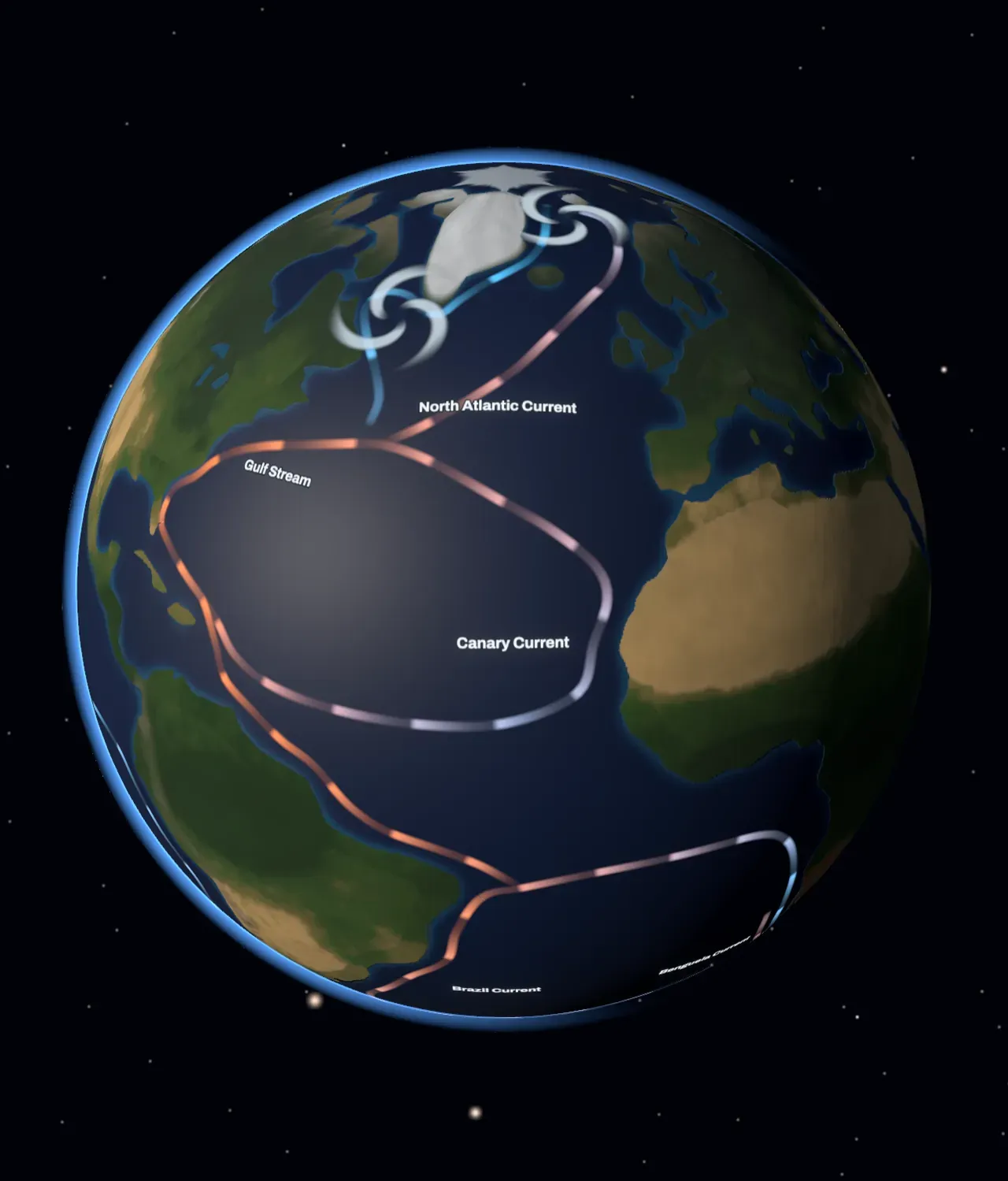
The surface currents, in the top few hundred metres, are driven mainly by the wind. Near the equator the trade winds push the water west; in the middle latitudes the westerlies push it east. The continents get in the way, so in each ocean basin the water ends up circling in a great loop, a gyre. Because of the Coriolis effect, moving water veers to the right in the northern hemisphere and to the left in the southern, so the northern gyres turn clockwise and the southern ones anticlockwise.
The loops are lopsided. On the western side of each ocean the return flow is squeezed into a fast, narrow current: the Gulf Stream, the Kuroshio off Japan, the Brazil, Agulhas and East Australian Currents. On the eastern side the water drifts back towards the equator in broad, slow, cold currents: the Canary, California, Benguela and Humboldt Currents. Around Antarctica no continent blocks the way, and the Antarctic Circumpolar Current flows all the way round the planet. It is the largest current on Earth, well over 100 Sv.
Try it: at Surface currents, follow the amber streaks of the Gulf Stream up the coast of North America and across the Atlantic, and the pale blue Canary Current coming back down past Africa. Each streak is brightest at its head, so it shows which way the water flows.
Warm water north, cold water south
The gyres are giant heat pumps. Their fast western currents carry warm tropical water towards the poles, and their eastern currents bring cold water back. The North Atlantic is unusual: some of the Gulf Stream’s water does not turn back. It runs on north as the North Atlantic Current, past Ireland and Norway into the Greenland and Norwegian Seas, and some of it into the Labrador Sea. There, in winter, it gives its heat to bitterly cold air. The heat the Atlantic carries north this way is about 1.2 petawatts, roughly sixty times the power all of humanity uses. It is part of the reason the ports of Norway stay free of ice in winter, while the sea off Labrador, at the same latitude across the Atlantic, freezes.
Where that northbound water ends up is the key to the rest of the ocean.
What makes water sink
Water sinks under water that is lighter, for the same reason a stone sinks in a pond (Floating and buoyancy): what matters is density, the mass of each cubic metre. Sea water gets denser in two ways. Cold water is denser than warm water. Salty water is denser than fresh water. Sea water at 1 °C with 35 grams of salt in each kilogram, a typical salinity, weighs about 1028.1 kg per cubic metre; at 20 °C the same water weighs 1024.8.
The two do not count equally everywhere. In warm water, cooling by a degree adds about 0.27 kg per cubic metre. Near freezing, a degree adds only about 0.08, while one more gram of salt per kilogram adds about 0.8, ten times as much. So in the polar seas, salt decides what sinks.
Salinity changes wherever water is added or taken away. Evaporation takes water and leaves the salt behind (see The water cycle), which is why the subtropical Atlantic, under its dry, sunny skies, is among the saltiest open ocean on Earth. Rain, rivers and melting ice add fresh water. When sea water freezes, the ice keeps very little of the salt, and the water left round it gets saltier.
The chart beside the Scene is how oceanographers draw this: temperature up the side, salinity along the bottom. Each grey curve joins water of the same density, and the curves are steep at the cold end because there temperature hardly matters. The blue dot is the surface water the Parameters set.
Try it: with Salinity at Meltwater, the dot moves left across the dashed line, out of the shaded region where water is dense enough to sink.
Sinking near the poles
The water the North Atlantic Current brings north was made salty in the subtropics. In winter, in the Greenland and Labrador Seas, freezing winds cool it to a degree or two above freezing. Now it is denser than the water below it, and it sinks, in places 2 to 3 km down, and spreads out as North Atlantic Deep Water. In the Scene, today’s water, at 1 °C and 35 g/kg, weighs 1028.1 kg per cubic metre. The deep water it has to sink through, at about 4 °C and 34.9 g/kg, weighs 1027.8. That small difference is enough.
Around Antarctica, sea water freezes into sea ice every winter, leaving salt behind in the water underneath. The coldest, saltiest water in the ocean forms there, and it slides down the continental slope to the very bottom, as Antarctic Bottom Water. It creeps north along the floor of every ocean, under the North Atlantic water, and in the Atlantic it reaches about 40° north, the latitude of New York.
Try it: step Follow the deep loop to Sinking. The sea turns clear, and water spirals down under the whirls at both ends of the Atlantic. Raise Water temperature to Mild winter, at 4 °C: the water is barely denser than the deep water and sinks slowly. Above about 4.7 °C it stops. Then return to Today and lower Salinity instead: it stops below about 34.5 g/kg. Half a gram of salt does what almost 4 degrees of warming does.
The overturning loop
Water that sinks has to go somewhere, and water has to flow in at the surface to replace it. The sinking in the north draws warm surface water up the Atlantic, and pushes the deep water south along the western side of the ocean to the Southern Ocean. There it joins the circumpolar flow and spreads into the Indian and Pacific Oceans. Strong westerly winds round Antarctica drive surface water away to the north, and deep water rises to take its place. Elsewhere the deep water rises slowly, mixed upward over centuries. Back at the surface it warms, and returns through the Indonesian seas and round the tip of Africa, or eastward round South America, to the Atlantic.
This slow global circulation is the overturning circulation, also called the thermohaline circulation (from the Greek for heat and salt), or the ocean’s conveyor belt. A full circuit takes about a thousand years. Some of the water at the bottom of the North Pacific last touched the air when Vikings were sailing the Atlantic. Since 2004, a line of moored instruments across the Atlantic at 26° north has measured the Atlantic’s share of it: about 17 Sv flowing north near the surface and back south in the deep.
Try it: step Follow the deep loop to The deep loop and watch the blue deep water spread south from the whirls in the north, with the violet bottom water creeping the other way beneath it. Then drag the globe round to follow the deep water into the Pacific.
Can it slow down?
Anything that makes the northern surface water lighter weakens the sinking. A warmer climate (see Climate) brings both: warmer water, and more fresh water from rain, rivers and the melting Greenland ice sheet. Climate models expect the Atlantic overturning to weaken during this century; how much, and whether it could stop altogether, is still debated.
It has happened before. As the last ice age was ending, about 12,900 years ago, the lands round the North Atlantic plunged back into near-glacial cold for about 1,200 years, a period called the Younger Dryas. The leading explanation is that floods of meltwater from the retreating North American ice sheets freshened the North Atlantic and slowed the overturning. On a smaller scale, a pool of fresher water drifted round the northern North Atlantic in the late 1960s and 1970s, and for several winters the deep sinking in the Labrador Sea weakened.
Try it: at The deep loop, choose Meltwater. The northern sinking stops, the warm branch running north fades, and the blue deep water stops flowing, while the Antarctic water keeps sinking.
Not all ocean changes are this slow. Every few years the warm surface water of the tropical Pacific sloshes east in an El Niño, moving rain and drought round the world within months, a story of its own.
What this model leaves out
The currents follow fixed, hand-drawn routes. Real currents meander, shed eddies hundreds of kilometres across, change with the seasons and in the northern Indian Ocean reverse with the monsoon. The wind-driven currents do not change with the Parameters here, although the North Atlantic Current is partly fed by the overturning, so it fades when the sinking stops.
The density of sea water comes from a simplified equation that is within a few tenths of a kilogram per cubic metre of the real one at the surface. It ignores pressure, which squeezes cold water a little more than warm and makes the Antarctic bottom water the densest in the deep. The deep water is held at fixed properties, and the strength of the overturning is a rule of thumb: in proportion to how much denser the surface water is than the deep water for small differences, levelling off towards 30 Sv, and set so that today’s water gives 17 Sv. The heat it carries north assumes the northbound water arrives at 18 °C. The Antarctic sinking does not respond to the Parameters at all.
In the Scene the overturning responds at once. The real ocean takes decades to centuries to adjust, and simple models of the loop can flip between a strong and a weak state, so that the way back is not the way in. This model has no such memory. The ocean is drawn about two hundred times deeper than it is, the rising deep water is shown at a few places although it really rises across wide areas, and the streaks move many thousands of times faster than the water.