A number that is a point
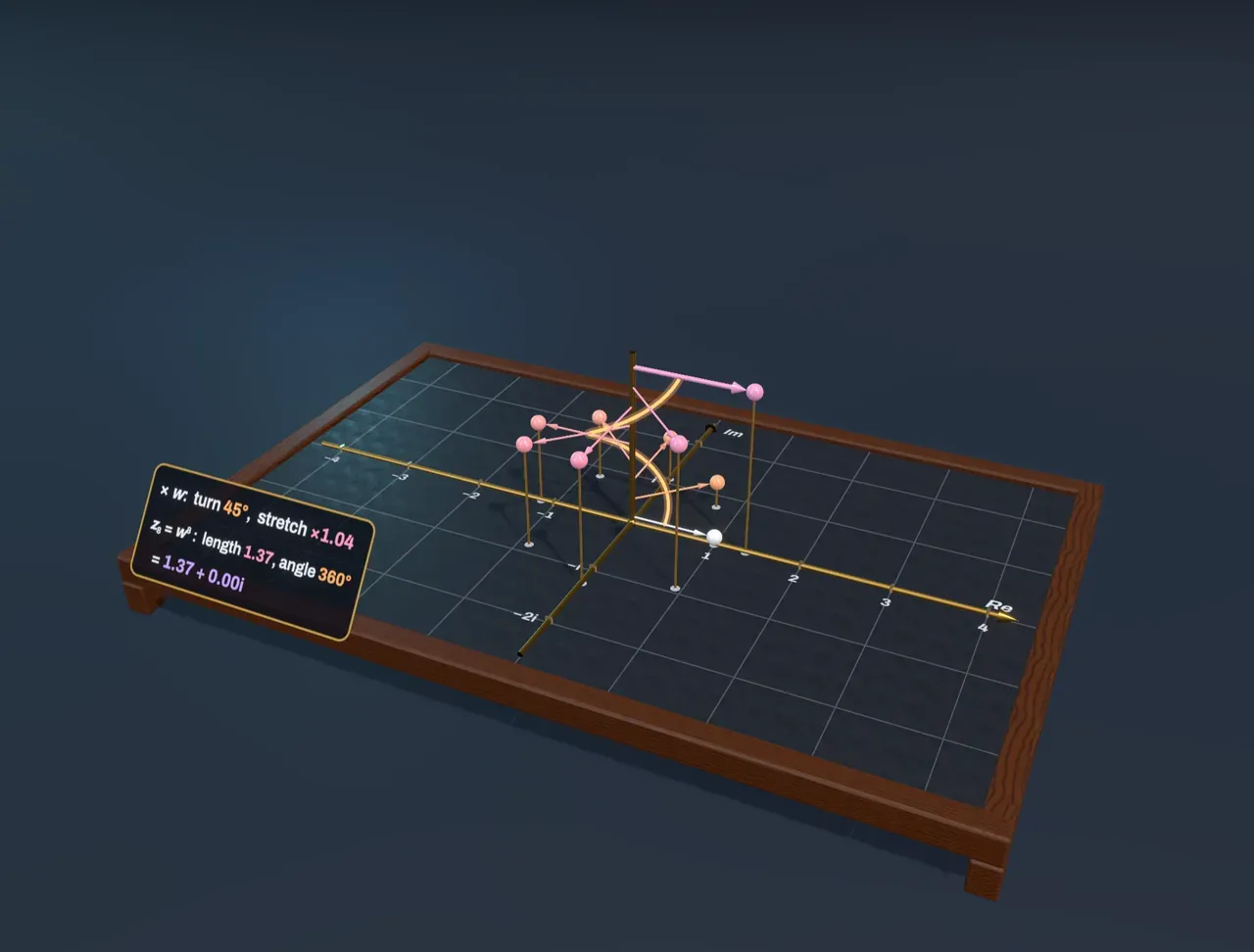
Ordinary numbers sit along a line: negatives to the left, positives to the right. A complex number such as 3 + 2i has two parts, a real part (3) and an imaginary part (2), so it needs two directions. Put the real part across and the imaginary part up and every complex number becomes a point on a flat plane, the complex plane. The board in the Scene is that plane, with its real axis marked Re and its imaginary axis Im.
The symbol i stands for a number whose square is −1. No number on the ordinary line does that, since any number times itself is positive or zero. Girolamo Cardano ran into square roots of negative numbers in 1545 while solving cubic equations, and Rafael Bombelli worked out how to calculate with them in 1572. Caspar Wessel in 1799 and Jean-Robert Argand in 1806 independently drew them as points on a plane, which is what made them make sense.
Multiplying turns and stretches
Multiply 1 by i and you get i: the point has moved from the right-hand end of the real axis to the top of the imaginary axis, a quarter turn. Multiply by i again and you get i × i = −1, another quarter turn. Then −i, then back to 1. Four steps, once round.
That is not special to i. Every complex number w has a length, its distance from 0, and an angle, measured round from the positive real axis. Multiplying any point by w does two things at once:
- it turns the point by w’s angle, and
- it stretches its distance from 0 by w’s length.
So when you multiply, lengths multiply and angles add. The Scene starts at 1 and multiplies by the same w again and again. Each product is a bead, with an arrow from the centre and a glowing ramp round the brass pole showing the turn of each step. To keep the products apart, the Scene lifts each bead one step higher than the last, so repeated multiplication climbs a spiral staircase. Drag Steps down to 0 and back up to add the products one multiplication at a time.
Try it: press × i on Turn per step and set Stretch per step to 1: the beads come back over the start every four steps, stacking into a helix. Then press × −1 and watch each step flip the point across the centre.
With a stretch above 1 each step pushes the point further out and the staircase widens; below 1 it winds in towards 0. At exactly 1 the point never leaves the unit circle, the circle of radius 1.
The smooth spiral and Euler’s formula
Slide Build Euler’s formula towards Euler’s formula. First the Scene labels the last step with its turn and its stretch. Then a smooth curve grows through every bead. Repeated multiplication by w gives wⁿ for whole numbers n, and the curve fills in the steps between: it is w to the power t for every t, the same spiral drawn without gaps. A growing quantity that multiplies by the same amount in each equal step is exactly what an exponential function describes, so this curve is an exponential, seen on the complex plane.
Finally the unit circle appears with one point on it, at the turn angle φ. Its shadow on the real axis is cos φ and its height is sin φ, as in trigonometry. Leonhard Euler published in 1748 the formula that joins the two ideas:
e^(iφ) = cos φ + i sin φ
Raising the number e (about 2.718) to an imaginary power does not make something bigger. It turns. With φ measured in radians, a half turn is φ = π, and the formula gives e^(iπ) = −1, often written e^(iπ) + 1 = 0. Press × −1 with Build Euler’s formula at Euler’s formula to see it printed on the card.
Where complex numbers turn up
Anything that rotates or repeats is easier with complex numbers. Electrical engineers describe alternating current as a turning complex number, so that the delays caused by coils and capacitors become simple multiplications. Signal processing breaks sounds and images into turning components, which is how music is compressed and how a phone separates one radio signal from another. Quantum mechanics describes particles with complex-valued waves.
What this model leaves out
The heights of the beads are only the step numbers, added for clarity; they are not part of the complex numbers. The Scene shows at most twelve steps, and keeps the stretch between 0.92 and 1.08 so that the spiral stays on the board; with stretches further from 1 the points race away or collapse to 0 within a few steps. Turns are whole degrees from 0° to 180°, so turning the other way (a negative angle) is left out, although it works the same way, as a mirror image.