The number i, whose square is minus 1, and the complex plane: multiplying by i as a quarter turn, the powers of i, a complex number by length and angle, and a number that three times over makes minus 1.
Step 1 of 6 · The square of i
Step 1 of 6
The square of i
No real number has a negative square: and too. Mathematicians added a new number, , defined so that , and found that it contradicts nothing. A complex number is , with and real: is the real part and the imaginary part. Every such number is a point in the plane, across and up, like a vector . This is the complex plane.
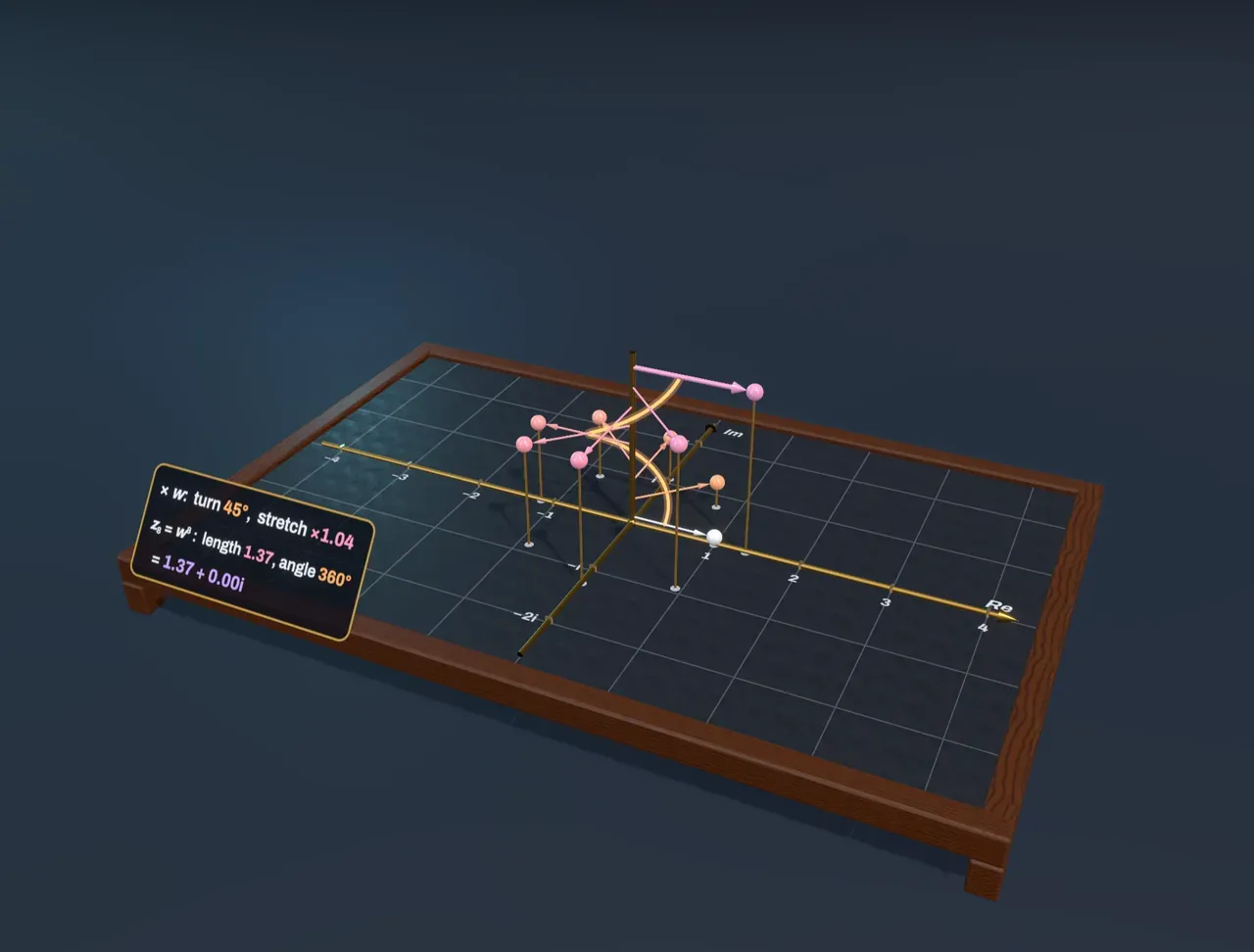
On the board the point starts at , and each step multiplies it by a number . Here : Turn per step is and Stretch per step is . Each point is raised above the board by its step number, so the products climb a spiral staircase. Predict where the point will be after two steps.
Step 2 of 6
The powers of i
Multiplying by turns any number a quarter turn: , , , . The powers of repeat every four. Move Steps and follow the card, which shows the last product.
Step 3 of 6
Length and angle
Like a vector, a complex number can also be described by a length and an angle from the real axis:
Here turns by and has length , and Steps is locked at : the board shows only the starting point, , and on the card as a turn and a stretch. Write in the form .
Step 4 of 6
Roots of minus 1
If one multiplication by turns by , then turns by . Find the Turn per step whose three steps bring to .
Step 5 of 6
Squaring
To multiply , open the brackets as with algebraic expressions, and remember that :
Choose your answer, then check it on the board with Steps.
Step 6 of 6
The imaginary part
A number whose length is not can also be written by its length and angle. The real part is how far right it is, and the imaginary part how far up.
Loading the interactive version…
Loading the interactive version…
Each step sets up the Scene for you, and a control marked “fixed” stays put for that step.
Practice · Predict, then look
Turn per step is and Stretch per step is : each step multiplies by . Start from . Where will the point be after two steps, ?
Practice · Predict, then look
Turn per step is and Stretch per step is : each step multiplies by . Start from . Where will the point be after two steps, ?
Practice · Reach the target
Each step multiplies by . Change Steps so that the last point is , then press Check.
Practice · Reach the target
Each step multiplies by . Change Steps so that the last point is , then press Check.
Practice · Calculate
turns by and has length : . What is the real part of ?
Practice · Calculate
turns by and has length : . What is the real part of ?
Practice · Reach the target
Steps is locked at and Stretch per step at . Change Turn per step so that , then press Check.
Practice · Reach the target
Steps is locked at and Stretch per step at . Change Turn per step so that , then press Check.
Practice · Choose
. What is ?
Practice · Choose
. What is ?
Practice · Calculate
Turn per step and Stretch per step : has length and angle . What is the imaginary part of ?
Practice · Calculate
Turn per step and Stretch per step : has length and angle . What is the imaginary part of ?
Lesson complete. Every practice question here is done.