Multiplying complex numbers multiplies lengths and adds angles: powers as spirals, doubling time on the complex plane, a spiral that closes in on zero, and Euler’s formula, in which e to the iπ equals minus 1.
Step 1 of 5 · Angles add
Step 1 of 5
Angles add
When two complex numbers multiply, the lengths multiply and the angles add:
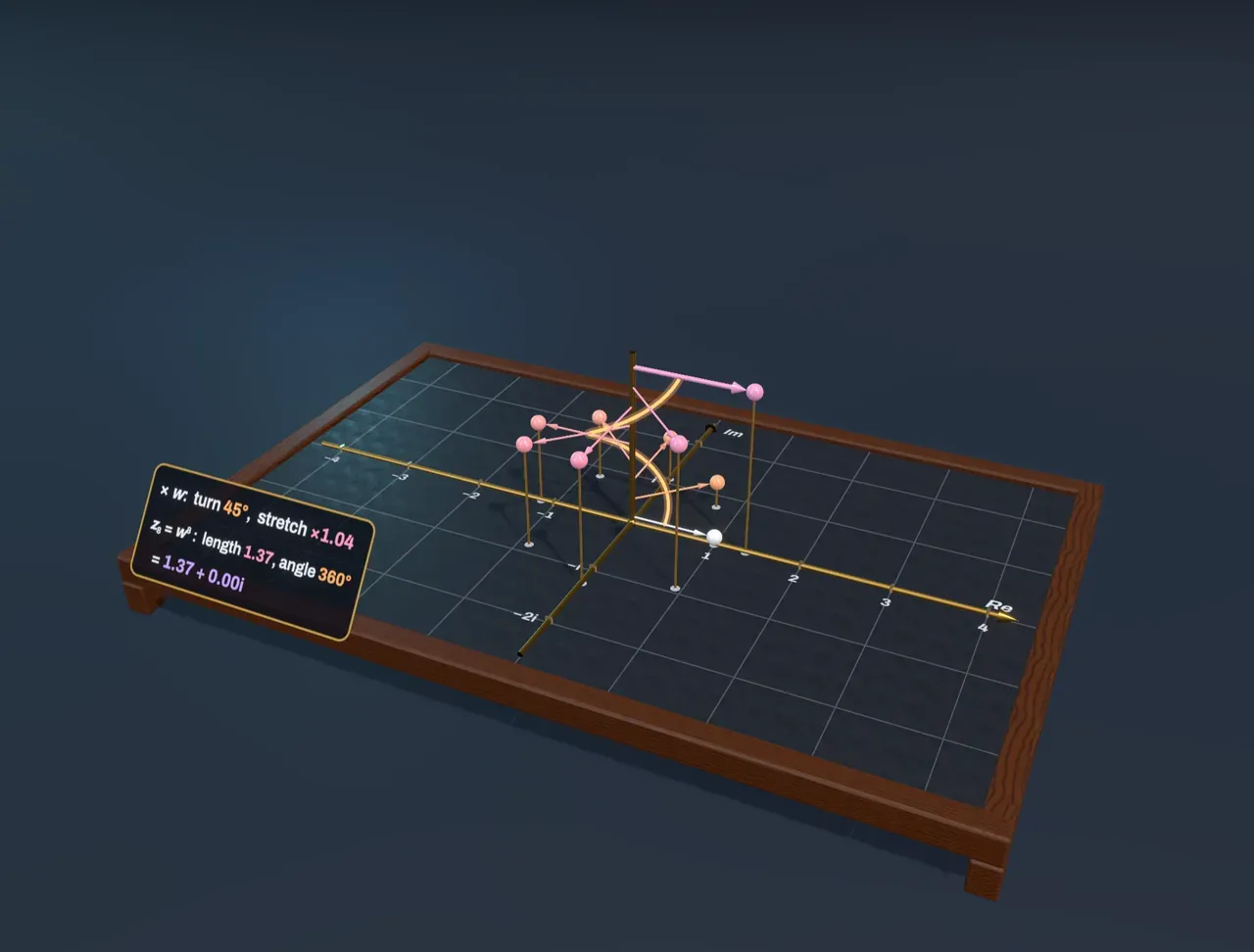
This follows from the formulas for the sine and cosine of a sum of angles. So multiplying by turns by ’s angle and stretches by its length, like the maps in the previous Unit. Here Turn per step is . Predict the angle after five steps.
Step 2 of 5
Lengths multiply
Stretch per step is : each multiplication lengthens the point by , like interest in the exponents Unit. The length after steps is , and the points climb a widening spiral. Find how many steps double the length.
Step 3 of 5
The rule
Drag Build Euler’s formula a little: the board marks the last step’s turn and stretch. Then use the rule to multiply two numbers given by length and angle.
Step 4 of 5
Spiralling in
When Stretch per step is less than , the points close in on zero in a spiral. The glowing curve through all the points is , between the whole steps too. Steps is locked at ; set the other two controls so that the last point lands in a given place.
Step 5 of 5
Euler’s formula
The smooth curve is a power with a real exponent, and when has length it runs round the unit circle. Leonhard Euler found that it is exactly the exponential function with an imaginary exponent, when the angle is measured in radians:
is the point on the unit circle at angle . Here Turn per step is , radians. Predict , then watch: the board will drag Build Euler’s formula all the way.
Loading the interactive version…
Loading the interactive version…
Each step sets up the Scene for you, and a control marked “fixed” stays put for that step.
Practice · Predict, then look
Turn per step is and Stretch per step is . What will the point’s angle be after steps, in degrees?
Practice · Predict, then look
Turn per step is and Stretch per step is . What will the point’s angle be after steps, in degrees?
Practice · Reach the target
Stretch per step is locked at : each multiplication lengthens by . Change Steps so that the last point’s length is , then press Check.
Practice · Reach the target
Stretch per step is locked at : each multiplication lengthens by . Change Steps so that the last point’s length is , then press Check.
Practice · Choose
has length and angle , and has length and angle . What is ?
Practice · Choose
has length and angle , and has length and angle . What is ?
Practice · Reach the target
Steps is locked at . Change Turn per step and Stretch per step so that the last point lies on the negative real axis, at angle , with a length of about a half, between and . Press Check.
Practice · Reach the target
Steps is locked at . Change Turn per step and Stretch per step so that the last point lies on the negative real axis, at angle , with a length of about a half, between and . Press Check.
Practice · Predict, then look
Turn per step is , that is radians, with length . By Euler’s formula, . What is ?
Practice · Predict, then look
Turn per step is , that is radians, with length . By Euler’s formula, . What is ?
Lesson complete. Every practice question here is done.