One more direction
Start with a point. Drag it along a straight line and it traces a segment, with 2 ends. Drag the segment sideways, at right angles to itself, by its own length, and it sweeps out a square: 4 corners and 4 edges. Drag the square straight up and you get a cube: 8 corners, 12 edges, 6 square faces.
Each step adds one new direction at right angles to all the ones before. Our space has three: left–right, forward–back, up–down. Nothing stops a mathematician from writing down a fourth, usually called w, at right angles to all three. Drag a cube a distance equal to its edge along w and it sweeps out a tesseract, the four-dimensional cube.
Counting works even when picturing does not. Each drag doubles the corners, since the old shape and its copy each have a full set, so the tesseract has 2 × 8 = 16 corners. Its edges are the cube’s 12, the copy’s 12, and one new edge traced by each of the 8 corners: 32 edges. In the same way it has 24 square faces and 8 cubic cells, just as a cube’s surface is made of 6 squares. A point in four dimensions needs four numbers, (x, y, z, w), and the tesseract of edge 1 is every point with all four between −½ and ½.
A world of two dimensions
In 1884 the schoolmaster Edwin Abbott wrote Flatland, a story about A Square, who lives in a plane and cannot imagine “up”. When a sphere visits him, he sees only where it crosses his plane: a point that grows into a circle, swells and shrinks back to a point. To him, a solid ball is a circle that changes over time.
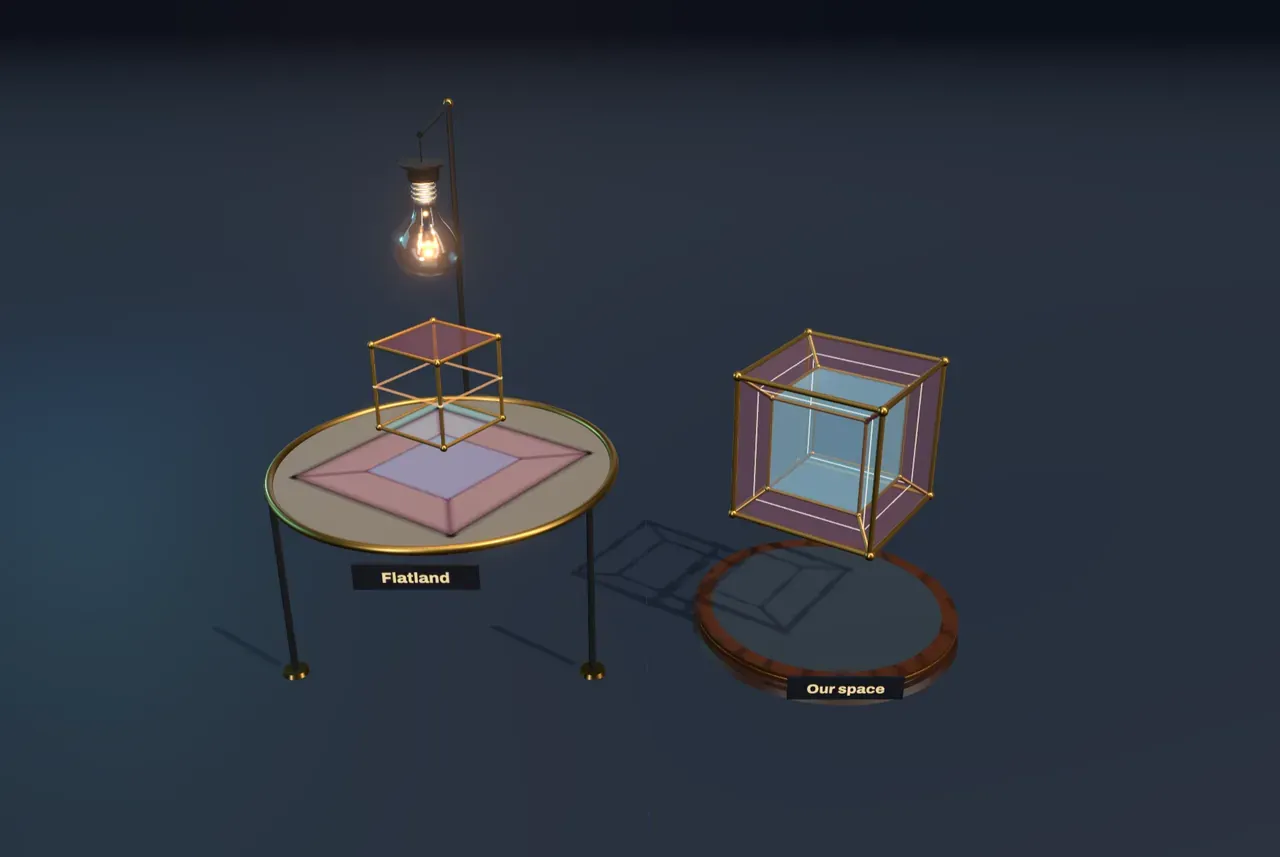
A flat creature has two ways to learn about a cube. It can study the cube’s shadow on its plane, or it can watch the cube’s slices as the cube passes through. The Scene puts Flatland on the left: a frosted sheet with a wire cube above it and a lamp above that. On the right is our space, with a tesseract shown the same two ways. We are to the tesseract what A Square is to the cube.
Shadows: a cube inside a cube
The lamp over Flatland casts the cube’s shadow on the sheet. With the cube square on, the bottom face, farther from the lamp, casts a small square, the top face a big one, and the four side faces become trapezoids joining them: a square inside a square. Nobody standing above thinks the bottom face is really smaller. It is only farther from the lamp.
The tesseract’s shadow is the same picture one dimension up. A lamp further along w casts its shadow into our space: the cell farther along w becomes the small inner cube (glazed blue), the nearer cell the big outer cube, and the six other cells become the squashed cubes joining them: a cube inside a cube. All eight cells of the real tesseract are identical cubes; the shadow distorts them exactly as the lamp distorts the cube’s faces.
Try it: move Turn in 4D slowly from 0° to 180°. The blue cell slides out of the middle, swells into one of the sides and at 180° has become the outside cube. The tesseract has not turned inside out or changed shape. It has turned in a plane that includes w, the way the cube on the left tips its blue face from the bottom to the top.
A turn in four dimensions happens in a plane, not about an axis. In our space every turn leaves an axis fixed; in four dimensions, a turn in the plane of x and w leaves a whole plane untouched. Every corner keeps its y and z, and only its x and w trade places.
Slices: what our space would see
Now choose Slice under Shadow to slice. The cube sinks until the sheet cuts it at Cut height, the lamp goes out, and the cut glows on the sheet: that is all a Flatlander would see. On the right, the tesseract’s shadow fades to a ghost and its cut becomes a glass solid. If a tesseract passed through our space, this solid is what we would see, changing as it moved.
Square on, both cuts are simple: Flatland sees a square and we see a cube, the same at every height, until the shape has passed. Choose Corner first and the cuts become surprising. The cube enters Flatland at a corner, so the cut starts as a point, grows into a triangle, turns into a hexagon at the middle and shrinks back. The tesseract enters our space at a corner too: the cut is a growing tetrahedron, then a tetrahedron with its corners cut off, then a perfect octahedron at the middle.
Try it: choose Corner first, choose Slice under Shadow to slice, and move Cut height from 1 down to −1. Compare the two worlds at 0.75, 0.25 and 0.
Every face of a cut comes from one part of the shape. Each side of Flatland’s polygon is where the sheet crosses one face of the cube; each face of our glass solid is where our space crosses one cubic cell of the tesseract, tinted blue or pink when it comes from the far or near cell. The octahedron has eight faces because the tesseract has eight cells, and corner first our space crosses every one of them.
Counting what you cannot see
| Shape | Corners | Edges | Square faces | Cubic cells |
|---|---|---|---|---|
| Square | 4 | 4 | 1 | 0 |
| Cube | 8 | 12 | 6 | 1 |
| Tesseract | 16 | 32 | 24 | 8 |
The pattern continues: an n-dimensional cube has 2ⁿ corners and n × 2ⁿ⁻¹ edges. Slices obey a pattern too. Stack the areas of all the cube’s slices, the way a loaf is made of slices of bread, and you get its volume. Stack the volumes of all the tesseract’s slices and you get its four-dimensional volume, 1 for edge 1, whichever pose it passes through in.
Turning a shape in four dimensions is done with a 4 × 4 matrix, exactly as a 2 × 2 matrix moves the plane. In four dimensions there are six regular solids instead of the five Platonic solids; the tesseract is one of them. And four dimensions are roomy enough to untie any knot in a loop of string, or to make a closed bottle with no inside, the Klein bottle, a relative of the Möbius strip.
Where four dimensions turn up
Physics treats time as a fourth coordinate: an event has a place and a moment, and relativity mixes them. Time is not just another direction of space, though; distances in spacetime follow different rules. Data scientists work in hundreds of dimensions, because each measurement of a thing is one coordinate, and the geometry of squares and cubes still holds there. Whether space has extra directions too small to notice is an open question in physics, not something any experiment has shown.
What this model leaves out
The tesseract’s shadow is a perspective projection from a single lamp 2.5 edges along w; a lamp farther away would make the inner cube larger, and other kinds of projection give different pictures of the same tesseract. Rods, glass and knobs give the edges, cells and corners thickness so they can be seen. The blue and pink glazing marks two cells to follow and is not part of the shape. Once the cut is shown, the shadow is kept as a faint guide, rescaled so the cut sits inside it at its true size. The slow spin about the vertical is an ordinary turn within each world, added so the shapes read as solid; only Turn in 4D reaches into the extra direction.