What happens to a meal: a stomach that empties slowly, the small intestine where food is absorbed, why fat stays longer, what bile does, and what reaches the large intestine.
Step 1 of 6 · A tube through the body
Step 1 of 6
A tube through the body
To use a meal, the body has to get it into the blood. But bread, meat and butter are made of very large molecules, starch, proteins and fats, and the wall of the gut lets only small molecules through. Digestion is cutting the large molecules into the small units they are built from: sugars, amino acids and fatty acids. Absorption is those units crossing the wall.
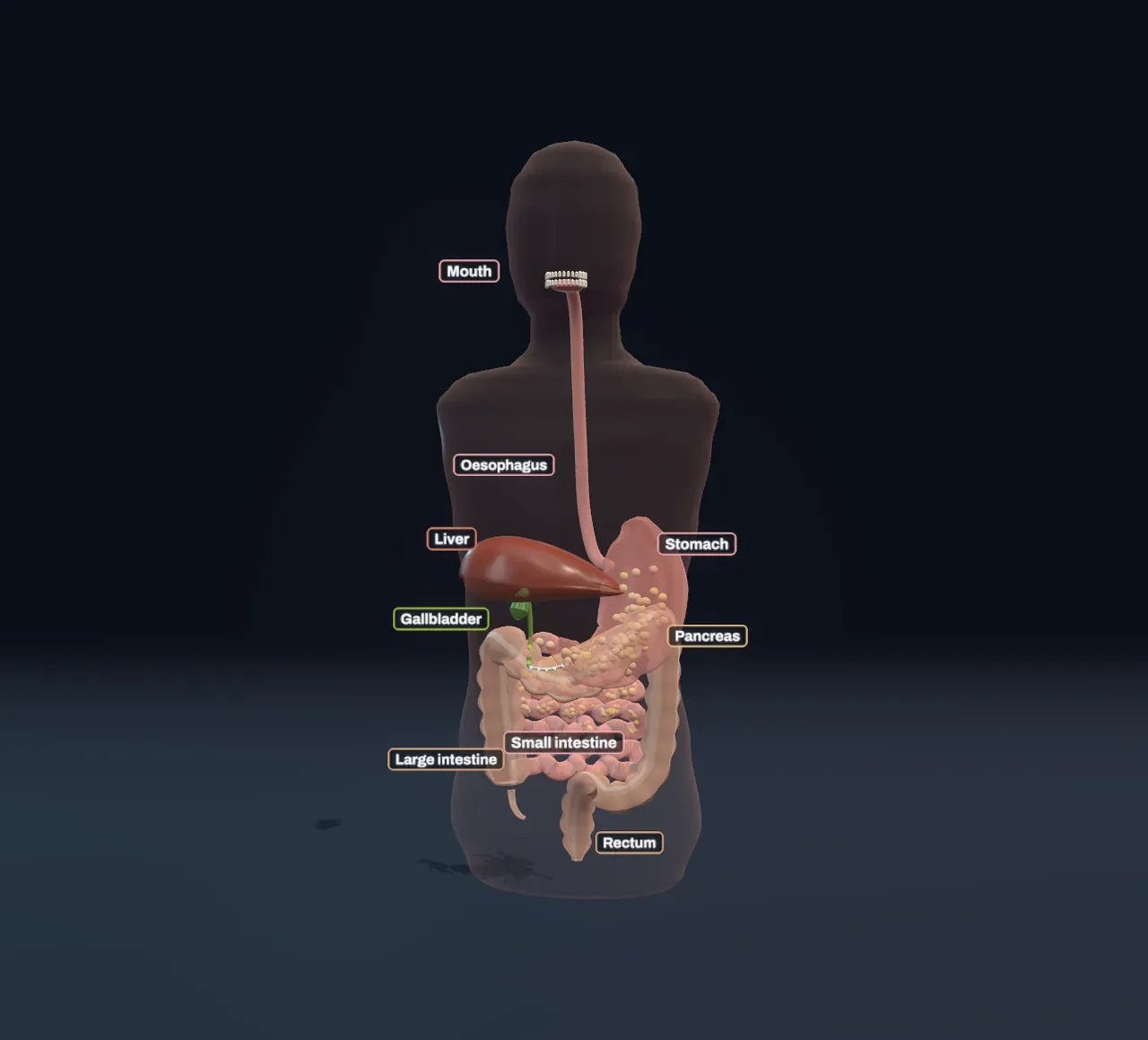
The digestive system is one tube: the mouth, the gullet, the stomach, the small intestine and the large intestine. Beside it sit the liver, the gallbladder and the pancreas, which pour juices into it. In the Scene, three hours after a mixed meal, each dot is part of the meal. Watch where the dots shrink.
Step 2 of 6
The stomach empties slowly
The stomach is a muscular bag that stores the meal, dissolves it in acid and grinds it to a soup. Only then does the pylorus, a ring of muscle at its outlet, let the soup on into the small intestine, a few millilitres at a time. So a meal does not leave the stomach all at once: at first almost nothing comes out, then it empties gradually.
The time at which half the meal is still in the stomach is a good way to measure the pace. The chart beside the Scene shows what share of the meal is in each place at the hour you choose.
Step 3 of 6
Fat stays longer
The pace at which the stomach empties is set by the intestine. When fat reaches the duodenum, the first stretch of the small intestine, the cells there release hormones that hold the pylorus back. Fat is the intestine’s hardest job, and the intestine gives itself time to do it. A meal that stays longer in the stomach is also one reason a fatty meal keeps you full for longer.
Step 4 of 6
Timing a fatty meal
Now measure it yourself. Meal is fixed at Butter (fat). Move Time since eating along the day and follow on the chart the share left in the stomach.
Step 5 of 6
On the lining
Zoom to the gut lining is at Gut lining. The lining is covered in villi, tiny fingers each with a net of blood capillaries and a lacteal, a lymph vessel. Here enzymes cut the food up: amylase the starch, trypsin and other enzymes the proteins, and lipase from the pancreas the fat. Sugars and amino acids cross into the blood; fat is rebuilt inside the cell and leaves in droplets into the lymph.
But fat does not mix with water, and an enzyme dissolved in water reaches only the surface of a drop. This is where bile comes in.
Step 6 of 6
The next morning
Most of what can be digested is absorbed in the small intestine within a few hours. What is left moves on into the large intestine: fibre, a few per cent of the food that escaped digestion, and a lot of water. The large intestine takes most of the water back, and the bacteria living there feed on the fibre. In the Scene, a meal of rice the next morning: only a small remainder still creeps along it.
Loading the interactive version…
Loading the interactive version…
Each step sets up the Scene for you, and a control marked “fixed” stays put for that step.
Practice · Choose
Three hours after a mixed meal, much of it has already been absorbed into the body. In which organ is most of the food absorbed?
Practice · Choose
Three hours after a mixed meal, much of it has already been absorbed into the body. In which organ is most of the food absorbed?
Practice · Reach the target
Meal is fixed at All three. Move Time since eating until half the meal is still in the stomach, and press Check.
Practice · Reach the target
Meal is fixed at All three. Move Time since eating until half the meal is still in the stomach, and press Check.
Practice · Predict, then look
Three hours after a meal of rice, almost all the rice has left the stomach. What will be in the stomach three hours after a meal of butter of the same size?
Practice · Predict, then look
Three hours after a meal of rice, almost all the rice has left the stomach. What will be in the stomach three hours after a meal of butter of the same size?
Practice · Calculate
A meal of butter. Move Time since eating and find after how many minutes half the meal has left the stomach.
Practice · Calculate
A meal of butter. Move Time since eating and find after how many minutes half the meal has left the stomach.
Practice · Choose
The liver makes bile, and the gallbladder squeezes it into the duodenum when fat arrives. What does bile do to the fat?
Practice · Choose
The liver makes bile, and the gallbladder squeezes it into the duodenum when fat arrives. What does bile do to the fat?
Practice · Calculate
A meal of rice, the next morning. What percentage of the meal has reached the large intestine without being absorbed?
Practice · Calculate
A meal of rice, the next morning. What percentage of the meal has reached the large intestine without being absorbed?
Lesson complete. Every practice question here is done.