One drop of pond water under a microscope: what the eye alone can make out, which magnification suits each creature, single cells bigger than whole animals, and three ways to get food: hunting, grazing and making it from light.
Step 1 of 6 · A drop of pond water
Step 1 of 6
A drop of pond water
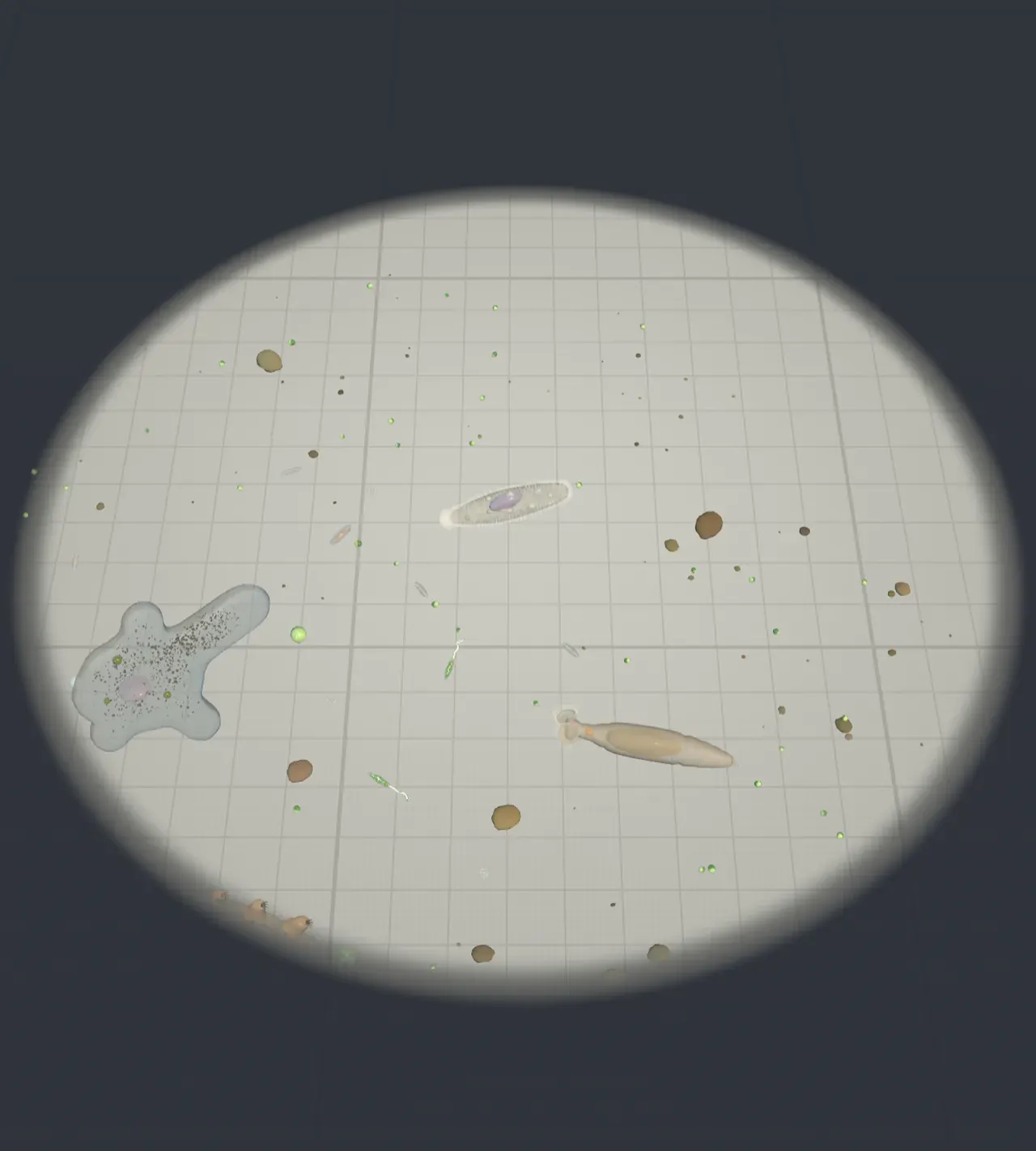
Pond water looks almost clear, but a single drop of it is full of life. The Scene holds six creatures, each at its true size relative to the others: an Amoeba (about 500 µm), a Paramecium (about 250 µm), a Euglena (about 50 µm), a Diatom (about 60 µm), a Rotifer (about 300 µm) and a Tardigrade (about 350 µm). A micrometre is a thousandth of a millimetre.
Magnification (powers of ten) is at 10× for now, and the whole drop, about 6 mm across, fits in view. The unaided eye can just make out something a tenth of a millimetre across, 100 µm, held at reading distance.
Step 2 of 6
Zoom in to the euglena
A microscope does not show more of the drop as it magnifies; it shows a smaller patch of it, enlarged to fill the same circle of light. With an ordinary eyepiece the field is about 200 mm divided by the total magnification across. Raise the magnification ten times and the field is ten times narrower, and the creature looks ten times bigger inside it.
Step 3 of 6
One cell or a thousand
Four of the creatures in the drop are single-celled: the whole body of the amoeba, the paramecium, the euglena and the diatom is one cell. The amoeba moves, feeds and reproduces without any other cell. Follow the amoeba at 100×, and predict what the rotifer will turn out to be.
Step 4 of 6
Not bacteria
A bacterium is a single cell too, but far smaller: about 2 µm, the tiny specks round the paramecium in the Scene. The drop’s four single cells are protists: single-celled eukaryotes, built like the cells of your body and not like a bacterium. Move Watch it feed a little from Outside, and the paramecium’s body turns glassy.
Step 5 of 6
Bailing out water
A protist must do on its own everything a whole body does, including what kidneys do. The paramecium lives in fresh water, and its inside is saltier than the pond. In its glassy body you can see two star-shaped bladders, the contractile vacuoles, filling and emptying in turn.
Step 6 of 6
Three ways to eat
Watch it feed is at Feeding, and the euglena is making food. Try the others too: the amoeba is a hunter, whose two pseudopods flow round an alga and seal it in a food vacuole; the paramecium is a grazer, whose cilia sweep bacteria into its oral groove; the tardigrade stabs an alga cell and sucks it empty. The euglena and the diatom are gardeners: their chloroplasts turn carbon dioxide and water into sugar in light, as plants do.
Loading the interactive version…
Loading the interactive version…
Each step sets up the Scene for you, and a control marked “fixed” stays put for that step.
Practice · Choose
The eye alone can just make out something 100 µm long. Which of the six creatures in the drop could you see, at least as a speck, in a jar held up to the light? Choose all of them.
Practice · Choose
The eye alone can just make out something 100 µm long. Which of the six creatures in the drop could you see, at least as a speck, in a jar held up to the light? Choose all of them.
Practice · Reach the target
The euglena is about 50 µm long. Change Magnification (powers of ten) until it spans a tenth of the field’s width, and press Check.
Practice · Reach the target
The euglena is about 50 µm long. Change Magnification (powers of ten) until it spans a tenth of the field’s width, and press Check.
Practice · Predict, then look
The amoeba, about 500 µm long, is one cell. The rotifer is shorter, about 300 µm. Predict how many cells the rotifer is built of.
Practice · Predict, then look
The amoeba, about 500 µm long, is one cell. The rotifer is shorter, about 300 µm. Predict how many cells the rotifer is built of.
Practice · Choose
The paramecium is one cell, and so are the bacteria it eats. What does the paramecium have that a bacterium does not?
Practice · Choose
The paramecium is one cell, and so are the bacteria it eats. What does the paramecium have that a bacterium does not?
Practice · Choose
Why does the paramecium need the contractile vacuoles that fill and empty every few seconds?
Practice · Choose
Why does the paramecium need the contractile vacuoles that fill and empty every few seconds?
Practice · Choose
Which of the drop’s creatures make their own food, from light? Choose all of them.
Practice · Choose
Which of the drop’s creatures make their own food, from light? Choose all of them.
Lesson complete. Every practice question here is done.