A fingertip as a laboratory of the senses: receptors that report strength by how fast they fire, fast and slow receptors, vibration that each receptor is tuned to a rhythm of its own, and separate nerve endings for cold, warmth and pain.
Step 1 of 6 · One job
Step 1 of 6
One job
Every sense starts with receptor cells, and each kind of receptor responds to one kind of stimulus. When the stimulus arrives, the receptor turns it into an electrical signal, transduction, and beyond a threshold its nerve fibre fires impulses. One impulse looks like any other: a fibre reports how strong the stimulus is by how many times it fires a second, and what kind of stimulus by which fibre it is.
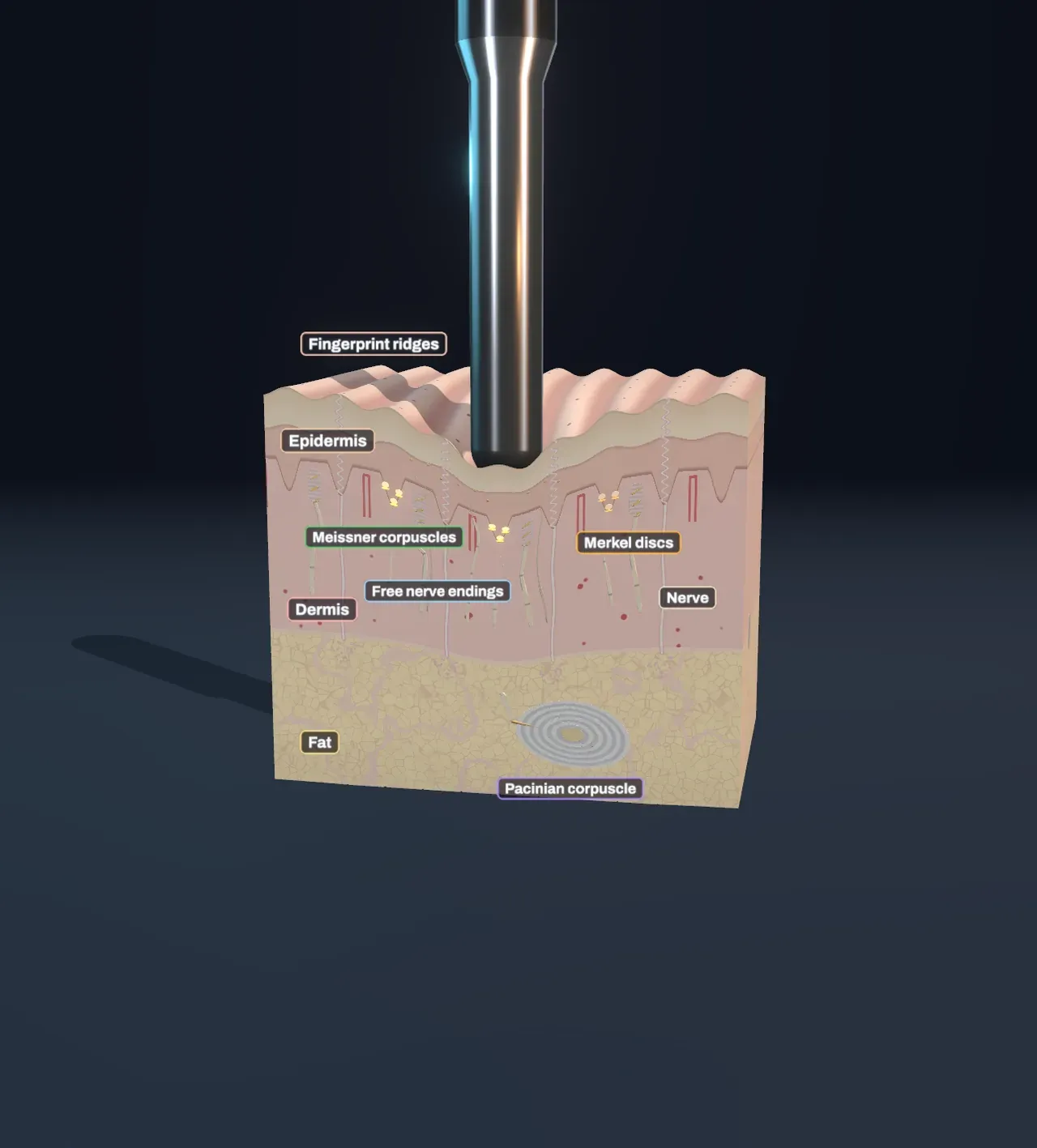
The Scene is a block from the pad of a fingertip, and a steel probe presses on it every few seconds. Show the nerve signals is at Nerve signals: the skin is see-through, and each receptor flashes as it fires. Amber Merkel discs sit at the base of the epidermis.
Step 2 of 6
Fast and slow
Watch one press on the chart: a row for each kind of receptor. What sets them apart is adaptation: how long a receptor keeps firing when its stimulus stays the same. Meissner corpuscles, just under the epidermis, and Pacinian corpuscles, deep in the fat, flash only as the probe goes in and comes out.
Step 3 of 6
Tuned to a rhythm
The fast receptors are also tuned to how fast the skin vibrates. Vibration is at 30 Hz, a flutter: the Meissner corpuscles fire an impulse for each tap.
Step 4 of 6
Warm endings
Temperature and pain receptors have no special structure: they are free nerve endings, bare branches of thin fibres that reach up into the epidermis. There are cold endings and warm endings, and what makes each one special is a channel in its membrane that opens at a certain temperature. Resting skin is about 33 °C, and Probe temperature is at that too for now.
Step 5 of 6
Too hot
Probe temperature is at 40 °C, warm. Pain endings, nociceptors, carry a channel called TRPV1, which opens above about 43 °C.
Step 6 of 6
Mint and chilli
Cold endings carry a channel called TRPM8, which opens below about 26 °C. But a channel does not only sense temperature: certain molecules that bind to it open it too. TRPM8 also opens when menthol, the stuff in mint, binds to it, and TRPV1 when capsaicin, the hot stuff in chilli, binds to it.
Loading the interactive version…
Loading the interactive version…
Each step sets up the Scene for you, and a control marked “fixed” stays put for that step.
Practice · Reach the target
At a Press of 0.8 mm a Merkel disc fires about impulses a second while the press is held. Change Press until it fires impulses a second, and press Check.
Practice · Reach the target
At a Press of 0.8 mm a Merkel disc fires about impulses a second while the press is held. Change Press until it fires impulses a second, and press Check.
Practice · Choose
You feel a shirt as you put it on, and a minute later you no longer do. What explains it, going by what the Scene shows?
Practice · Choose
You feel a shirt as you put it on, and a minute later you no longer do. What explains it, going by what the Scene shows?
Practice · Predict, then look
At 30 Hz, a flutter, the Meissner corpuscles fire an impulse for each tap. Predict which receptor keeps time when Vibration rises to 250 Hz, a buzz like a phone buzzing in a pocket.
Practice · Predict, then look
At 30 Hz, a flutter, the Meissner corpuscles fire an impulse for each tap. Predict which receptor keeps time when Vibration rises to 250 Hz, a buzz like a phone buzzing in a pocket.
Practice · Reach the target
At skin temperature the warm endings fire slowly. Change Probe temperature until a warm ending fires as fast as it can, and press Check.
Practice · Reach the target
At skin temperature the warm endings fire slowly. Change Probe temperature until a warm ending fires as fast as it can, and press Check.
Practice · Predict, then look
At 40 °C, warm, the warm endings fire about times a second. Predict what happens when Probe temperature rises to 48 °C, hot.
Practice · Predict, then look
At 40 °C, warm, the warm endings fire about times a second. Predict what happens when Probe temperature rises to 48 °C, hot.
Practice · Choose
Why does a mint feel cool in the mouth, though it is at room temperature?
Practice · Choose
Why does a mint feel cool in the mouth, though it is at room temperature?
Lesson complete. Every practice question here is done.