Pathogens that are not cells: what is inside a virus, how small it is, how it takes over a cell, why antibiotics cannot touch it, and how fast viruses multiply.
Step 1 of 7 · Not a cell
Step 1 of 7
Not a cell
Pathogens are tiny organisms and particles that get into the body and multiply there: bacteria, viruses, fungi and parasites. A bacterium is a whole living cell, which divides by itself. A virus is something else entirely.
Cut open is at Cut open: the coronavirus is opened from the front, and its genome lifted out. Look at what is inside it, and what is not.
Step 2 of 7
How small
Most viruses are between twenty and three hundred nanometres across, millionths of a millimetre. An ordinary light microscope cannot make out anything much smaller than 200 nm, so nobody saw a virus until electron microscopes arrived. Switch between the viruses in Virus and read the size of each.
Step 3 of 7
Taking over a cell
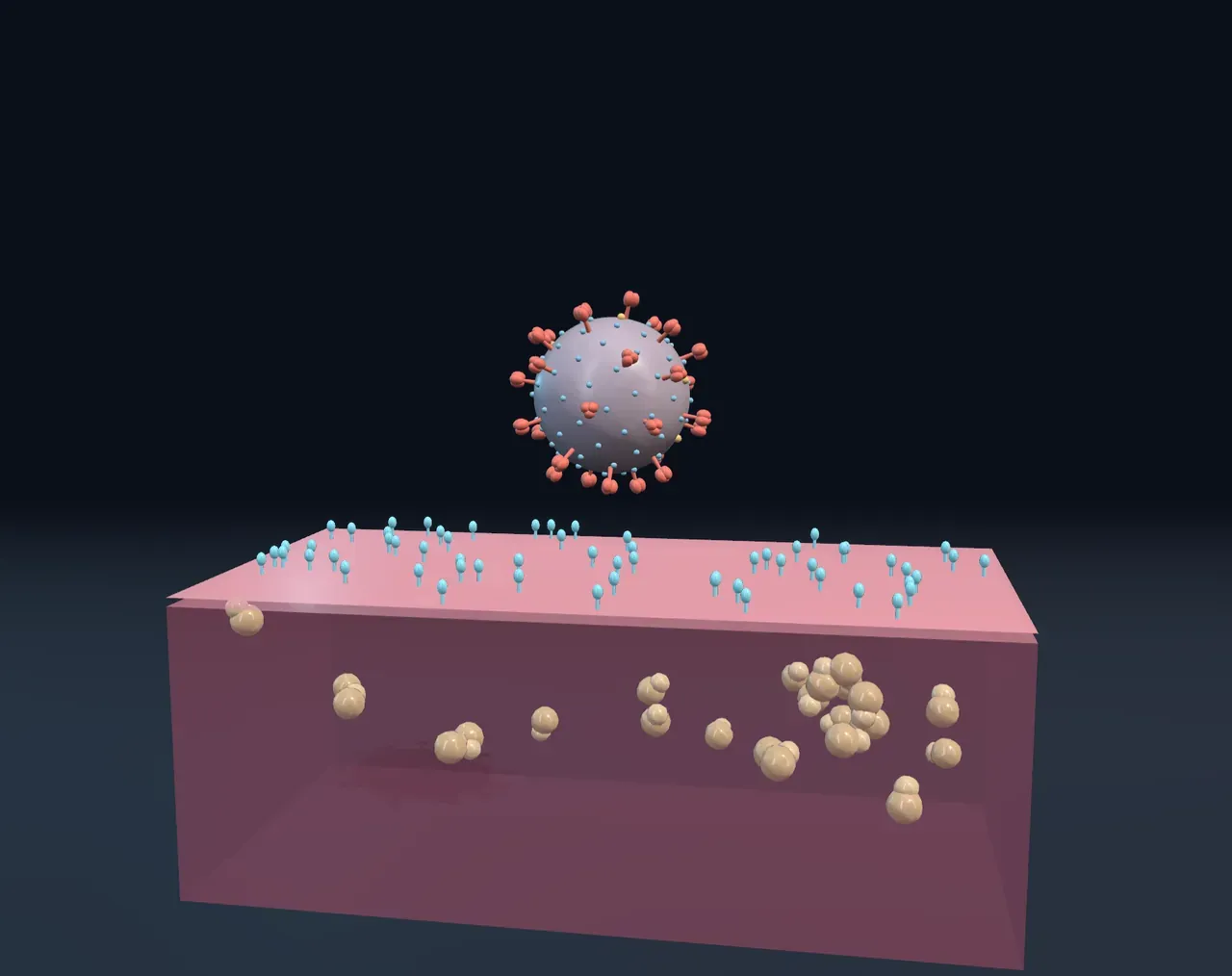
A virus drifts until it meets a cell with a molecule on its surface that fits the virus’s proteins. That fit decides which cells it can infect: the coronavirus grips cells lining the airways. Then its genes get inside. Virus and Infection are now fixed at the start.
Step 4 of 7
Genes in a box
Every virus has a genome, DNA or RNA, inside a capsid, a shell built of many copies of the same few proteins. Cut open is at Cut open. In most viruses the genome is one long molecule, but not in all.
Step 5 of 7
Envelopes
Some viruses also wear an envelope over the capsid: a piece of fatty membrane taken from the last cell they left, studded with proteins of their own. Switch between the four viruses in the Scene and compare.
Step 6 of 7
Why not antibiotics
An antibiotic is a drug that kills bacteria or stops them, without harming our own cells. It can do that because it aims at structures only bacteria have. In the Scene, an influenza virus in the middle of copying: who is doing the work inside the cell?
Step 7 of 7
Bursting out
At the end of the cycle the new particles leave the cell: enveloped viruses by budding, and phages such as T4 by bursting the cell. Virus is fixed at Phage T4, which infects bacteria. The Scene shows four offspring; in reality a hundred or more come out.
Loading the interactive version…
Loading the interactive version…
Each step sets up the Scene for you, and a control marked “fixed” stays put for that step.
Practice · Choose
Both bacteria and viruses cause disease. What is the main difference between them?
Practice · Choose
Both bacteria and viruses cause disease. What is the main difference between them?
Practice · Calculate
A coronavirus is about 100 nm across, and an E. coli bacterium about 2 µm long. How many coronaviruses in a row would match the length of one bacterium?
Practice · Calculate
A coronavirus is about 100 nm across, and an E. coli bacterium about 2 µm long. How many coronaviruses in a row would match the length of one bacterium?
Practice · Predict, then look
The coronavirus attaches to a cell and its genes get inside. Who will build the new copies of the virus?
Practice · Predict, then look
The coronavirus attaches to a cell and its genes get inside. Who will build the new copies of the virus?
Practice · Predict, then look
The coronavirus’s genome is one long molecule of RNA. In the Influenza virus, in how many separate pieces will the genome come?
Practice · Predict, then look
The coronavirus’s genome is one long molecule of RNA. In the Influenza virus, in how many separate pieces will the genome come?
Practice · Choose
Some viruses wear an envelope: a piece of fatty membrane taken from the cell they left. Go through the viruses in the Scene and choose all that have an envelope.
Practice · Choose
Some viruses wear an envelope: a piece of fatty membrane taken from the cell they left. Go through the viruses in the Scene and choose all that have an envelope.
Practice · Choose
Flu is caused by a virus. Why do antibiotics not cure it?
Practice · Choose
Flu is caused by a virus. Why do antibiotics not cure it?
Practice · Calculate
One T4 phage turns a bacterium into about 100 new phages in about half an hour. If each of them infects a new bacterium, how many phages will there be after two rounds?
Practice · Calculate
One T4 phage turns a bacterium into about 100 new phages in about half an hour. If each of them infects a new bacterium, how many phages will there be after two rounds?
Lesson complete. Every practice question here is done.