Orangutans in a forest cut into patches: less forest feeds fewer apes, small isolated groups die out even while their forest stands, the risk of extinction is a chance rather than a sentence, and wildlife corridors join the patches into one population.
Step 1 of 6 · A forest cut up
Step 1 of 6
A forest cut up
A species is threatened when it is likely to vanish if nothing changes, and extinct when its last individual dies. The biggest threat to species is the loss of the places they live. All three orangutan species, the red great apes of Borneo and Sumatra, are critically endangered, mostly because lowland rainforest is being replaced by oil palm plantations.
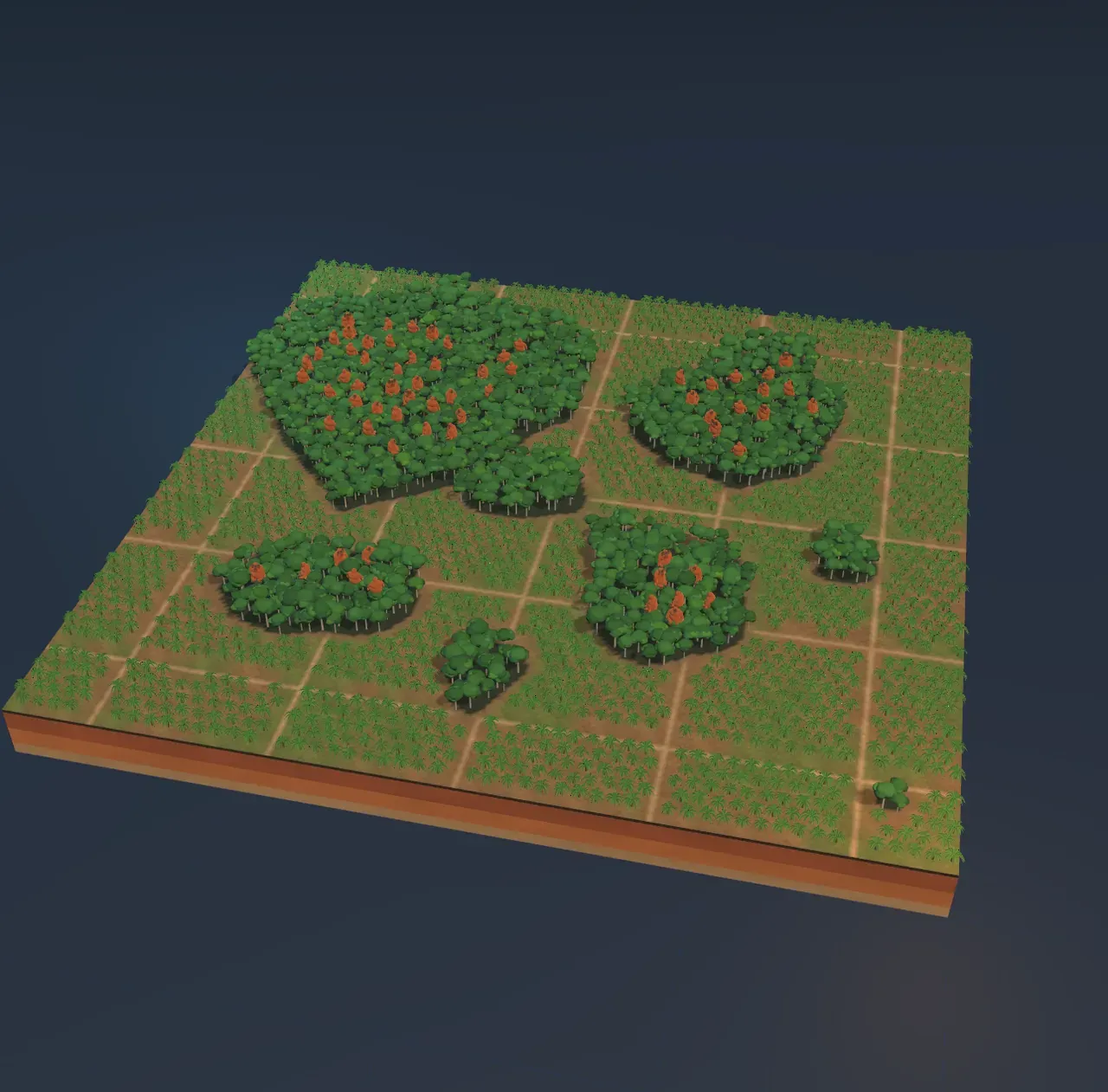
The Scene holds 400 km² of rainforest. With Forest left at 100%, untouched, orangutans live in it, about one for every 2 km². Now it is at 35%, mostly cleared: what remains is cut into patches, and scraps too small to feed even two do not count. Breaking habitat up like this is called fragmentation.
Step 2 of 6
A century on
To an ape that lives in the trees, the plantation between the patches is a desert. A youngster crossing it gets lost easily, and may be killed. So each patch becomes an island, and each group must survive on its own. Years is at Year 0.
Step 3 of 6
Why small groups fail
In the typical run the two small patches have emptied, though their forest still stands. The extinction vortex is a spiral in which a small group shrinks, grows more fragile, and shrinks again.
Step 4 of 6
A matter of chance
The Scene shows one possible century. Switch Luck to Unlucky and Lucky: the same orangutans dwindle to or keep . The model runs times, each with its own chance births, deaths and bad years. The lower chart counts the runs with no orangutan left after a hundred years: that is the risk of extinction. Working it out for a real population is called population viability analysis.
Step 5 of 6
Corridors
A wildlife corridor is a strip of habitat that animals can travel along between patches. Here, strips of planted forest. Without them, in the typical run of the orangutans are left after a hundred years.
Step 6 of 6
How a corridor helps
Along the Kinabatangan River in Borneo, forest is being replanted along the banks to join patches, and orangutans cross tributaries on rope bridges. In Canada, bears and wolves cross a highway on bridges and through tunnels.
Loading the interactive version…
Loading the interactive version…
Each step sets up the Scene for you, and a control marked “fixed” stays put for that step.
Practice · Calculate
An untouched forest of 400 km² holds about orangutans, one for every 2 km². How many orangutans can the forest left, 35% of it, feed, counting only patches that feed two or more?
Practice · Calculate
An untouched forest of 400 km² holds about orangutans, one for every 2 km². How many orangutans can the forest left, 35% of it, feed, counting only patches that feed two or more?
Practice · Predict, then look
Four patches hold , , and orangutans, and no more trees will be felled. Predict what Years shows when you drag it to 100 years on.
Practice · Predict, then look
Four patches hold , , and orangutans, and no more trees will be felled. Predict what Years shows when you drag it to 100 years on.
Practice · Choose
What makes a small, cut-off group fragile? Choose everything that is true.
Practice · Choose
What makes a small, cut-off group fragile? Choose everything that is true.
Practice · Predict, then look
At 35%, mostly cleared, all the orangutans vanish within a century in only about 1% of the runs. Predict the risk of extinction when Forest left drops to 15%, mere scraps.
Practice · Predict, then look
At 35%, mostly cleared, all the orangutans vanish within a century in only about 1% of the runs. Predict the risk of extinction when Forest left drops to 15%, mere scraps.
Practice · Predict, then look
Without corridors, of the orangutans are left after a hundred years. Predict how many are left in the same run when Wildlife corridors is switched on.
Practice · Predict, then look
Without corridors, of the orangutans are left after a hundred years. Predict how many are left in the same run when Wildlife corridors is switched on.
Practice · Choose
The corridors are narrow strips of planted forest. What is the main way they help the orangutans?
Practice · Choose
The corridors are narrow strips of planted forest. What is the main way they help the orangutans?
Lesson complete. Every practice question here is done.